
Is your organization hungry for strategic intent?
We are living and working in an environment that is full of volatility and change. Many organizations are hungry for strategic intent, a term used to describe the intended direction, purpose, and plans that leaders put in place to achieve their organization’s vision.
SIVO Insights helps organizations set their strategic intent, by leading and facilitating the strategic planning process. This strategic planning process can be summarized into three steps. Leaders must:
1. Assess,
2. Align
3. Articulate
STEP 1: ASSESS
Leaders must gather and assess relevant trends, consumer insights, market intelligence and institutional knowledge to answer critical questions across the 5C’s Assessment Framework.
Trending
Do customers want to ‘hire’ your product?

STEP 2: ALIGN
With this knowledge in hand, leaders participate in a facilitated strategic planning session to review their assessment of the 5C’s, to ideate, prioritize and most importantly, to align on the mission, vision, and values that will carry the organization into the future.

STEP 3: ARTICULATE
Lastly, leaders need to articulate their strategic intent—the vision, mission and values as well as the plan—to employees, collaborators, stakeholders, and in some cases to consumers and customers. This communication needs to happen repeatedly, in multiple forums, in-person or virtually, in internal documentation, as well as, in external communication. Strategic Intent can’t be communicated enough to ensure it is internalized by all parties.

In this time of continuous change, with a refreshed grounding in foundational insights and market intelligence, combined with solid strategic planning (i.e., Assess, Align and Articulate), you can give your organization and your stakeholders what they are hungering for . . . strong strategic intent. Let SIVO help with strategic intent consulting!
Schedule a discovery with SIVO to learn how you and your leadership team can create or re-establish your organization’s strategic intent.
By Natasha Weith
Innovation is often seen as a creative pursuit—a way for businesses to stay ahead, differentiate, and drive growth. But for many companies, the innovation process feels uncertain. How do you know if an idea will resonate in the market? Will consumers adopt a new product, behavior, or service? How do you distinguish between a promising concept and a costly misstep?
Most innovation initiatives are guided by internal vision, expert intuition, and trend analysis—all valuable inputs. But in a rapidly shifting consumer landscape, these elements alone aren’t enough.
Too many innovations fail—not because they weren’t good ideas, but because they weren’t validated in the real world before launch. The key to success? Embedding consumer input via market research into every stage of innovation instead of treating it as a final checkpoint.
Companies often assume they “know” their market. Here’s where innovation efforts commonly go wrong:
The result? Companies invest millions in ideas that sound good internally but fail to gain traction.
Consumers don’t just react to new offerings—they make trade-offs based on convenience, price, and habit. A product might be superior on paper, but that doesn’t mean consumers will switch.
To succeed, businesses must:
Without these insights, even a groundbreaking innovation can flop.
The most successful companies don’t just test ideas—they build them alongside the target consumer using agile, iterative research. However, even companies that invest in research get it wrong when they:
✖︎ Use Research as a One-Time final checkpoint – Instead of a continuous input, insights are only used for last-minute validation.
✖︎ Seek Confirmation Instead of Challenge – Teams look for data to support their pre-existing beliefs instead of stress-testing their assumptions.
✖︎ Over-Rely on Stated Consumer Intent – What consumers say they’ll do and what they actually do aren’t always the same.
✖︎ Fail to Connect Insights to Execution – Research reports sit in PowerPoints instead of shaping strategy and launch plans in real-time.
That’s where agile market research comes in. And let’s be clear: Agile research isn’t just about speed – it’s about making sure insights are integrated into the development process and at every decision point. Here’s how:
By embedding agile insights, companies create faster, more successful go-to-market strategies—without unnecessary spend.
It’s easy to get excited about a breakthrough idea. But without rigorous, real-time consumer input, even the most promising innovations can fail.
The best companies don’t just test innovations—they co-develop them with their consumer target. They ensure research isn’t a last-minute formality but a continuous input that sharpens ideas and launch plans and accelerates success.
As you think about your next big move—whether launching a new product, repositioning a brand, or identifying a growth opportunity—ask yourself:
If you’re not fully confident in the answers, it’s time to rethink how market research fits into your innovation strategy.
At SIVO, we help businesses turn market research into a competitive advantage. Whether you're validating early-stage concepts, refining go-to-market strategies, or optimizing post-launch success, we ensure that insights fuel smarter, faster decision-making at every stage of the process.
Our senior insights professionals specialize in agile, in-context research that goes beyond validation to actively shape breakthrough innovations. And with On-Demand Talent, we provide fractional research experts to scale your capabilities—without long-term hiring commitments.
Want to sharpen your innovation strategy? Contact us at Contact@SIVOInsights.com or visit SIVOInsights.com to learn more.
Context. Clarity. Conviction. Consider these your driving factors for presenting Insights that shape strategic business decisions. Eliana Wahnon (General Mills, VP of Consumer & Market Insights) recently joined The SIVO Insights Forum to share her expertise.
Let’s dive deeper into the framework Eliana uses:
https://youtu.be/Yv8JdvFvILY
Tune into a lively on-demand conversation “Bridging The Gap: Translating Insights Into Meaningful Business Results" to hear from Eliana and other Insights experts including Khary Campbell (Comcast, VP of Consumer Research & Insights) and Elizabeth Oates (Book Author, and former Ulta Beauty VP of Consumer Insights.)
Learn from Insights leaders as they discuss:
Special shout out to Natasha Weith, VP of Research at SIVO Inc. for hosting The SIVO Insights Forum!
By Natasha Weith and Leslie Turner
Successful market research begins with experts designing, collecting, processing, and analyzing data. Impactful market research goes a step further. The true power lies in how we translate that data into compelling narratives that drive action and resonate with stakeholders. Storytelling in market research reporting is an art form, one that transforms raw numbers and consumer responses into meaningful insights that can shape business strategies and decisions. Here’s a closer look at what makes effective storytelling in market research and some key components to consider.
What is Storytelling in Market Research Reporting?
Storytelling in the context of market research reporting involves presenting data and insights in a way that is not only informative but also engaging and impactful. It’s about crafting a narrative that resonates with your audience, aligns with their business objectives, and drives actionable outcomes. Effective storytelling ensures that the findings are not just understood but are also memorable and persuasive, facilitating better decision-making. This requires experience and creativity.
Key Components of Effective Storytelling in Market Research
Beyond the Report
While the report is typically a critical deliverable in a market research project, the storytelling doesn’t end with the report. It extends to the presentation, follow-up working sessions, and/or stakeholder meetings. This means thinking about how the insights will be communicated beyond the written report. Engaging presentations, interactive discussions, and follow-up conversations with key stakeholders can enhance the impact of the findings and ensure that the insights are effectively implemented.
Expect a Well-Told Story from SIVO
At SIVO, Inc., we believe that storytelling in market research reporting is about more than just presenting data; it's about creating a narrative and presenting it in a way that is compelling, memorable and inspires stakeholders to act in service of consumers and the business. This all starts with the SIVO team listening to your needs and designing and reporting in a way that delivers real business value.
Contact us via our website form or email us at Contact@SIVOInsights.com today to schedule a discovery call!
As fall season begins and planning cycles ramp up, most brand teams are juggling budgets, media calendars, and launch timelines. But there’s one question that quietly determines how effective all of that work will be next year:
Ever since your brand was established, your consumers have moved through shifting economic pressures, cultural tensions, new product entrants, and evolving expectations in your category. If your brand positioning hasn’t been revisited with fresh consumer insight, you’re likely planning 2027 with an outdated map.
Q4 is the ideal time to reset.
A clear, differentiated brand positioning is the foundation of an effective marketing strategy because it forces the team to define who the brand serves, what primary benefit it delivers, why it can credibly deliver that benefit, and how it stands apart from key competitors.
Without that clarity, campaigns become fragmented, messaging drifts, and teams default to generic claims that could belong to any brand in the category.
As a reminder, a classic, disciplined positioning statement (your differentiating benefit) looks like:
For (consumer target), Brand is the only (product type) that provides (key benefit), because Brand has (reason to believe 1), (reason to believe 2), and (reason to believe 3).
For example, Peleton’s positioning statement looks something like this:
For people looking to stay motivated with their in-home workout routines, Peloton is the connected fitness platform that delivers an energizing studio experience, with premium equipment, live and on-demand classes, motivating instructors, and personalized progress tracking.
The past few years have reshaped what “value” means in many categories. Consumers are re-evaluating trade-offs between price, quality, health, and convenience; looking for brands that reflect their emotional needs and life stage; paying closer attention to how brands show up on issues like sustainability, wellbeing, and social impact; and comparing more options more quickly across digital and physical channels.
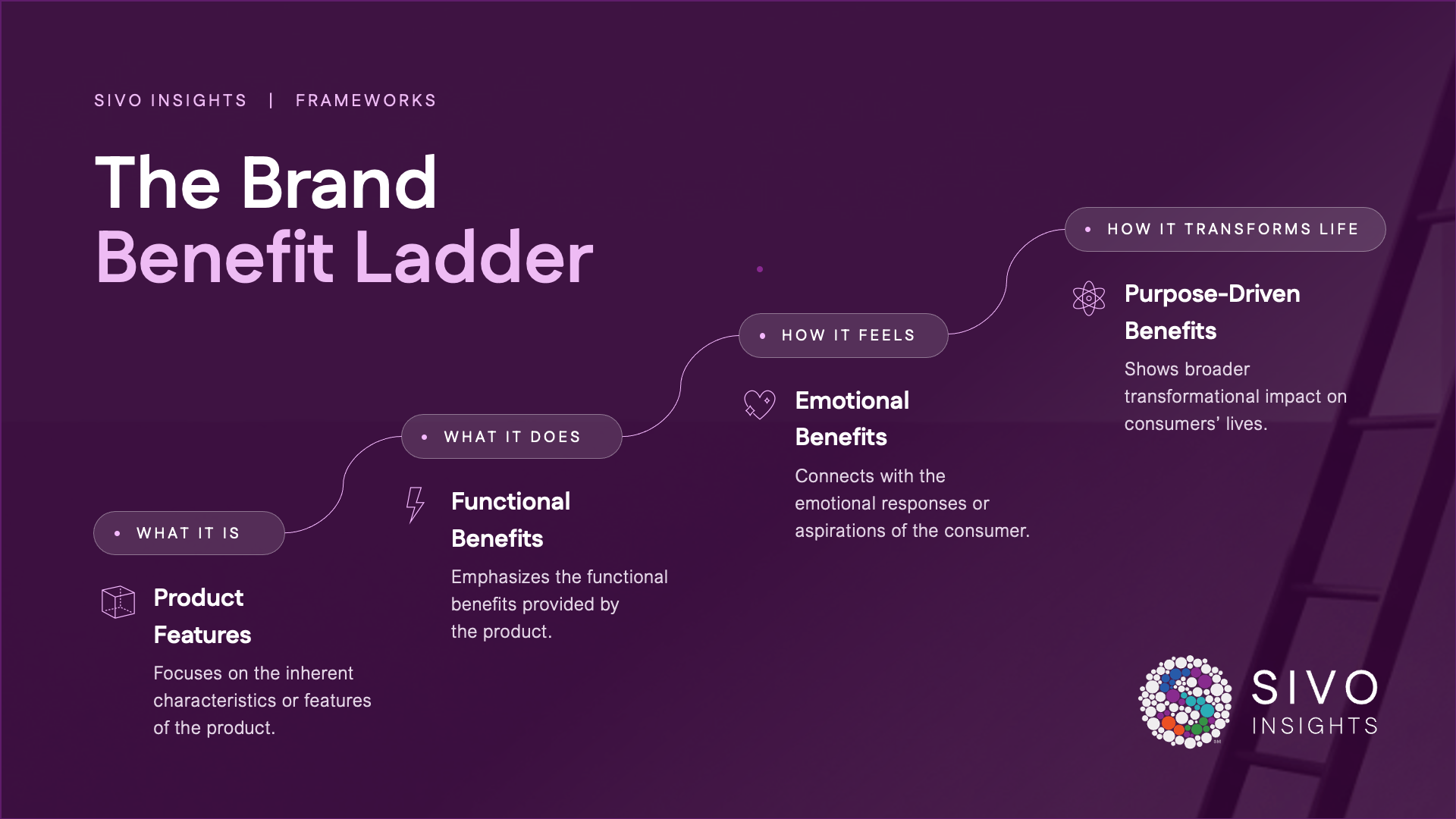
Within that context, positioning can no longer rest solely on functional benefits, i.e., “what it is” or “what it does.” Strong brands are intentionally climbing the Brand Benefit Ladder:
Depending on your brand's maturity and competitive set, you may need to refresh your positioning at any level, from sharpening a functional claim to elevating toward more emotional or purpose-led territory. But you can’t make that decision in a vacuum.
That’s where disciplined, end-of-year consumer research become critical.
Q4 is a valuable time for positioning work because it bridges “what has happened” and “what’s next”:
By investing in brand positioning research now, you give your team the time they need to align on a refined or new positioning territory, translate it into clear messaging and activations and brief your agencies and internal partners in Q1 with a strong strategic foundation.
At SIVO, we’ve spent many years helping brand teams across industries develop and evaluate brand positionings that resonate with both consumers and internal stakeholders. Our approach combines proven frameworks with rigorous qualitative and quantitative research to ensure your positioning is both inspiring and grounded.
In Q4, that typically looks like a two-step process:
1. Qualitative Exploration: Refining the Story With Real Consumers
We start by exploring how consumers currently perceive your brand, your competitors, and the broader category. For example:
We can work side-by-side with you and your agency partners toevolve the statements as we learn, so you’re not waiting months for direction.
2. Quantitative Positioning Validation: Selecting the Strongest Position
Once we’ve refined a set of viable positioning routes qualitatively, we move into quantitative validation to identify the most motivating and distinctive option.
Using surveys and, where appropriate, real-world testing (such as digital ad experiments), the SIVO team will:
The result is not just “a good idea,” but a validatedstrategic choice: a positioning that is clear, unique, credible, and proven toconnect with your consumers across channels all year long, via campaigns,packaging, digital, shopper, innovation, and more.
If you’re already planning for 2027, this is the moment to build a positioning that truly reflects today’s consumer and tomorrow’s opportunity. Let the SIVO team help you develop and validate a brand positioning that communicates exactly how your brand wants to show up in the world, and why that matters to the people you serve!
SIVO Insights brings together research, talent, and intelligent technology to help organizations navigate complexity with confidence. Have a business challenge? Let's talk!
We bring together research, talent, and intelligent technology to help organizations navigate complexity with confidence