
By Marilyn Weiss
In the evolving landscape of market research, methods that leverage technology are continually being developed to gain deeper insights into consumer behavior. Mobile Missions are a straightforward approach that has proven successful for SIVO clients. This approach allows researchers to tap into consumers' real-life experiences in a natural and engaging way, collecting meaningful data in the form of open-ended responses, photos and video footage.
Understanding Mobile Missions
Mobile Mission research is an immersive approach that leverages mobile technology to engage participants on their own schedule and in their natural environments. This involves prompting consumers to complete a series of activities and questions via their mobile devices, capturing their experiences, thoughts, and behaviors in real-time.
Benefits of Mobile Missions
Mobile Missions offer several advantages over traditional research techniques:
Real-Time Interaction: Participants receive prompts and tasks on their mobile devices, allowing them to respond in real-time as they shop, prepare, or use products.
Natural Environment: The method captures consumer behavior in real-life settings, such as their homes or local stores, ensuring more genuine participation and deeper insights.
Engagement and Comfort: Participants can complete tasks at their own pace, allowing them time to reflect and encouraging more thoughtful and honest responses.
Remote Observation: Researchers can observe and interact with participants remotely, making it easier to conduct research in environments where in-person observation might be challenging or restricted.
Applications for Mobile Missions
Mobile Missions are versatile and can be utilized to achieve various research objectives. Five common applications that we see at SIVO include:
1. Shopper Insights
2. Customer Journey Mapping
3. Brand and Promotion Engagement
4. Behavioral Insights
5. Competitive Analysis
By utilizing Mobile Missions across these diverse areas, companies can gain a holistic understanding of their consumers and their products, leading to more informed decisions and tailored strategies that resonate with their target audience.
Executional Details
The execution of Mobile Missions typically involves the following specifications:
Your Partner for Progressive Solutions and Actionable Insights
At SIVO, Inc., we are on a constant quest to identify innovative solutions that lead to meaningful insights for our clients. We have had great success in utilizing Mobile Mission technology to capture consumer perceptions and behaviors in a natural and engaging manner to achieve your learning objectives.
Contact us via our website form or email us at Contact@SIVOInsights.com to schedule a discovery call to discuss your business and market research needs.
As fall season begins and planning cycles ramp up, most brand teams are juggling budgets, media calendars, and launch timelines. But there’s one question that quietly determines how effective all of that work will be next year:
Ever since your brand was established, your consumers have moved through shifting economic pressures, cultural tensions, new product entrants, and evolving expectations in your category. If your brand positioning hasn’t been revisited with fresh consumer insight, you’re likely planning 2027 with an outdated map.
Q4 is the ideal time to reset.
A clear, differentiated brand positioning is the foundation of an effective marketing strategy because it forces the team to define who the brand serves, what primary benefit it delivers, why it can credibly deliver that benefit, and how it stands apart from key competitors.
Without that clarity, campaigns become fragmented, messaging drifts, and teams default to generic claims that could belong to any brand in the category.
As a reminder, a classic, disciplined positioning statement (your differentiating benefit) looks like:
For (consumer target), Brand is the only (product type) that provides (key benefit), because Brand has (reason to believe 1), (reason to believe 2), and (reason to believe 3).
For example, Peleton’s positioning statement looks something like this:
For people looking to stay motivated with their in-home workout routines, Peloton is the connected fitness platform that delivers an energizing studio experience, with premium equipment, live and on-demand classes, motivating instructors, and personalized progress tracking.
The past few years have reshaped what “value” means in many categories. Consumers are re-evaluating trade-offs between price, quality, health, and convenience; looking for brands that reflect their emotional needs and life stage; paying closer attention to how brands show up on issues like sustainability, wellbeing, and social impact; and comparing more options more quickly across digital and physical channels.
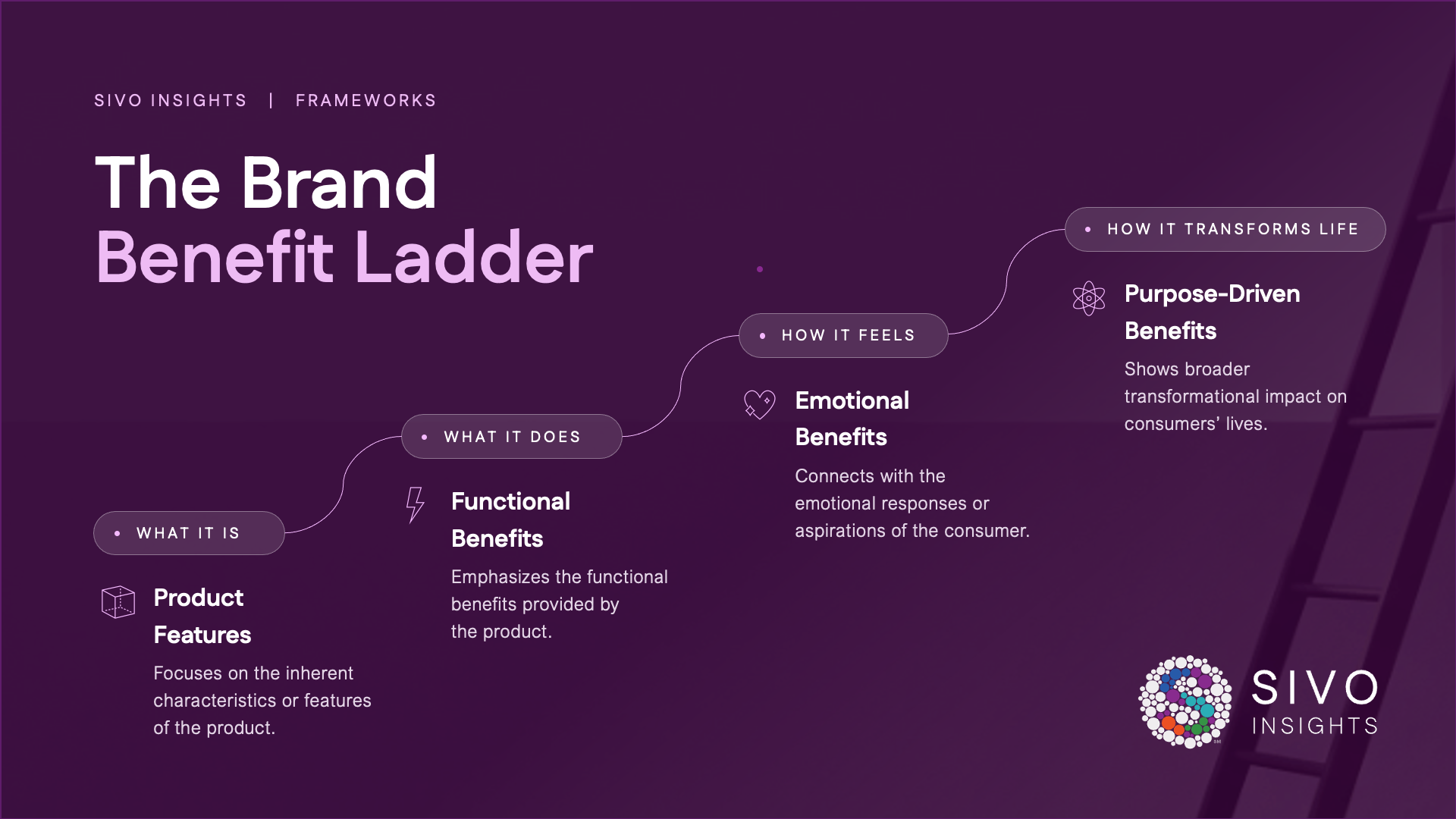
Within that context, positioning can no longer rest solely on functional benefits, i.e., “what it is” or “what it does.” Strong brands are intentionally climbing the Brand Benefit Ladder:
Depending on your brand's maturity and competitive set, you may need to refresh your positioning at any level, from sharpening a functional claim to elevating toward more emotional or purpose-led territory. But you can’t make that decision in a vacuum.
That’s where disciplined, end-of-year consumer research become critical.
Q4 is a valuable time for positioning work because it bridges “what has happened” and “what’s next”:
By investing in brand positioning research now, you give your team the time they need to align on a refined or new positioning territory, translate it into clear messaging and activations and brief your agencies and internal partners in Q1 with a strong strategic foundation.
At SIVO, we’ve spent many years helping brand teams across industries develop and evaluate brand positionings that resonate with both consumers and internal stakeholders. Our approach combines proven frameworks with rigorous qualitative and quantitative research to ensure your positioning is both inspiring and grounded.
In Q4, that typically looks like a two-step process:
1. Qualitative Exploration: Refining the Story With Real Consumers
We start by exploring how consumers currently perceive your brand, your competitors, and the broader category. For example:
We can work side-by-side with you and your agency partners toevolve the statements as we learn, so you’re not waiting months for direction.
2. Quantitative Positioning Validation: Selecting the Strongest Position
Once we’ve refined a set of viable positioning routes qualitatively, we move into quantitative validation to identify the most motivating and distinctive option.
Using surveys and, where appropriate, real-world testing (such as digital ad experiments), the SIVO team will:
The result is not just “a good idea,” but a validatedstrategic choice: a positioning that is clear, unique, credible, and proven toconnect with your consumers across channels all year long, via campaigns,packaging, digital, shopper, innovation, and more.
If you’re already planning for 2027, this is the moment to build a positioning that truly reflects today’s consumer and tomorrow’s opportunity. Let the SIVO team help you develop and validate a brand positioning that communicates exactly how your brand wants to show up in the world, and why that matters to the people you serve!
By Julie Rose
Whether in need of C-Suite leadership, mid-level managers or junior-level analysts, many companies are turning to fractional talent to fill temporarily open roles, expand their team bandwidth or bring new or specialized skillsets to meet business needs. SIVO, Inc. has worked with many companies to place fractional Consumer Insights Professionals (fCIPs) across all levels of the Insights function. Through this work, we have established a few guidelines for a positive outcome to make your outsourcing experiences successful.
To prepare for the fCIP to join your team and set everyone up for success, you should:
Clearly Outline Your Fractional Talent Needs
It is important to be clear on the work that requires the expertise of fractional insights professionals. We’ve helped our best clients with this critical first step and it has had a huge impact on their ability to get the help they need.
Each quarter, I outline the prioritized initiatives for my team and in that process, I identify the critical work for my SIVO On Demand Talent resource. This practice provides both clear direction for the fractional talent and it also helps me estimate the hours needed and budget appropriately. Continually getting clear on priorities has led to a successful outcome for both Perdue and SIVO.
– Tara Campbell, Sr. Director, Insights, Analytics & Sensory, Perdue Farms
For one week, you should log all the work that you wish you had someone available to delegate to. When something comes up that you think, “wow, if only I had a resource to help,” write down the task and the skills you believe are needed. At the end of the week, you are well-equipped for a scope of work plan that can be short-term, long-term, for a fill-in role or a finite project. Your log of the work that needs to get done will help you identify a fCIP with the appropriate skillset to accomplish the work effectively and efficiently.
Interview Candidates
Once you are clear on what you are looking for in terms of skills, expertise, and know-how, it is a good idea to interview 2 to 3 candidates for the temporary role. It may seem like “overkill” when the role is temporary but in the end, finding a person that fits your team will make your work-life a lot easier. This is an opportunity to evaluate organizational fit, establish rapport and set expectations. During the interview, you will ask about previous experience the candidates will bring to the role, what expectations the candidates have, and gauge how the candidates will approach your specific role.
We looked at resumes for a few candidates for the role we had on our team. On paper, all three looked equally suited to the role however after interviewing the candidates we realized the best cultural fit with our team and organization. I appreciated the opportunity SIVO provided to meet with more than one candidate for the role.
– Marnie Pfeifer, VP Customer Experience Leader
Set Up Regular Updates
Once you’ve chosen the fCIP for your role, it’s important to establish a clear work plan and a good working relationship. Through regular check-ins and updates, you will be able to align on objectives, stay informed on progress, and understand any barriers that might need to be addressed. Regular updates allow the insights professional to meet smaller deadlines throughout the project while keeping the overall timeline and success metrics front and center.
Provide Timely Feedback
The regular updates will also facilitate the ability to provide timely feedback throughout the project. It is critical to invest some of your time to monitor progress and be actively engaged in the work of your new resource. This professional comes with experience and expertise, but may need guidance to navigate the organization, such as recognizing unwritten rules or norms that are tied to the organizational culture. There might be a need to provide constructive feedback, that if given early, will set the fCIP up for success. Feedback will provide clarity and optimize the experience for both parties – you and your contract talent.
Show Appreciation
Once you’ve built a good working relationship with your fCIP, you will likely want to tap into this resource again in the future, when the need arises. Providing positive feedback and showing appreciation for the contributions this person is making to your organization will increase satisfaction in doing the current role and increase the likelihood of taking on future assignments. Appreciation can be shown with a simple thank you or by recommending this talent to others in the industry who may also need this type of resource.
Following these steps will help you find the right fCIP and make the entire process easier for you and your team.
For fractional Consumer Insights Professionals, you can lean on SIVO’s On Demand Talent team to walk you through the process and provide you with the support you need to get the right talent working on your behalf. We are passionate about matching our clients’ needs with our fCIP’s experience and skills.
Reach out today to learn more about SIVO On Demand Talent. Contact@SIVOInsights.com
Across industries, brands attempt to access and leverage data to unlock stronger sales and business growth. Your team can bring a wealth of experience and expertise to initiatives, but getting feedback from the people who engage with the product produces better outcomes. Below, we’ll answer the questions: what are consumer insights? Why are consumer insights important? And What is the best way to get consumer insights for my business?
First thing’s first, what are consumer insights? Consumer insights are the underlying motivations or needs that make a consumer behave a certain way. Insights professionals work to understand consumer attitudes, requirements, desires and behaviors to uncover insights that can then guide brand building, portfolio and marketing communications efforts. Many organizations gather data from their consumers, but the real depth of insight comes in asking the right questions and getting the full picture from consumers. Insights gleaned from studying and connecting with your consumers can inform nearly every aspect of your business’ path to growth.
So, how do you get consumer insights? Businesses can get consumer insights in several ways. The correct method for your team depends largely the business question, as well as the industry and market you serve. For example, organizations may capture qualitative data via focus groups, in-depth interviews, and user immersions to identify the nuances in consumer values and opinions.
Meanwhile, quantitative data like path-to-purchase, product testing, and volumetric forecasting can help teams validate consumer interest and behaviors and build confidence in decision-making and actions. Consumer insights experts can gather this information in a number of ways. See some of the most effective consumer insight solutions and techniques below:
Qualitative Consumer Insights
Ethnographies
In-Depth Interviews
Focus Groups
Shopalongs
Shopper Intercepts
Mobile Missions
Online Bulletin Boards
Fishbowls
Agile Sprints
Rapid Refinement
Communication Checks
User Immersions
In-Home Usage
Interactive User Experience
Jobs to Be Done
Quantitative Consumer Insights
Segmentation
Attitude and Usage
Path-to-Purchase
Tracking Testing / Screening
Brand Positioning
Brand Architecture
Product Testing
Creative Testing
Opinion Polling
Now that we know what they are, why are consumer insights important? Essentially, consumer insights remove some of the speculation from your business decisions and actions. It provides actionable answers to what consumers think about your brand, your category, and your products or services. Once you receive those insights, you can take it and run. It’s the fuel that ignites new product or service innovation and optimization, brand experiences and communications. At a higher level, it gives your business access to an entirely new perspective within your consumer market. Consumer insights give you a more holistic understanding of the consumer target audience you want to connect with, allowing you to gain a competitive edge within your industry.
So, why is consumer insight important? There are several reasons growing brands invest in these solutions to drive growth and gain a competitive edge. See why more and more businesses focus on obtaining consumer insights for their strategies below:
The best business strategies have data-backed insights behind them. Consumer insights allow you to identify a “why” to inform and support your business initiatives. The same goes for your brand.
Understanding what people truly believe about your brand can transform marketing strategies. Today, it is important to know who your customers are, what they do, what they value, and why it matters. The best way to answer those questions is to identify your consumers and start a dialogue to better understand them. This dialogue and the insights that come from it allows your business to bring more value to the people you serve. It all leads to better customer experiences and a stronger return on investment.

Every product or service has areas for improvement. Who are the best people to provide that feedback? The individuals who purchase and use them. Getting honest opinions on your current portfolio helps you identify the best places for optimization. You can spot holes in the market and create solutions that fill consumers' unmet needs. Some of the best product ideas and business innovation can come straight from your customers.
It all starts with empathy. Providing enhanced, consumer-focused products and services can only benefit brand loyalty. Brands need to continuously check in with their customers to ensure they have positive brand experiences and identify new ways to delight them. As mentioned above, your products/services can consistently improve to meet the needs of your customer base. Ultimately, this all works toward a stronger relationship with your audience to gain ongoing loyalty. That goes a long way when they are choosing between brands.
How can consumer insights fuel your marketing campaign? Speaking directly to your target audience members creates more nuance and specificity in your consumer-first marketing campaigns. Every engagement in your advertising and beyond should prioritize your consumer. Understanding their values and preferences deeply allows you to speak to them more directly and effectively. If you’re on the journey of building your brand or audience-based marketing (AMB) strategy, these insights provide a path toward successful campaigns that move the needle and influence consumer behavior.

What is your customer’s experience with your brand? Are there features that they like or dislike? Sometimes small things go unseen by marketers, but small details can leave a lasting impression on consumers. Whether it’s digital user journeys, messaging, or customer service conversations, it’s invaluable to hear, understand and react to what people think when they engage with your brand, products, and representatives.
If your organization is wondering how to get consumer insights, the best path is through a specialized consumer insights company. SIVO is a global insights and strategy firm specializing in understanding people and their needs and beliefs that drive behavior. We partner with brands to answer key questions that guide strategies and fuel growth. First, we schedule a discovery meeting, where we ask your stakeholders and subject matter experts key questions about your business and needs. Then, we design a custom research approach that aligns with those requirements. From the data gathered, we identify key insights that inform your decisions and drive business growth. Our experts act as your ongoing partner, helping you access your consumers and interpret the research every step of the way.
Ready to get meaningful consumer insights to unlock your next business and brand strategy? SIVO provides full-service custom consumer research and experiences for business across industries. Whether you need consumer insights, organizational intelligence, market and competitive intelligence, or on-demand talent, we empower organizations to get the most of their business, marketing, and brand building efforts to better achieve their goals. Contact SIVO today to get started.
By Kerry Juhl
Managing a business is non-stop, full-time leadership. Typically, 90% of a leader's workday is focused on the daily needs of employees, customers, supply chain, marketing, sales, financials... and the list goes on. However, it is also a leader's job to present their team with a vision for the future, a "north star" that provides direction and goals for the organization, allowing them to compete effectively and transform opportunities into growth.
A great step in looking toward the future is to take stock of the landscape that you operate within, especially when there are changing dynamics in the external environment. The future growth of your business requires you to have a point of view on how your business will be impacted by changing consumer behaviors and preferences, the actions of your competitive set and external partners, and possibly the impact of new technologies. In other words, you need to have a vision of what your category/industry will look like in 5+ years to remain relevant in that future state and capitalize on future growth opportunities.
Trending
Do customers want to ‘hire’ your product?
Our team at SIVO has experience with helping clients build their category vision of the future. In fact, we have developed a step-by-step process that results in a defined Future-State Category Map to inform the Category Vision and Key Strategies for growth. A Category Vision not only demonstrates category leadership and anticipates the future, but it allows clients to take control and literally create their own destiny…a future where the business can thrive.

Define Current State:
Clients need to define the space that they currently play in. For some it might be narrow, for example, Skin Care. For others it might be broad, for example, Beauty Products. (There are pros and cons for how narrow or broad your category definition is and SIVO can guide your team to get to a definition that is relevant and actionable through our consumer insights solutions).
This step requires the gathering of category, competitive and consumer intelligence from a variety of sources, to answer questions, like:
Articulate Future State:
SIVO facilitates the client team through a small series of assignments and working sessions to envision the Future State of the category and to prioritize where to “place bets” within the category to maximize growth.
Create a Vision & Strategies to build Future State:
With the future state of the category defined, SIVO facilitates client teams through the creation of a Category Vision that serves as the "North Star", and Growth Strategies that the organization can put into action to drive category and brand growth for years to come.
A solid process with proven success. Are you ready to help your business create a category vision for the future? Schedule a discovery call today or reach out at Contact@SIVOInsights.com to develop strategies and plans that not only anticipate the future but create it!
SIVO Insights brings together research, talent, and intelligent technology to help organizations navigate complexity with confidence. Have a business challenge? Let's talk!
We bring together research, talent, and intelligent technology to help organizations navigate complexity with confidence