
We can all probably agree that we are living through one of the most disruptive events of our generation. With our worlds turned upside down, it comes as no surprise that the way people work in America has also vastly changed.
Just as news stories cropped up about 2021 being the year of the Great Resignation, other stories followed asking the question ‘where have all the workers gone?’ I’ve pondered this question as well, seeing the ‘short staffed’ signs everywhere I go and hearing from countless businesses about their struggle to retain talent.
The answer to what is causing the Great Resignation might lie in the reframing of the phenomenon. A smart colleague of mine, Vina Klein, astutely calls it the “Great Values Reset.” I really like that. It gives more insight to what is happening. People seem more attuned to their values when choosing how to live and how to work. At the start of the pandemic, we were sent home and we slowed down, we took stock, and we re-evaluated our lives. That experience impacted our choices in 2021 and beyond.
Trending
Do customers want to ‘hire’ your product?

Now enter the gig economy. The gig economy has always been around, but something interesting happened as a result of Covid-19. Gig workers represented around 35 percent of the U.S. workforce in 2020, up from between 14 and 20 percent in 2014. The number of companies that fully operate on gig work has increased by 85% since 2014. That growth has only accelerated as a result of Covid-19. As workers reset values and put more focus on having some control over their lives, employees are leaving the confines of a 9-5 and corporate bureaucracy. The gig economy is where they land, and SIVO Insights has the perfect launchpad for these workers.
I’m very fortunate to lead SIVO Insights On-Demand Talent. I’m passionate about helping my consumer insights consultants find fulfilling roles that match their skills and talent. I’m also very much “in the zone” when I’m able to help our clients fill a specific need on their team or find the right talent for a project. Matching our clients’ needs with SIVO’s On-Demand Talent experience and skills is the best part of my job.
SIVO Insights On-Demand Talent allows people to choose how they want to work. It provides the flexibility and work-life balance that comes with the gig economy. For companies, On Demand Talent delivers flexibility, too. Whether an organization is struggling to find and retain talent or is not in a position to commit to a full-time hire, tapping into SIVO On Demand Talent is a win-win!
Spoiler alert! It’s people who drive success, not machines.
By Julie Rose
Don’t get us wrong, SIVO is pro-technology! We are all for technology that enables efficiency and effectiveness. Within the insights industry, online surveys, advances in virtual reality, neuroscience, and even webcams (to name a few) have changed how we collect data. Artificial intelligence applications have transformed data analytics, for example, turning massive data sets into insights frameworks, personalized performance tracking dashboards and real-time, micro-targeted digital marketing campaigns. Technology has literally changed how we connect with consumers, identify insights, view the marketplace and essentially, how we manage our business.
And yet, these technologies still require human talent—possessing the sensitivities and critical thinking of the human brain—to use these powerful, innovative tech tools to identify the insights, apply the learning back to the business, drive decision-making and ultimately, help teams achieve sustainable growth.
Let’s consider why talent eclipses tech:

Creativity: Thinking outside the box, coming up with innovative solutions, and understanding nuances give creative thinkers a competitive advantage. While technology can automate and save loads of time, it's limited by what it's been programmed to do.

Emotional Intelligence: Humans are empathetic beings and can be tuned into the emotional nuances of others, such as body language, facial expressions, and culture-specific interpersonal behaviors. While machines can be designed to recognize emotions, they can miss deeper level connections and cannot develop the same strong relationships.

Adaptability: Being flexible and adjusting quickly is necessary in today's changing business environment. Great talent learns new skills quickly, pivots when necessary and is overall more agile than AI, especially when things like emotions, unwritten rules, biases and company politics and culture are part of the equation.
Leadership: While machines provide a plethora of data and insights, it’s the true leaders who synthesize the information, across multiple sources and vantage points, to meet the needs of their organization. They inspire, motivate, and guide their team in ways that are consistent with the company culture, toward success and making the right business decisions.
It is the talent that will leverage technology to take calculated risks, explore the possibilities, identify the insights, and develop the opportunities to move your business forward that would be impossible to do with technology alone. So, start with the right talent, select the right tech tools to support them, and then build a culture of excellence that is difficult for competitors to replicate.
SIVO Fractional Research Capabilities
SIVO On Demand Talent team includes an extensive pool of Fractional Insights Professionals with years of experience and expertise across an array of industries such as CPG, healthcare, finance, technology, apparel and retail. You can rely on SIVO’s team of experts to leverage technology to collect high-quality data, provide an accurate interpretation of that data, and offer guidance on how to best utilize the insights learned. From managing a portion of a research project to full-service research design through insight application, SIVO helps clients make data-driven decisions and identify opportunities for growth.
Please email us at Contact@SIVOInsights.com or request a discovery call from our website at SIVOInsights.com.
By Julie Rose
“CEOs aren’t feeling the need to hoard labor as much as they once did. A quarterly survey of CEO confidence released on February 8, 2024, by The Conference Board, a think tank, shows 23% of CEOs expect to lay off workers in the next 12 months, up from 13% from the previous quarter.” *
With employee staffing constraints and cutbacks sweeping through many companies, business teams are feeling the pressure. So how does the work get done?
We know that business leaders continue to seek actionable insights to guide their decisions but there are fewer people and often not enough time to get it all done. Many insights teams are turning to fractional talent to fill staffing gaps. This provides the freedom to say “YES” to internal stakeholders, set strategies and take on new projects while not burning out the team or falling short on annual objectives.
As teams consider their staffing options, here are three easy steps for making the case for adding fractional resources.
Step 1 – Outline what issue you are solving.
Use information on hand to justify what the “current state” is costing you and the business.
Step 2 – Evaluate and select the right resource for your needs.
Workforce talent continues to evolve and there is no shortage of options, including interns, fractional talent, contract to hire, or permanent hire. Determining what’s best for you and your organization is key. When evaluating the right resource for your needs, there are a few key questions. Short vs. Long term? Trained vs. Untrained? Junior vs. Senior Level? Hours per week? Budget parameters?
Step 3 – Make the case to your internal stakeholders.
Finding the right talent with experience and selling the option internally might seem daunting. With the right solution, it is possible. Present your case to internal stakeholders by outlining the business need, presenting a tight range of staffing solutions, including the benefits of your recommended choice, and the associated cost and timing. You may also want to include the bios or resumes of the potential talent you are recommending.
If your evaluation in Step 2 supports contract or fractional talent as the optimal solution, below are a few additional resources from SIVO that can help.
Why Choose SIVO On Demand Talent for your Fractional Insights Talent Needs
SIVO On Demand Talent is here for you, with exceptional insights talent for fill-in roles or finite initiatives. You will experience the uniqueness of SIVO On Demand Talent through our Experience, Service and exceptional Talent!
Contact SIVO, Inc. at Contact@SIVOInsights.com to discuss how SIVO can help you make the case for fractional talent. Also, check out SIVO’s On Demand Talent Profiles to learn more about the many fractional Insights Professionals - from Insights Generalists to Research Specialists - that can be an asset to you and your team and help you meet your goals.
* Noted in a NerdWallet article, Will 2024 Be a Big Year for Layoffs? February 2024
Every year, businesses face the same challenge: key research projects grind to a halt when insights professionals go on vacation. Deadlines can slip, stakeholder requests pile up, and business decisions get delayed, all because critical expertise isn’t available when it’s needed most.
For many teams, the choice is either overloading remaining staff (leading to problems like burnout) or putting projects on hold (risking lost momentum and missed opportunities). But there’s a better way.
Leading brands solve this problem by leveraging On Demand Market Research Talent—highly skilled, fractional insights professionals who step in seamlessly, ensuring that research initiatives keep moving, even when core team members are out. Whether planned months in advance or needed at the last minute, these experts keep insights flowing year-round without the cost or commitment of full-time hiring.
In this article, we’ll explore:
If your research team has ever struggled to keep up during vacation seasons, this is for you. Let’s dive in.

Insights teams (or their superiors) often assume they can absorb the impact of vacation gaps—but the reality is more disruptive than expected. When key insights professionals are out of office, projects stall, timelines get pushed, and business decisions are delayed. The ripple effect extends beyond just a temporary pause—it can create significant financial, operational, and strategic costs.
Insights don’t operate in isolation. When research is postponed due to staffing shortages, marketing campaigns, product launches, and strategic initiatives suffer. A postponed concept test could mean missing the ideal market entry window, and a delayed brand study could leave unanswered questions right when leadership needs clarity.
The default response to vacation gaps? Overloading remaining team members. This short-term fix often leads to long-term burnout, reducing productivity and increasing the likelihood of rushed, lower-quality insights. High-performing researchers need time to recharge, but when teams are stretched too thin, performance—and retention—suffers.
Even with strong documentation, there’s always implicit knowledge that only team members carry—research nuances, stakeholder preferences, and the context behind past decisions. When an insights pro steps away, this expertise temporarily disappears, forcing teams to either pause projects or make assumptions that may not align with prior research.
Insights teams thrive on being trusted advisors to the business, but when gaps in coverage lead to stalled projects or incomplete data, stakeholder confidence erodes. If leadership views the insights function as unreliable, they may turn to gut instinct over data-driven decision-making—undermining the very role of the Consumer Insights function.
The bottom line? Vacation gaps in insights teams aren’t just an inconvenience—they create costly disruptions that affect business performance. But there’s a way to avoid these risks while still ensuring that research professionals get the breaks they need.
Vacation gaps are inevitable—but research delays don’t have to be.
Vacation gaps are inevitable—but research delays don’t have to be. The key to maintaining momentum without burnout is having a strategy in place before gaps happen. Whether you’re proactively planning or scrambling for last-minute coverage, here’s how leading companies keep research running smoothly, even when key team members are away.
When key team members are out, the biggest risk is insights bottlenecks—studies stall, stakeholder questions pile up, and research deliverables get delayed. SIVO’s On-Demand Talent steps in seamlessly, ensuring business-critical work continues without disruption.
Certain projects can’t afford to pause just because someone is on vacation. Product launches, consumer deep dives, and ad testing require continuity and expert oversight.
Sometimes, vacation coverage isn’t planned—it’s needed last-minute. Whether it’s a sudden leave of absence or a forgotten PTO overlap, scrambling to fill gaps can lead to expensive delays.
Whether planned or unexpected, vacation gaps don’t have to slow down insights. With an On-Demand Talent strategy in place, businesses stay ahead of potential disruptions—avoiding last-minute scrambles and keeping research moving seamlessly year-round.
Leading companies plan ahead—or react quickly—with On-Demand Talent, ensuring no critical work falls through the cracks that can impact the organization. Here’s how organizations leverage fractional insights pros to bridge gaps and keep research running smoothly:
Scenario 1: A national CPG company has ongoing brand equity tracking and ad testing, but their Senior Consumer Insights Manager was heading out for a month-long vacation.
Without coverage, research timelines would have slipped, and stakeholder meetings would have lacked fresh insights. Instead, the company brought in an On-Demand Consumer Insights Strategist to manage the process, ensuring:
This proactive approach prevented research bottlenecks and decision-making gaps, keeping the business moving.
Scenario 2: A global food & beverage company had a new product launch scheduled—but their Head of Consumer Insights and two key team members had overlapping PTO.
With final-stage concept testing still underway and last-minute adjustments needed for packaging and claims, the company faced a potential launch delay. Instead of postponing, they brought in a fractional Insights Lead to:
ODT gave them specialized expertise exactly when they needed it, ensuring no compromises in research quality or speed.
Scenario 3: A leading technology brand was in the middle of a competitive landscape study when an unexpected leave of absence left their insights team short-staffed.
Rather than overloading remaining team members or pressing pause on critical work, they:
With rapid-response talent placement, the company avoided research disruptions and kept its competitive intelligence up to date.
Scenario 4: A major retailer had a busy summer innovation pipeline, but multiple insights pros were out on PTO at the same time.
Rather than pausing consumer co-creation sessions and delaying concept testing, they used On-Demand Talent to:
With fractional insights experts seamlessly filling gaps, the company stayed on schedule without sacrificing research quality.
Whether you plan ahead or need urgent support, On-Demand Talent ensures your research stays on track—so your team can take time off without work grinding to a halt.
By leveraging fractional insights professionals, companies can prevent last-minute scrambles, reduce the risk of missed deadlines, and maintain research momentum year-round.
So, how do you avoid research slowdowns when your team is out? And if you’re already facing an urgent coverage issue, what’s the best way to bridge the gap without scrambling?Let’s break it down.
Businesses plan for financial forecasts, marketing campaigns, and supply chain logistics months in advance. Yet, many insights teams still treat PTO gaps as an inevitable issue. The key is building vacation coverage into your annual research strategy so that insights continue flowing, no matter the time of year. Some things you can do:
Planning ahead prevents vacation gaps from becoming business roadblocks. But what if PTO conflicts weren’t anticipated—and now key insights work is at risk of falling behind?
Even with careful planning, unexpected gaps happen. A last-minute PTO request, overlapping team absences, or an urgent business need can leave insights teams short-staffed at critical moments. If you’re already dealing with a research gap, here’s how to minimize disruption fast:
As companies seek more efficiency, many turn to AI-powered research tools to bridge staffing gaps. While AI can be a valuable support system, it has clear limitations that make it an unreliable substitute for expert insights professionals—especially when high-stakes decisions are involved.
For instance, AI is great at surfacing data but doesn’t interpret nuances, human motivations, or cultural relevance—leading to misaligned insights. AI models also (unfortunately) inherit biases from training data, which can skew results if not carefully reviewed and adjusted by human experts. Additionally, executives rely on strategic recommendations, not just raw data—AI lacks the credibility and business acumen needed to drive stakeholder decisions.
If you’re considering using AI to fill vacation coverage gaps for your research team, keep in mind that the more tools you introduce, the more training your team will require. This can actually take more time away from employees rather than increasing productivity—especially for short-term needs like a vacation fill. What seems like an easy solution can quickly turn into a time-consuming distraction, creating more inefficiencies rather than solving the original problem.
When critical insights projects can’t wait, finding temporary research experts quickly is essential. So, where can businesses turn for immediate, high-quality research support?
Many organizations look to freelance platforms and consulting firms, but these often require lengthy onboarding or lack the industry expertise needed for specialized research roles. Others attempt to redistribute workloads internally, which can lead to inefficiencies and overburdened teams.
A more effective approach is tapping into pre-vetted insights professionals (like ODT) who can integrate quickly, understand complex research needs, and keep projects moving without disruption. Whether covering for a planned PTO or responding to an unexpected gap, having a flexible resourcing strategy ensures that insights teams can maintain momentum—without last-minute scrambles or overburdening internal staff.
At SIVO, we provide businesses with flexible, on-demand insights talent to keep research initiatives moving—no matter the challenge. Whether you need short-term vacation coverage, interim leadership, or specialized expertise for a critical project, we place senior-level insights professionals within days.
Don’t let research slow down when key insight team members are out for vacation. Let’s talk:
contact@sivoinsights.com | www.sivoinsights.com/on-demand-talent-management/
As fall season begins and planning cycles ramp up, most brand teams are juggling budgets, media calendars, and launch timelines. But there’s one question that quietly determines how effective all of that work will be next year:
Ever since your brand was established, your consumers have moved through shifting economic pressures, cultural tensions, new product entrants, and evolving expectations in your category. If your brand positioning hasn’t been revisited with fresh consumer insight, you’re likely planning 2027 with an outdated map.
Q4 is the ideal time to reset.
A clear, differentiated brand positioning is the foundation of an effective marketing strategy because it forces the team to define who the brand serves, what primary benefit it delivers, why it can credibly deliver that benefit, and how it stands apart from key competitors.
Without that clarity, campaigns become fragmented, messaging drifts, and teams default to generic claims that could belong to any brand in the category.
As a reminder, a classic, disciplined positioning statement (your differentiating benefit) looks like:
For (consumer target), Brand is the only (product type) that provides (key benefit), because Brand has (reason to believe 1), (reason to believe 2), and (reason to believe 3).
For example, Peleton’s positioning statement looks something like this:
For people looking to stay motivated with their in-home workout routines, Peloton is the connected fitness platform that delivers an energizing studio experience, with premium equipment, live and on-demand classes, motivating instructors, and personalized progress tracking.
The past few years have reshaped what “value” means in many categories. Consumers are re-evaluating trade-offs between price, quality, health, and convenience; looking for brands that reflect their emotional needs and life stage; paying closer attention to how brands show up on issues like sustainability, wellbeing, and social impact; and comparing more options more quickly across digital and physical channels.
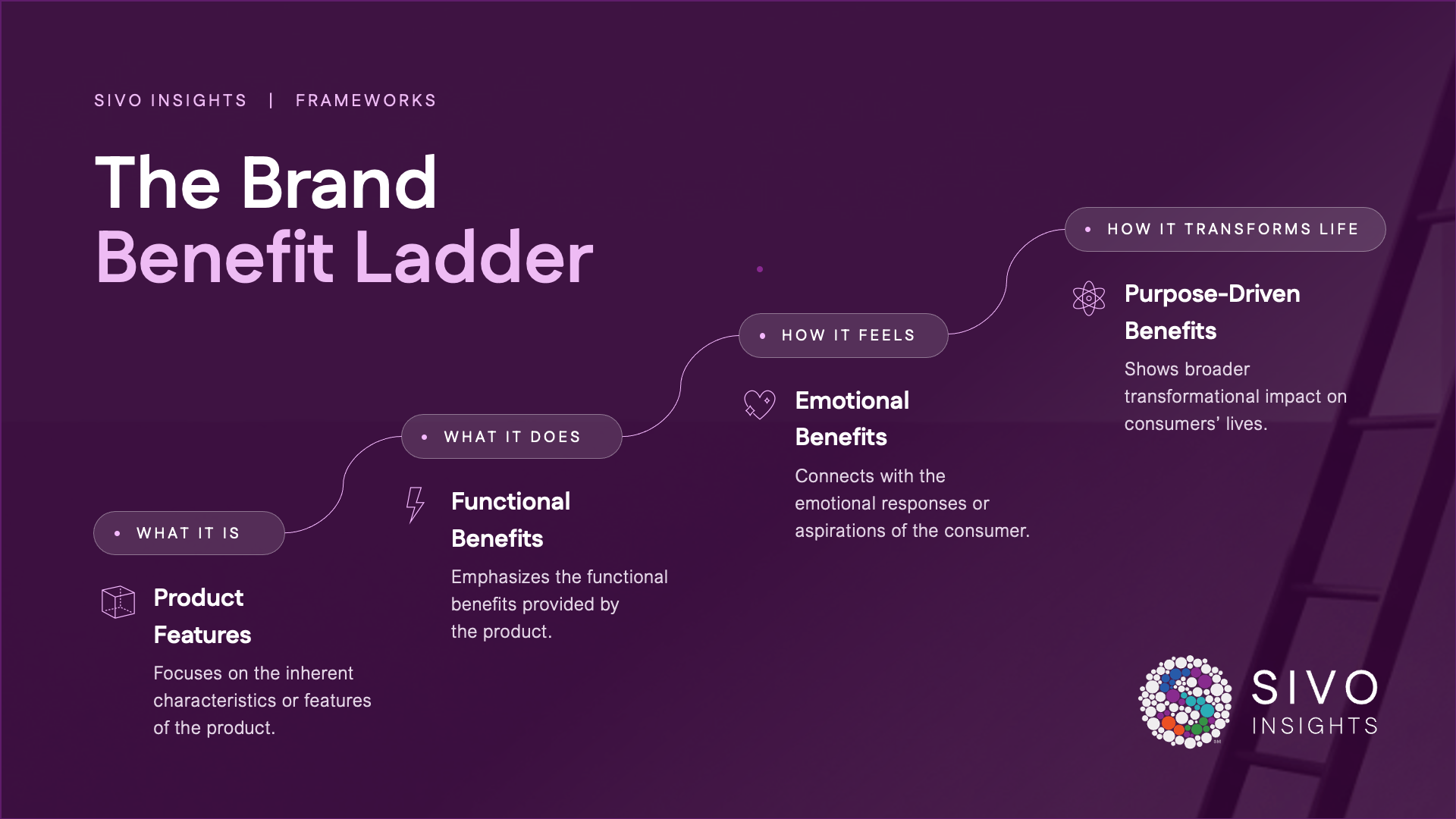
Within that context, positioning can no longer rest solely on functional benefits, i.e., “what it is” or “what it does.” Strong brands are intentionally climbing the Brand Benefit Ladder:
Depending on your brand's maturity and competitive set, you may need to refresh your positioning at any level, from sharpening a functional claim to elevating toward more emotional or purpose-led territory. But you can’t make that decision in a vacuum.
That’s where disciplined, end-of-year consumer research become critical.
Q4 is a valuable time for positioning work because it bridges “what has happened” and “what’s next”:
By investing in brand positioning research now, you give your team the time they need to align on a refined or new positioning territory, translate it into clear messaging and activations and brief your agencies and internal partners in Q1 with a strong strategic foundation.
At SIVO, we’ve spent many years helping brand teams across industries develop and evaluate brand positionings that resonate with both consumers and internal stakeholders. Our approach combines proven frameworks with rigorous qualitative and quantitative research to ensure your positioning is both inspiring and grounded.
In Q4, that typically looks like a two-step process:
1. Qualitative Exploration: Refining the Story With Real Consumers
We start by exploring how consumers currently perceive your brand, your competitors, and the broader category. For example:
We can work side-by-side with you and your agency partners toevolve the statements as we learn, so you’re not waiting months for direction.
2. Quantitative Positioning Validation: Selecting the Strongest Position
Once we’ve refined a set of viable positioning routes qualitatively, we move into quantitative validation to identify the most motivating and distinctive option.
Using surveys and, where appropriate, real-world testing (such as digital ad experiments), the SIVO team will:
The result is not just “a good idea,” but a validatedstrategic choice: a positioning that is clear, unique, credible, and proven toconnect with your consumers across channels all year long, via campaigns,packaging, digital, shopper, innovation, and more.
If you’re already planning for 2027, this is the moment to build a positioning that truly reflects today’s consumer and tomorrow’s opportunity. Let the SIVO team help you develop and validate a brand positioning that communicates exactly how your brand wants to show up in the world, and why that matters to the people you serve!
SIVO Insights brings together research, talent, and intelligent technology to help organizations navigate complexity with confidence. Have a business challenge? Let's talk!
We bring together research, talent, and intelligent technology to help organizations navigate complexity with confidence