
By Julie Rose
As someone who has spent over three decades in the market research industry, I've seen firsthand how technology reshapes our professional lives. The advent of online surveys, the rise of internet scraping and text analytics, opportunities coming from big data mining, and the now the integration of Artificial Intelligence (AI) all represent significant milestones in the Digital Age intersecting with the Market Research Industry.
AI isn't just a new tool; it's a game-changer. It's capable of automating repetitive tasks, processing and analyzing vast amounts of data, at speeds previously unimaginable. It is an exciting time to once again, adopt new ways of working that will advance our mission to understand people and deliver insights that drive business growth.
New Heights in Market Research Analysis
In today's fast-paced world, the volume of data generated daily is staggering. AI excels at sifting through this data, identifying patterns, and providing preliminary insights. This capability is invaluable in market research analytics, where the first step is often labor intensive to comb through a variety of data sources to identify patterns, anomalies, outliers, consistencies and inconsistencies.
Here are a few examples of where AI analyses can advance market research:
Practical Considerations
AI takes data processing and analysis to new levels, providing speed and pattern recognition that was unheard of even a few years ago. That said, the storytelling aspect of market research - translating data into a clear and inspiring story with actionable insights that will unlock new growth opportunities - is where human expertise shines.
Embracing the Future of AI in Market Research
As AI technology continues to evolve, so will SIVO’s approaches and techniques. We view AI as a powerful augmentation to our workflows and capabilities and will continue to experiment and adopt new ways of working that drive our effectiveness and efficiency. At the same time, we believe that it is the combination of the AI tools and experienced, empathetic market researchers that skillfully identify the nuances of consumers perceptions and behaviors that leads to actionable, strategic insights. We will continue to invest in both resources – artificial intelligence and human intelligence.
Join us on this exciting journey
At SIVO, we are committed to blending the best of human expertise and AI innovation to deliver insights that drive your business forward. Contact us at Contact@SIVOInsights.com or visit SIVOInsights.com to schedule a discovery call and explore how we can help you take your market research to new heights!
As fall season begins and planning cycles ramp up, most brand teams are juggling budgets, media calendars, and launch timelines. But there’s one question that quietly determines how effective all of that work will be next year:
Ever since your brand was established, your consumers have moved through shifting economic pressures, cultural tensions, new product entrants, and evolving expectations in your category. If your brand positioning hasn’t been revisited with fresh consumer insight, you’re likely planning 2027 with an outdated map.
Q4 is the ideal time to reset.
A clear, differentiated brand positioning is the foundation of an effective marketing strategy because it forces the team to define who the brand serves, what primary benefit it delivers, why it can credibly deliver that benefit, and how it stands apart from key competitors.
Without that clarity, campaigns become fragmented, messaging drifts, and teams default to generic claims that could belong to any brand in the category.
As a reminder, a classic, disciplined positioning statement (your differentiating benefit) looks like:
For (consumer target), Brand is the only (product type) that provides (key benefit), because Brand has (reason to believe 1), (reason to believe 2), and (reason to believe 3).
For example, Peleton’s positioning statement looks something like this:
For people looking to stay motivated with their in-home workout routines, Peloton is the connected fitness platform that delivers an energizing studio experience, with premium equipment, live and on-demand classes, motivating instructors, and personalized progress tracking.
The past few years have reshaped what “value” means in many categories. Consumers are re-evaluating trade-offs between price, quality, health, and convenience; looking for brands that reflect their emotional needs and life stage; paying closer attention to how brands show up on issues like sustainability, wellbeing, and social impact; and comparing more options more quickly across digital and physical channels.
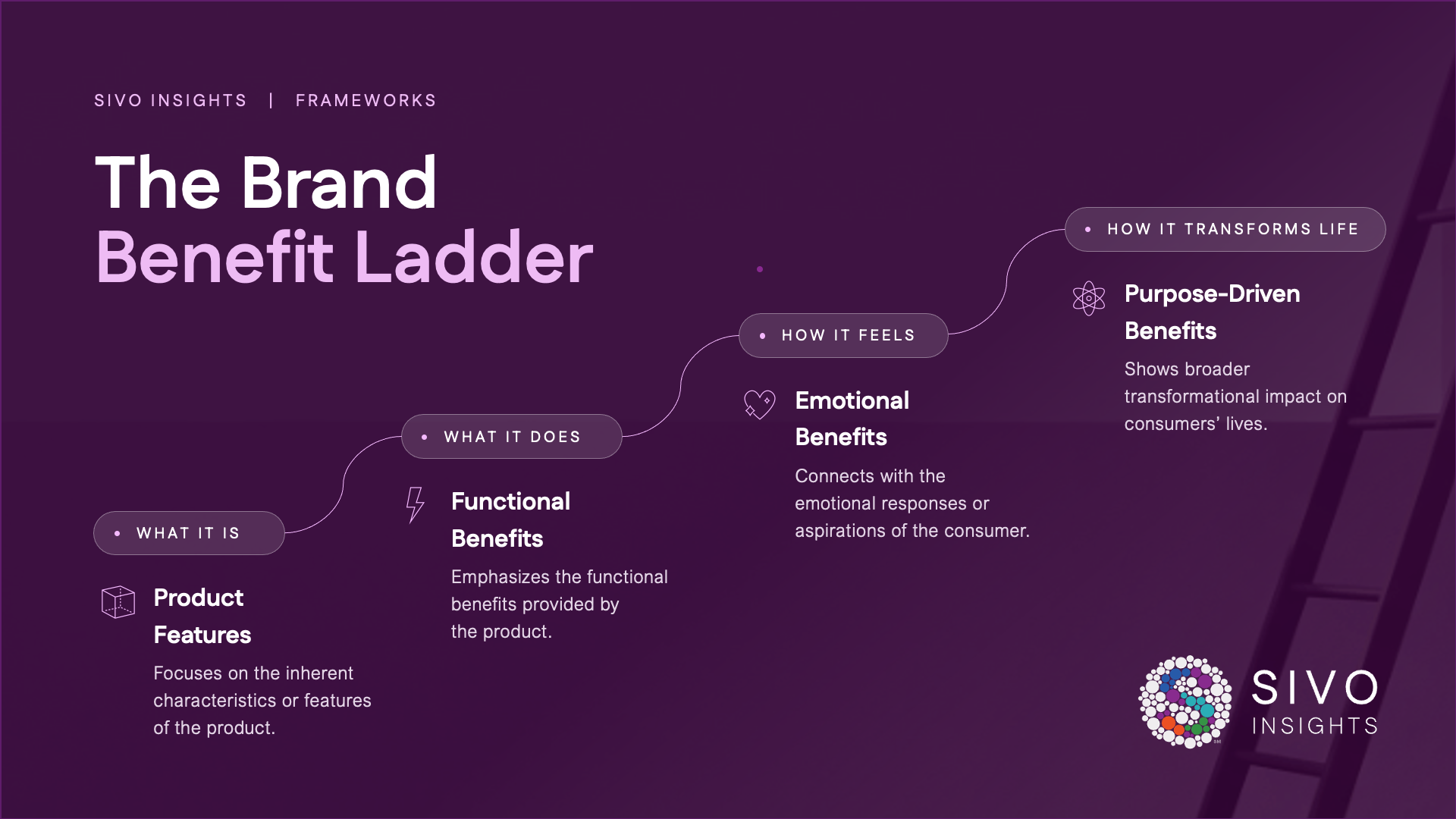
Within that context, positioning can no longer rest solely on functional benefits, i.e., “what it is” or “what it does.” Strong brands are intentionally climbing the Brand Benefit Ladder:
Depending on your brand's maturity and competitive set, you may need to refresh your positioning at any level, from sharpening a functional claim to elevating toward more emotional or purpose-led territory. But you can’t make that decision in a vacuum.
That’s where disciplined, end-of-year consumer research become critical.
Q4 is a valuable time for positioning work because it bridges “what has happened” and “what’s next”:
By investing in brand positioning research now, you give your team the time they need to align on a refined or new positioning territory, translate it into clear messaging and activations and brief your agencies and internal partners in Q1 with a strong strategic foundation.
At SIVO, we’ve spent many years helping brand teams across industries develop and evaluate brand positionings that resonate with both consumers and internal stakeholders. Our approach combines proven frameworks with rigorous qualitative and quantitative research to ensure your positioning is both inspiring and grounded.
In Q4, that typically looks like a two-step process:
1. Qualitative Exploration: Refining the Story With Real Consumers
We start by exploring how consumers currently perceive your brand, your competitors, and the broader category. For example:
We can work side-by-side with you and your agency partners toevolve the statements as we learn, so you’re not waiting months for direction.
2. Quantitative Positioning Validation: Selecting the Strongest Position
Once we’ve refined a set of viable positioning routes qualitatively, we move into quantitative validation to identify the most motivating and distinctive option.
Using surveys and, where appropriate, real-world testing (such as digital ad experiments), the SIVO team will:
The result is not just “a good idea,” but a validatedstrategic choice: a positioning that is clear, unique, credible, and proven toconnect with your consumers across channels all year long, via campaigns,packaging, digital, shopper, innovation, and more.
If you’re already planning for 2027, this is the moment to build a positioning that truly reflects today’s consumer and tomorrow’s opportunity. Let the SIVO team help you develop and validate a brand positioning that communicates exactly how your brand wants to show up in the world, and why that matters to the people you serve!
If you're part of a consumer insights team, you already know what this time of year looks like. The upcoming start of annual planning season brings high expectations, overlapping requests, and limited capacity. You’re pulling together top trends, completing industry reviews, immersing stakeholders, and expected to deliver fast, sharp guidance that informs decisions across the business. There’s no shortage of urgency. But there is often a shortage of time, hands, and headspace.
In this post, we’ll focus on how teams like yours are preparing for the planning season pressure with smart, flexible insights support. From tips for handling the volume to examples of how fractional talent can plug in fast, this is a practical guide to getting through planning season without compromising on quality.
Planning season can be a moment of high visibility for insights teams. It’s when your work directly shapes decisions on budgets, brand priorities, innovation pipelines, and go-to-market plans. Expectations are high, and so is the payoff if done well.
This is also when the work becomes less linear, as you’re often not managing one big project, but you’re responding to competing needs from multiple teams, often simultaneously. You’re asked to shift from high-level trends to granular customer behavior, to turn data into strategy, and to do it all faster than ever. Internally, you may be running up against resource constraints, limited capacity for synthesis, or pressure to answer questions that haven’t been fully scoped. Stakeholders want insights, leaders want speed, and everyone wants you to predict the future so they can plan better for it.
This is the reality many insights leaders are preparing to navigate right now: how to maintain rigor under pressure, how to prioritize when everything is urgent, and how to protect the quality of insight that drives real decisions.
With overlapping asks and limited time, prioritization becomes a strategic skill. It’s not just about getting things done, but making sure the most valuable work gets done well. Below are a few practical ways we’ve seen insight teams stay focused and deliver effectively under pressure.
Start with internal alignment
Before saying yes to every request, align with key stakeholders on what’s truly critical to planning outcomes. What decisions need to be made in the next few weeks? What’s nice to have versus required? This helps filter the noise and focus resources where they matter most. If you’re a seasoned insights pro, this step probably comes naturally to you.
Map deliverables to decisions
For every request, clarify what decision it’s intended to inform. This helps the team determine how deep to go, what methods are appropriate, and whether existing insights already cover it.
Synthesize what’s already known
Planning often sparks redundant questions. A quick synthesis of past work, organized by theme, audience, or priority, can help prevent unnecessary rework and provide fast traction. Even a short “What We Know” session can help reset expectations and surface gaps more clearly.
Be transparent about trade-offs
Not everything can be done at the same depth, and it’s best to communicate that clearly. Stakeholders usually respond well when you explain what’s possible, what’s at risk, and where additional support would make a difference. This creates space for smarter resourcing decisions, and helps prevent extra stress and burnout among your team.
Build in a checkpoint before things scale
Use a mid-cycle checkpoint to review whether what’s being delivered is actually moving planning forward. If not, it’s better to adjust early than stretch your team to deliver work that won’t be used.
When insight teams hit capacity during planning season, the instinct is often to either say no, or simply push through. But overloading the team rarely leads to strategic work. It leads to shortcuts, slower turnarounds, and deliverables that lack the synthesis stakeholders expect – putting the strategic plans at risks.
Many teams are addressing this challenge by bringing in short-term support. But success depends on who you bring in and how they work. Traditional freelancers or overflow support often require onboarding, guidance, or extra training time. That adds to your workload instead of reducing it, and that’s not what you need when you’re already stretched thin.
What works better is adding insight professionals who understand planning cycles, know how to manage complexity, and can operate as part of your internal team. When done right, this model gives teams the room to focus on what matters most. It protects insight quality while meeting the volume and speed planning requires, and it also reduces pressure on the team, making it possible to stay sharp across multiple workstreams.
At SIVO, we work with companies across industries to extend insights teams during planning season. Our On Demand Talent includes seasoned researchers, strategic thinkers, moderators, planners, and communicators who can step into the specific functions you need. Whether that’s help managing an overflow of qual studies, needing someone to run stakeholder synthesis, or build strategic narratives that tie research to business planning – fractional insight experts are here to help.
You don’t need to compromise quality to meet a deadline, and you don’t need to burn out your team to deliver on planning season demands. Whether you need a sharp moderator for next week’s workstream, a strategic partner to help frame consumer implications, or someone to translate findings into clear planning outputs, we can match the right talent to your exact need.
Need Extra Capacity on Your Insights Team for Planning Season, Fast?
Let’s find your perfect match!
by Julie Rose
I’ve been in the workforce for over 30 years (GASP!). I’ve witnessed and been part of a lot of change. Changing technology is a mainstay in the Age of Information, which is centered on accessing information and knowledge easily and quickly. Artificial Intelligence (AI) and machine learning is another advancement in getting that knowledge even faster and more quickly.
With each advancement or new tool, there is the inevitable talk of our jobs going away because the latest advancement is expected to replace us. In many cases, with advancement in technology, there are shifts that do render obsolescence. From my experience, it is the past technologies, not people, that have become obsolete. As people, we adjust, we leverage, we apply critical thinking, we learn, and take advantage of technological advancements to be more effective and efficient but we typically are not replaced.
Experience with Workplace Technological Advances
Early in my career, I was on the Email Task Force when email was just being introduced in the workplace. We grappled with tough topics, like were we going to allow employees to send personal emails. Yes, this is a true story! Email technology has made information flow much faster and easier. In fact, I don’t remember the last time I faxed something to someone. Email improved the way I work, but it didn’t replace me or make my job obsolete.
I also remember leading a team that was evaluating social media listening techniques and tools as we were trying to glean insights from the vast number of online conversations and content. People wondered if we would ever need to conduct primary market research again. People wondered if they would be replaced with Do-It-Yourself Digital scraping tools. It didn’t happen. I’m still here providing custom insights by leveraging the best market research tools to meet my clients’ business objectives.

The Soup-Starter, Not the Soup
The latest advancements in Artificial Intelligence have impacted every industry, and we are all evaluating it to figure out how to safely leverage it and integrate it into our current best practices. My reflection on the many changes I’ve personally experienced has helped me to formulate my thoughts on it. I’ve been asked quite a lot recently by friends, colleagues, and clients what do I think about AI, machine learning, and specifically natural language AI like ChatGPT or Google’s BERT. My latest answer . . . It’s the Soup-Starter, but it’s not the Soup (or the Chef!).
New tools like, ChatGPT, are an excellent way to access information and knowledge quickly and to easily get started on a topic or approach. It starts the soup, but it doesn’t finish the meal. Just like soup needs a chef, research needs a researcher, and insights require an Insights Professional. It takes discernment, creativity, experience, and nuanced choices to make a delicious, complex, flavorful pot of soup and the same goes for a custom market research study. Just like the chef might consider certain stocks and spices to start the soup, a researcher can start with ChatGPT to contemplate potential objectives, methodologies or questions before designing a custom market research project that fully meets the needs of the business.
Using ChatGPT in Market Research
When it comes to market research, we at SIVO have found ChatGPT and other AI tools to be a useful starting point in the following ways:
Evolve toward the Future
As AI technology evolves, we will evolve with it. We will leverage it to improve how we operate. For now, it becomes our new “soup starter” but we still own the recipe and must make the soup. All of us need to experiment and decide how AI can improve our ways of working but we will continue to apply our craftsmanship, critical thinking, and intuition to finish the job.
At SIVO, we are dedicated to understanding your business challenges and questions and will then use our expertise, resources, and access to technology to recommend a learning plan and approach that considers all variables and delivers on your needs. Contact us at Contact@SIVOInsights.com or go to SIVOInsights.com today to schedule a discovery call and connect!
By Ashton Walz
What is Consumer Segmentation
Market or consumer segmentation is a market research approach that allows you to divide a brand’s universe of potential consumers into smaller groups or segments based on their characteristics, e.g., demographics, values, attitudes, behaviors, and geography. The segments are composed of consumers who have similar characteristics within a segment and differing characteristics from all other segments.
Once the consumer population within the market has been segmented, teams can assess and compare segments to understand which segments offer the most potential for growth, i.e., which group is most likely to find value and be motivated by your products or services and respond to your marketing, promotion, and innovation initiatives.
Creating Your Segmentation
When developing your segmentation, the idea is to create segments that feature members who are as similar as possible to each other but different as possible from members in other segments. To do this, brand teams work with SIVO to define the parameters that will be used to segment the market, i.e., behaviors, attitudes, psychographics, or demographics, location, etc. For instance, if you wanted to segment the breakfast food category, you might want to include demographics (e.g., presence of kids in the household), behaviors (e.g., whether breakfast is eaten in the home or out of home) and attitudes (e.g, level of commitment to healthy eating habits) to help define your segments.
Once a plan is in place, a survey will be developed, and data will be collected from consumers in your defined market. Survey respondents will be presented with a scale to rate the importance of a series of behavioral and attitudinal statements or participate in a trade-off exercise to choose one of four statements that is most important or best describes them.
With the data collected, segments are created using clustering analysis. The ideal number of segments for a typical market is 5 to 8. More than 8 segments can be overwhelming to manage and fewer than 5 may lump too many consumers together.
Once the segments are developed, SIVO Consumer Insights experts will develop detailed profiles or personas, using all the survey data to describe or tell a story about each segment. The profiles/personas highlight the unique attributes and behaviors of the segments for easy comparisons.
Applications for Consumer Segmentation
When analyzing the consumer segmentation, it is important to understand the best ways to use this valuable marketing research tool.
Targeted Marketing Campaigns
The first primary use is to develop targeted marketing campaigns. By understanding the unique needs, interests, and demographics of each segment, business teams can alter their marketing messages and promotional activities to resonate with specific segments to increase consumer engagement. When marketing communications have been written with a specific consumer segment in mind, consumers feel understood and are more motivated to make a purchase.
Optimized Distribution in Stores and Channels
Understanding the consumer segmentation within a market also helps businesses optimize their distribution and sales channels. Different consumer segments may have varying preferences for different store banners or channels. They might also have different preferences for online shopping, physical stores, or a combination of both. By identifying these preferences and behaviors, companies can allocate resources strategically, focus on the most effective stores and channels, and provide a seamless shopping experience for each segment.
Identify Market Gaps
Another significant use of consumer segmentation is to help identify market gaps where there are a lack of products or services that are currently meeting the needs of specific segments. Gaps in the market can then be translated into opportunities to develop new products or modify existing ones to cater to the needs of specific segments. This strategy enables companies to stay ahead of competitors, enhance consumer satisfaction, and build stronger brand loyalty.
Identify Additional/Secondary Markets
Consumer segmentation allows businesses to identify untapped market opportunities and potential areas for expansion. By analyzing the demographics, behaviors, and preferences of different segments, companies can uncover secondary or adjacent target segments that also align with their products or services. This knowledge enables strategic decision-making and facilitates successful market penetration.
Your Source for Expert Consumer Insights
At SIVO, Inc., we are dedicated to helping our clients develop and utilize consumer segmentation that reveals their consumer target. We design custom learning plans that will help you understand which segment of consumers hold the most potential for growth and then facilitate the development of action plans so you can connect with and serve your consumer target.
Contact us via our website form or email us at Contact@SIVOInsights.com today to schedule a discovery call!
SIVO Insights brings together research, talent, and intelligent technology to help organizations navigate complexity with confidence. Have a business challenge? Let's talk!
We bring together research, talent, and intelligent technology to help organizations navigate complexity with confidence