As you close out this fiscal year and reflect on all that you know and have learned about your business and customer, we at SIVO have one question for you:
Do you understand what drives customer value for your brand and category?
Most teams have pieces of the answer: past studies, segmentations, trackers, performance data. But when it’s time to make real trade‑offs, what to improve, what to protect, and where to put that “$1 more or $1 less”, the picture often blurs.
That’s risky in a market where expectations and definitions of “value” are shifting faster than annual plans. Luckly, we are just heading into Q4 and there is still plenty of time to identify the Value Drivers for your consumer, to set you up for success in the year ahead.
At SIVO, we look at consumer value across four interconnected dimensions:
Most marketers understand the functional benefits for their brand. Far fewer have a clear, evidence‑based view of the emotional, life‑changing and social impact dimensions that increasingly drive choice, loyalty, and willingness to pay — and even fewer can say which specific value drivers matter most for their target consumer in their category today.
As planning ramps up, teams are asking:
Answering those questions requires more than a benefit list. You need a prioritized list of the Customer Value Drivers, that can guide your decisions.
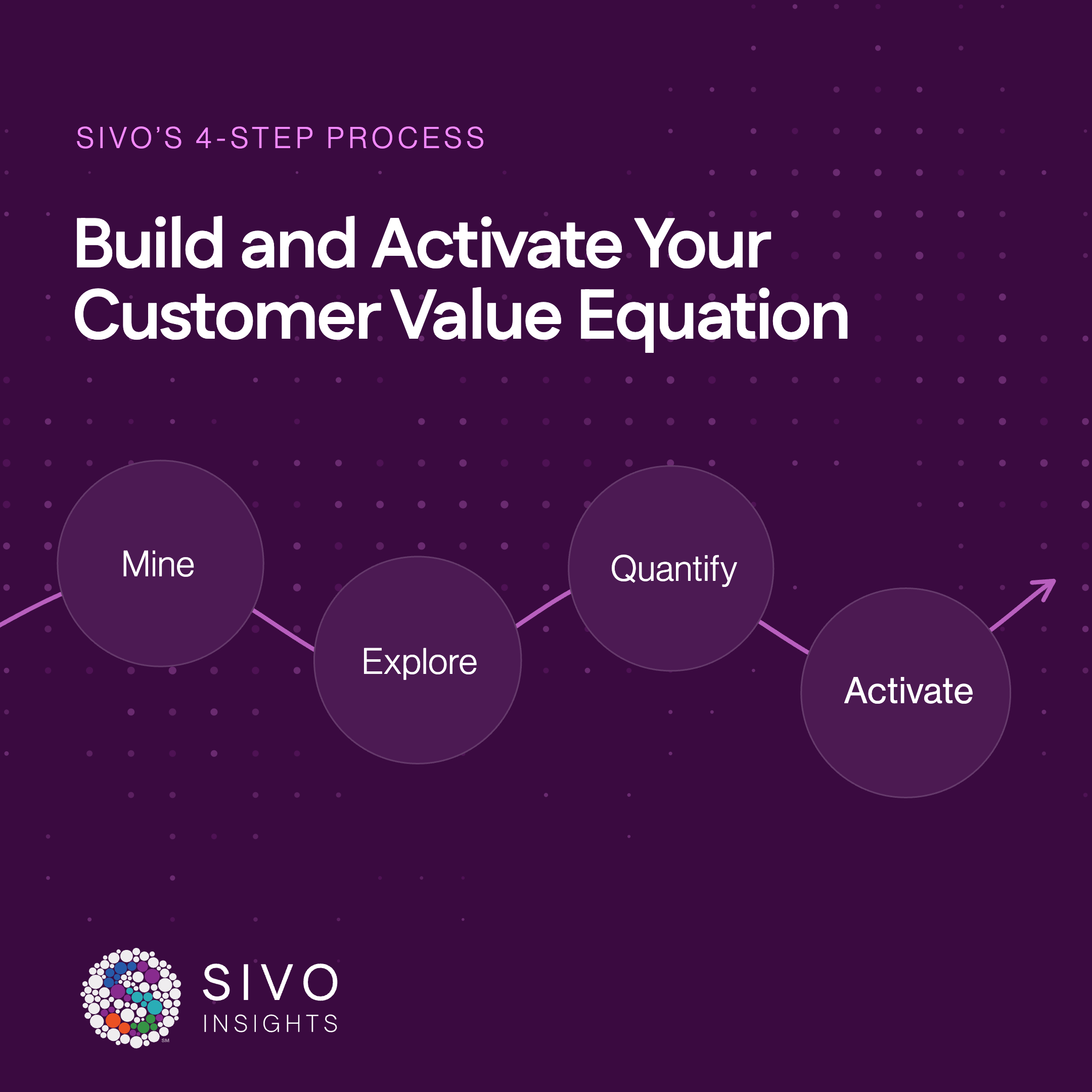
SIVO uses a four‑step process to turn “consumer value” from an abstract concept into a practical decision tool:
Each step builds on what you already know and ends with clear direction for your teams.
We begin by mining and summarizing your organization’s existing information, not starting from scratch. We synthesize:
This clarifies what you already understand customer value drivers and where the gaps, contradictions, and blind spots are. The output is a summarized view of current understanding and a focused learning agenda.
Next, we Explore through qualitative, in‑depth interviews with your target consumers.
Our researchers:
This reveals the language consumers naturally use, the hidden tensions and trade‑offs they navigate, and what is truly non‑negotiable versus what simply delights or disappoints.
We then Quantify what we’ve heard, turning rich stories into a set of “potential value drivers” among category customers. We execute a quantitative survey to size and rank the importance of all potential value drivers within a category AND how well your brand and competitive brands perform on each driver.
The result is an evidence‑based view of which Value Drivers are critical to your brand vs your key competitors, and which are less important or not essential. You will see which value drivers are:
This becomes a shared “north star” and common language for how your brand creates or maintains value for your customers.

Finally, we activate through a facilitated workshop led by SIVO’s expert team.
We bring together cross‑functional stakeholders, typically insights, marketing, R&D, sales, and key agency partners, to:
This process gives you a unifying understanding of your target customers’ purchase drivers, must‑haves, and nice‑to‑haves — and a sharp view of how you stack up versus alternatives.
Most importantly, it gives your teams confidence and clarity: where to invest, where to hold, and where to trim, across innovation, marketing, and customer experience.
As you wrap this fiscal year and shape the next, let SIVO help you understand what your customers truly value so your team is ready to deliver it better than anyone else!
by Jennifer Dilley
What is a consumer insight? How do you know when you have found one? What does it look like?
These are questions that every marketer or consumer insights professional gets asked at some point. And while it might be useful to rattle off a definition in an elevator conversation, it is more important to internalize the definition so that when you are conducting consumer research you have a clear understanding of what you are looking for.
Definition of a Consumer Insight
So, what are we looking for? A consumer insight is an underlying motivation or need that explains why a consumer makes a certain decision or behaves in a certain way. But that is not all. When the underlying motivation is uncovered, it is only a consumer insight if it can be applied to a brand in an ownable way to unlock brand growth.
A consumer insight identifies consumers’ beliefs and values that drive their behavior. It provides a deeper understanding of why consumers purchase certain products and dismiss others.

Consumer Insights vs Facts
Be careful to distinguish an insight from a fact. There is a difference. A consumer fact is just a statement about a consumer behavior or the marketplace. Here are examples of facts:
These facts are interesting and might be relevant to a brand, but they don’t explain why people behave the way they do.
Consumer Insights Highlight Pain Points and Opportunities
Consumer Insights shed light on pain points for consumers and uncover potential opportunities for brands. As an example, an insight from the findings above could be articulated as, “People want a luxury car to signal their lifestyle and financial success.” This is an insight because it taps into consumers’ underlying motivation (often more emotional that functional) and a pain point, resulting in an opportunity.
Consumer Insights Must be Ownable
A consumer insight is only valuable if it is relevant and can be applied back to a brand in an ownable way. If competitive brands are already addressing a specific consumer need and motivation, then the insight is true but not necessarily ownable for a brand. A good insight will inspire ideas and communications that allow the brand team to communicate brand benefits in a unique way.
Note that an insight might link to a category benefit, but it can still be ownable by a brand, if it has not been adopted by the competition.
Consumer Insights Unlock Growth
The job of a consumer insight is to highlight the possibility for an emotional connection between a product/service and the consumer. It provides brand teams with the context that explains how the product can be relevant in consumers lives. Understanding the emotional connection between consumers motivations/needs and the brand benefits can fuel creative marketing ideas that will capture the attention and convert consumers along the marketing purchase funnel.

Consumer Insights May Not be Overtly Articulated by Consumers
Note that consumer insights are deeper motivations that are quite often subconscious. In fact, a good consumer insight is often described as an “Aha moment.” Good insights tend to be simple human truths that we don’t discuss, but are still there, right under our noses. Because of this, specialized consumer learning techniques are needed. Ethnography, in-context observation, consumer diaries, and projective techniques like mood boards and semiotics, are required to dig beneath the surface of what consumers say to uncover their actual motivations. This may also require us to look beyond consumers values and lifestyle to macro trends – demographic, economic, pop culture, health, and technology trends that are also influencing consumer behavior.
Tying back to the luxury car example, consumer perceptions are also influenced by economic and geo-political fluctuations such as, inflation, higher gas prices, climate change and the transition to electric vehicles. This can subconsciously change consumer beliefs and behaviors, leading to new consumer insights.
Consumer Insights Summary
The best consumer insights:
✔ Explain WHY? By identifying and articulating an underlying motivation, need or belief that is driving consumer behavior
✔ Address a pain point or point of tension
✔ Are ownable when applied to a brand/product/service
✔ Unlock opportunities, inspiring creative marketing ideas that fuel business growth
To discuss consumer insights with experts from SIVO, please reach out to our team at Contact@SIVOInsights.com
By Julie Rose
Now more than ever, it’s crucial to balance future readiness with the demands of today.
The future isn’t distant. It’s already here and unfolding in ways most can’t imagine. If you look closely, the signs of what's to come are everywhere. Technology, consumer preferences, and industry landscapes are evolving at an unprecedented pace.
Yet, many still expect gradual change, a slow evolution of today’s norms. The reality is different. The future is coming faster and with more disruption than we’ve ever experienced before. To remain competitive, companies must adopt a future readiness mindset.
More Different Than Ever Before
In the next 20 years, society will change more than it has in the past 300 years. We live in the Technology Era, where things evolve exponentially. This is hard to grasp because we’re wired to think in linear steps, not exponential leaps.
For example, the stepwise expansion of grocery store refrigerated sections to include fresh snacks and functional beverages and grab & go meals was a slow, predictable evolution. But the rise of Instacart, which recognized paradigm shifts in eCommerce, the gig economy, and rideshare platforms was a significant leap that changed grocery shopping substantially. Today, 25% of groceries are bought through delivery services like Instacart.
While we easily project near-term change, we vastly underestimate long-term transformations.
Take TikTok, Zoom, Peloton, Alexa, Airbnb, and Tesla—none existed 5 to 10 years ago, yet they are now embedded in our daily lives, and disrupted industries almost overnight.
How will your industry, competitors, and consumers transform in the next decade?
The Power of Exponential Change
Exponential technological growth, driven by Moore’s Law, is driven by the power and capabilities of technology doubling every two years, if not faster. This exponential curve is almost impossible for our linear human brains to understand. Let’s demonstrate:
Imagine folding a giant piece of notebook paper in half. Now fold it again and again until you’ve folded it 42 times. How tall would that folded tower of paper be? Four inches? Four feet? Four yards?
Wrong. It would stretch all the way to the moon (0.004 inches x 242 ≈ 240,000 miles)!
This is the power of exponential growth—small changes compound quickly, creating massive impacts. Companies and individuals who can think exponentially, recognizing and preparing for the transformational changes on the horizon, will thrive in a future that looks radically different from today.
How to Prepare for Tomorrow, Today
Here are four critical steps to get your organization ready for the era of exponential change:
1. Narrow Your Lens
With endless opportunities (and challenges) on the horizon, it’s easy to lose focus. Which do you want to solve? Where do you want to start? Narrow your focus to areas where you can make the biggest impact. Rather than trying to chase every opportunity, focus on solving the problems that align with your strengths and strategic goals. Successful companies of the future will be those that zero in on the right opportunities, rather than trying to cover too much ground (or worse, choosing to stand still).
You don’t have to be Amazon, Tesla or Google X—but you better not be Blockbuster.
2. Notice & Anticipate
The future doesn’t usually arrive in the form of today’s familiar faces. Instead, it comes from the edges. Netflix didn’t resemble its current form in its early years, nor did Facebook. To see the signals of change, look beyond your immediate competition or traditional industry players. Explore the fringes of culture, markets, and technology. The future often looks weird before it goes mainstream—initially awkward, niche, and impractical—until it’s not.
What are you doing to discover tomorrow’s signals today?
3. Seek a Catalyst
Driving disruptive change is tough, especially for established organizations. That’s why you need innovation catalysts—people who have the rare ability to get things moving and drive change. These are the people who can activate ideas by building trust, challenging assumptions, and breaking through organizational inertia. If you have them on your team, nurture and empower them. If not, hire them. Additionally, reevaluate your network. Seek and develop deep partnerships that offer 1+1=3 potential.
Do you have a catalyst on your roster? Are your partners driving exponential potential?
4. Practice
Focus, anticipation, and catalysts alone won’t ensure success. You must also create the time and space to “rehearse the future”. Build experimentation into daily routines and make future discussions a core part of company culture. You still need to run day-to-day operations, but by weaving future preparation into daily practice, you’ll be better prepared when disruption hits. World class innovation companies like 3M, NASA and Nike create space, ring-fence funds and reward risk-taking and experimentation.
What systems and norms do you have in place to enable learning about your potential futures?
SIVO is Your Future Readiness Co-Pilot
While tomorrow’s marketplace will look very different from today’s, understanding human needs, beliefs, and behaviors will remain critical. At SIVO, our Custom Research and Growth Framework solutions will highlight tomorrow’s opportunities, and our On Demand Talent network offers “future-ready” experts ready to provide fractional support tailored to your needs. Additionally, we are “rehearsing the future” by actively using and experimenting with AI tools that support our researchers in uncovering insights and optimizing efficiency.
Contact us at Contact@SIVOInsights.com or visit SIVO's Website to hear more about our investigation or to schedule a discovery call. Let’s embrace the future together!
by Cindy Blackstock
Being part of a custom market research firm with global clients, we are often a go-to partner on international research—both qualitative and quantitative. And while all global market research has some challenges, global qualitative research has some unique ones.
From years of designing consumer research approaches, we’ve identified a list of questions we ask our clients to customize research for their needs. But whether you are researching with SIVO, another supplier, or leading research internally for your own organization; here are 5 watchouts when planning global, qualitative research. These apply for both in-person and virtual approaches.

Everything takes longer than domestic-only market research. Most global market research consists of multiple countries and languages. This requires added time to translate all materials such as recruitment screeners, discussion guides, and transcripts. For example, domestically you may receive a recruiting update every 1-2 days. But with the additional time needed to translate the recruiting progress, your updates may occur every 3 days with non-English speaking countries. And with transcripts needing translation time too, that delays the analysis and delivery of your final report.
SIVO Tip! When planning your research, build in extra time to account for translation needs on both the front and back ends of your research. This could easily add an additional 2-weeks to a simple qualitative design such as webcam focus groups.

Expect cultural differences in business norms. Corporate cultures differ around the world. When working with partners and consumers in other countries you need to expect, respect, and allow for cultural differences. One basic example of this is with interview start-times. As an example, our Thailand local moderator and consumers were consistently in-place and talking well before the official interview start time (making our client feel like they were late to observe the conversation); whereas in Brazil we had many consumers (and even a local moderator for one interview) who joined late.
SIVO tip! As a client who may be inviting other co-workers or organizational leaders to attend your research, prepare your team that some behaviors—from professionals and consumers—will be different. You can even remind your team these differences are likely one of the key reasons why you are conducting global research. Embrace it!

Know in advance if you want to adapt stimulus in real time. Particularly when researching marketing messages or communication, a client may learn from a few consumers and want to adapt the stimulus. This could be as simple as learning a word or phrase translated in your stim might be academically correct but needs to be modified to a more culturally relevant word – or it could be re-writing paragraphs of copy. In either example, you need a translator readily available to adjust the stimulus before the next interview.
SIVO Tip! Decide in advance if you will want or need to adjust your stimulus in real time. And if yes, identify the tactical steps and talent needed to achieve this.

Transcribe every word of the interview. Sometimes for efficiency (budget and time), a translator may only transcribe parts of the interview directly relevant to the brand, product and / or research objectives. But there is a lot of rich learning in the commentary! For example, consumer references to local politics can provide valuable context to their reactions to your product solution or marketing messages.
SIVO Tip! Confirm in advance that your translator understands your expectation that all words will be translated. And if efficiency is a concern, you can always limit the translation to only the ‘best’ interviews. This can condense your timeline and save costs.

Consider a collective discussion with all moderators and translators. If fielding research in multiple countries and/or markets to inform a global strategy (not a market specific plan); consider scheduling a collective debrief will all moderators and translators. This allows for discussion on what learning is consistent vs. the differentiated needs by country.
SIVO Tip! Such a discussion impacts your project timeline and costs and should be included as an expectation at the start of your project. A good research partner should be able to flex and add this to the close of your project but be aware of the implications to time and budget.
These 5 watchouts when planning global, qualitative research (in conjunction with a qualified and experienced Consumer Insights agency partner) will help ensure that you have a successful project resulting in global consumer insights to inform your business decisions.
To discuss these tips and any other questions about international or domestic consumer research, please feel free to contact the SIVO team at Contact@SIVOInsights.com for a consultation call.
Every year, businesses face the same challenge: key research projects grind to a halt when insights professionals go on vacation. Deadlines can slip, stakeholder requests pile up, and business decisions get delayed, all because critical expertise isn’t available when it’s needed most.
For many teams, the choice is either overloading remaining staff (leading to problems like burnout) or putting projects on hold (risking lost momentum and missed opportunities). But there’s a better way.
Leading brands solve this problem by leveraging On Demand Market Research Talent—highly skilled, fractional insights professionals who step in seamlessly, ensuring that research initiatives keep moving, even when core team members are out. Whether planned months in advance or needed at the last minute, these experts keep insights flowing year-round without the cost or commitment of full-time hiring.
In this article, we’ll explore:
If your research team has ever struggled to keep up during vacation seasons, this is for you. Let’s dive in.

Insights teams (or their superiors) often assume they can absorb the impact of vacation gaps—but the reality is more disruptive than expected. When key insights professionals are out of office, projects stall, timelines get pushed, and business decisions are delayed. The ripple effect extends beyond just a temporary pause—it can create significant financial, operational, and strategic costs.
Insights don’t operate in isolation. When research is postponed due to staffing shortages, marketing campaigns, product launches, and strategic initiatives suffer. A postponed concept test could mean missing the ideal market entry window, and a delayed brand study could leave unanswered questions right when leadership needs clarity.
The default response to vacation gaps? Overloading remaining team members. This short-term fix often leads to long-term burnout, reducing productivity and increasing the likelihood of rushed, lower-quality insights. High-performing researchers need time to recharge, but when teams are stretched too thin, performance—and retention—suffers.
Even with strong documentation, there’s always implicit knowledge that only team members carry—research nuances, stakeholder preferences, and the context behind past decisions. When an insights pro steps away, this expertise temporarily disappears, forcing teams to either pause projects or make assumptions that may not align with prior research.
Insights teams thrive on being trusted advisors to the business, but when gaps in coverage lead to stalled projects or incomplete data, stakeholder confidence erodes. If leadership views the insights function as unreliable, they may turn to gut instinct over data-driven decision-making—undermining the very role of the Consumer Insights function.
The bottom line? Vacation gaps in insights teams aren’t just an inconvenience—they create costly disruptions that affect business performance. But there’s a way to avoid these risks while still ensuring that research professionals get the breaks they need.
Vacation gaps are inevitable—but research delays don’t have to be.
Vacation gaps are inevitable—but research delays don’t have to be. The key to maintaining momentum without burnout is having a strategy in place before gaps happen. Whether you’re proactively planning or scrambling for last-minute coverage, here’s how leading companies keep research running smoothly, even when key team members are away.
When key team members are out, the biggest risk is insights bottlenecks—studies stall, stakeholder questions pile up, and research deliverables get delayed. SIVO’s On-Demand Talent steps in seamlessly, ensuring business-critical work continues without disruption.
Certain projects can’t afford to pause just because someone is on vacation. Product launches, consumer deep dives, and ad testing require continuity and expert oversight.
Sometimes, vacation coverage isn’t planned—it’s needed last-minute. Whether it’s a sudden leave of absence or a forgotten PTO overlap, scrambling to fill gaps can lead to expensive delays.
Whether planned or unexpected, vacation gaps don’t have to slow down insights. With an On-Demand Talent strategy in place, businesses stay ahead of potential disruptions—avoiding last-minute scrambles and keeping research moving seamlessly year-round.
Leading companies plan ahead—or react quickly—with On-Demand Talent, ensuring no critical work falls through the cracks that can impact the organization. Here’s how organizations leverage fractional insights pros to bridge gaps and keep research running smoothly:
Scenario 1: A national CPG company has ongoing brand equity tracking and ad testing, but their Senior Consumer Insights Manager was heading out for a month-long vacation.
Without coverage, research timelines would have slipped, and stakeholder meetings would have lacked fresh insights. Instead, the company brought in an On-Demand Consumer Insights Strategist to manage the process, ensuring:
This proactive approach prevented research bottlenecks and decision-making gaps, keeping the business moving.
Scenario 2: A global food & beverage company had a new product launch scheduled—but their Head of Consumer Insights and two key team members had overlapping PTO.
With final-stage concept testing still underway and last-minute adjustments needed for packaging and claims, the company faced a potential launch delay. Instead of postponing, they brought in a fractional Insights Lead to:
ODT gave them specialized expertise exactly when they needed it, ensuring no compromises in research quality or speed.
Scenario 3: A leading technology brand was in the middle of a competitive landscape study when an unexpected leave of absence left their insights team short-staffed.
Rather than overloading remaining team members or pressing pause on critical work, they:
With rapid-response talent placement, the company avoided research disruptions and kept its competitive intelligence up to date.
Scenario 4: A major retailer had a busy summer innovation pipeline, but multiple insights pros were out on PTO at the same time.
Rather than pausing consumer co-creation sessions and delaying concept testing, they used On-Demand Talent to:
With fractional insights experts seamlessly filling gaps, the company stayed on schedule without sacrificing research quality.
Whether you plan ahead or need urgent support, On-Demand Talent ensures your research stays on track—so your team can take time off without work grinding to a halt.
By leveraging fractional insights professionals, companies can prevent last-minute scrambles, reduce the risk of missed deadlines, and maintain research momentum year-round.
So, how do you avoid research slowdowns when your team is out? And if you’re already facing an urgent coverage issue, what’s the best way to bridge the gap without scrambling?Let’s break it down.
Businesses plan for financial forecasts, marketing campaigns, and supply chain logistics months in advance. Yet, many insights teams still treat PTO gaps as an inevitable issue. The key is building vacation coverage into your annual research strategy so that insights continue flowing, no matter the time of year. Some things you can do:
Planning ahead prevents vacation gaps from becoming business roadblocks. But what if PTO conflicts weren’t anticipated—and now key insights work is at risk of falling behind?
Even with careful planning, unexpected gaps happen. A last-minute PTO request, overlapping team absences, or an urgent business need can leave insights teams short-staffed at critical moments. If you’re already dealing with a research gap, here’s how to minimize disruption fast:
As companies seek more efficiency, many turn to AI-powered research tools to bridge staffing gaps. While AI can be a valuable support system, it has clear limitations that make it an unreliable substitute for expert insights professionals—especially when high-stakes decisions are involved.
For instance, AI is great at surfacing data but doesn’t interpret nuances, human motivations, or cultural relevance—leading to misaligned insights. AI models also (unfortunately) inherit biases from training data, which can skew results if not carefully reviewed and adjusted by human experts. Additionally, executives rely on strategic recommendations, not just raw data—AI lacks the credibility and business acumen needed to drive stakeholder decisions.
If you’re considering using AI to fill vacation coverage gaps for your research team, keep in mind that the more tools you introduce, the more training your team will require. This can actually take more time away from employees rather than increasing productivity—especially for short-term needs like a vacation fill. What seems like an easy solution can quickly turn into a time-consuming distraction, creating more inefficiencies rather than solving the original problem.
When critical insights projects can’t wait, finding temporary research experts quickly is essential. So, where can businesses turn for immediate, high-quality research support?
Many organizations look to freelance platforms and consulting firms, but these often require lengthy onboarding or lack the industry expertise needed for specialized research roles. Others attempt to redistribute workloads internally, which can lead to inefficiencies and overburdened teams.
A more effective approach is tapping into pre-vetted insights professionals (like ODT) who can integrate quickly, understand complex research needs, and keep projects moving without disruption. Whether covering for a planned PTO or responding to an unexpected gap, having a flexible resourcing strategy ensures that insights teams can maintain momentum—without last-minute scrambles or overburdening internal staff.
At SIVO, we provide businesses with flexible, on-demand insights talent to keep research initiatives moving—no matter the challenge. Whether you need short-term vacation coverage, interim leadership, or specialized expertise for a critical project, we place senior-level insights professionals within days.
Don’t let research slow down when key insight team members are out for vacation. Let’s talk:
contact@sivoinsights.com | www.sivoinsights.com/on-demand-talent-management/
SIVO Insights brings together research, talent, and intelligent technology to help organizations navigate complexity with confidence. Have a business challenge? Let's talk!
We bring together research, talent, and intelligent technology to help organizations navigate complexity with confidence