
by Jennifer Dilley
What is a consumer insight? How do you know when you have found one? What does it look like?
These are questions that every marketer or consumer insights professional gets asked at some point. And while it might be useful to rattle off a definition in an elevator conversation, it is more important to internalize the definition so that when you are conducting consumer research you have a clear understanding of what you are looking for.
Definition of a Consumer Insight
So, what are we looking for? A consumer insight is an underlying motivation or need that explains why a consumer makes a certain decision or behaves in a certain way. But that is not all. When the underlying motivation is uncovered, it is only a consumer insight if it can be applied to a brand in an ownable way to unlock brand growth.
A consumer insight identifies consumers’ beliefs and values that drive their behavior. It provides a deeper understanding of why consumers purchase certain products and dismiss others.

Consumer Insights vs Facts
Be careful to distinguish an insight from a fact. There is a difference. A consumer fact is just a statement about a consumer behavior or the marketplace. Here are examples of facts:
These facts are interesting and might be relevant to a brand, but they don’t explain why people behave the way they do.
Consumer Insights Highlight Pain Points and Opportunities
Consumer Insights shed light on pain points for consumers and uncover potential opportunities for brands. As an example, an insight from the findings above could be articulated as, “People want a luxury car to signal their lifestyle and financial success.” This is an insight because it taps into consumers’ underlying motivation (often more emotional that functional) and a pain point, resulting in an opportunity.
Consumer Insights Must be Ownable
A consumer insight is only valuable if it is relevant and can be applied back to a brand in an ownable way. If competitive brands are already addressing a specific consumer need and motivation, then the insight is true but not necessarily ownable for a brand. A good insight will inspire ideas and communications that allow the brand team to communicate brand benefits in a unique way.
Note that an insight might link to a category benefit, but it can still be ownable by a brand, if it has not been adopted by the competition.
Consumer Insights Unlock Growth
The job of a consumer insight is to highlight the possibility for an emotional connection between a product/service and the consumer. It provides brand teams with the context that explains how the product can be relevant in consumers lives. Understanding the emotional connection between consumers motivations/needs and the brand benefits can fuel creative marketing ideas that will capture the attention and convert consumers along the marketing purchase funnel.

Consumer Insights May Not be Overtly Articulated by Consumers
Note that consumer insights are deeper motivations that are quite often subconscious. In fact, a good consumer insight is often described as an “Aha moment.” Good insights tend to be simple human truths that we don’t discuss, but are still there, right under our noses. Because of this, specialized consumer learning techniques are needed. Ethnography, in-context observation, consumer diaries, and projective techniques like mood boards and semiotics, are required to dig beneath the surface of what consumers say to uncover their actual motivations. This may also require us to look beyond consumers values and lifestyle to macro trends – demographic, economic, pop culture, health, and technology trends that are also influencing consumer behavior.
Tying back to the luxury car example, consumer perceptions are also influenced by economic and geo-political fluctuations such as, inflation, higher gas prices, climate change and the transition to electric vehicles. This can subconsciously change consumer beliefs and behaviors, leading to new consumer insights.
Consumer Insights Summary
The best consumer insights:
✔ Explain WHY? By identifying and articulating an underlying motivation, need or belief that is driving consumer behavior
✔ Address a pain point or point of tension
✔ Are ownable when applied to a brand/product/service
✔ Unlock opportunities, inspiring creative marketing ideas that fuel business growth
To discuss consumer insights with experts from SIVO, please reach out to our team at Contact@SIVOInsights.com
by Kerry Juhl
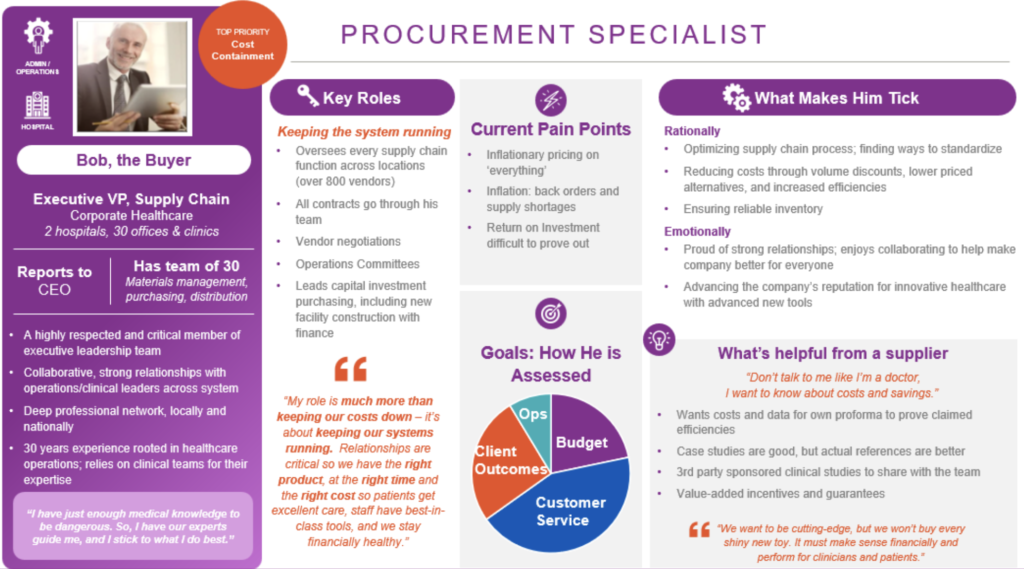
Consumer Personas are a great tool for bringing your consumer target to life for your organization, to inspire growth ideas, new brand experiences and product innovation. It is a representation of your target segment based on a combination of quantitative and qualitative data. It summarizes your consumers’ lifestyle, values, needs, challenges, and preferences, so that it can be easily shared and digested across the organization.
At a high level, here is SIVO’s guide on how to build consumer personas:
Building your Consumer Personas
Key information that should be considered when building consumer personas includes:
Check out these other SIVO blogs on consumer targets and consumer segmentation, to better understand the inputs and context for consumer personas.
Making Consumer Personas Interesting
The goal is to bring the consumer to life in an interesting and inspirational way. This information needs to be interesting and easy to read so that it gets internalized by the organization. Here are a few tips:
Keep it Brief: A good persona should be 1 to 3 pages in length. Ideally, there would be a 1-page summary and if needed, 1 to 2 follow-up pages with actionable details and insights.
Use Visuals: A persona should be visually interesting. Use photos, graphics, or infographics to bring the consumer persona to life and make them feel more tangible and relatable to your team.
Use Narratives and Quotes: Storytelling is an important part of building your persona. Use the data to create a short 1-paragraph narrative that describes the consumer persona – who they are, what they need, and their underlying motivations.
Include a Key Consumer Insight: It is important to include a one-sentence insight that describes the underlying motivation that would make them potentially interested in buying your product or service.
With the data summarized and visualized into clear and succinct personas, it is easy to understand and empathize with your consumer target, i.e., the segment of consumers that will inspire your growth ideas, marketing communications, promotions, distribution plans and new product innovation. Your team can now tailor brand messaging, content, and product offerings to align with the needs and preferences of key consumer targets. It is also easy to socialize the learning across the organization and agency partners in an efficient and effective way.
Maintaining Relevance of Consumer Personas
Consumer personas are foundational marketing and insights deliverables that will inspire your teams’ growth ideas and guide your agency partners for years. For this reason, you need to invest in ongoing maintenance to ensure continued relevance to your organization. Depending on the volatility and competitive dynamics within your market, you will want to:
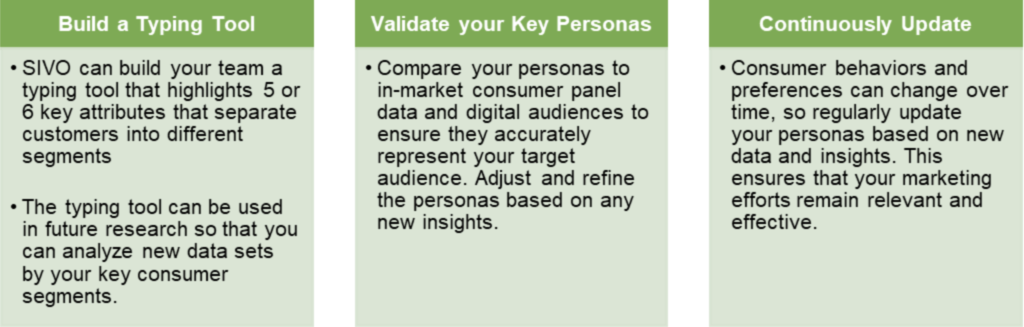
The success of your consumer persona profiles depends on the quality of your research, the depth of your understanding and getting it to land within your organization and with agency partners. Regularly leveraging the personas while also iterating and improving upon them will help you stay in tune with your consumers and maintain a competitive advantage in the market.
Your Source for Expert Customer Insights
At SIVO Inc., we are dedicated to helping our clients understand their consumer targets by designing and executing consumer segmentations, following up with qualitative research and building consumer personas. We can then facilitate activation sessions with your team to develop action plans and strategies that leverage these insights.
Reach out to us at Contact@SIVOInsights.com or go to SIVOInsights.com today to schedule a discovery call and connect!
By Kerry Juhl
Brand positioning is a critical component of a successful marketing strategy. It defines how a brand is perceived in the minds of its consumer target, differentiating it from key competitors. A well-crafted positioning statement serves as the foundation for all marketing efforts and ensures consistent messaging across all channels.
The SIVO team has spent many years helping brand teams develop and evaluate brand positionings across a variety of industries. While every positioning project is somewhat unique, we have supported our clients with proven frameworks and research approaches, leading to the development of successful brand positionings.
The Positioning Statement
A positioning statement is a concise description of how a brand wants to “show up” in the world, highlighting the primary (and ideally, unique) benefit it provides, along with the rationale for how it can deliver the benefit. The statement typically includes the following format and elements:
For (consumer target), Brand is the only product type that provides (key benefit), because Brand has (feature/reason to believe), (feature/reason to believe) and (feature/reason to believe).
For example, Volvo’s positioning statement looks something like this:
For safety-conscious families, Volvo premium automobiles offer the safest cars on the road because they have advanced safety features, industry-leading crash test ratings, and innovative safety technologies.
The Brand Benefit Ladder
At the heart of developing a strong brand positioning is a solid understanding of the Brand Benefit Ladder, a strategic tool used early in the positioning development process. It helps brand teams articulate the value proposition by identifying benefits at four levels:
1) What it is
2) What it does
3) How it makes you feel
4) How it can transform your life
This framework ensures a clear articulation of the brand’s offerings and the emotional and transformational benefits they provide. Depending on the brand’s maturity and the competitive landscape, positioning can be based on functional benefits (what it is/what it does) or a more emotional/transformational benefits (how it makes me you feel/changes your life).
Positioning Types
There are a variety of positioning types that fit across the Brand Benefit Ladder:
Product Features:
Attribute-Based Positioning centers on specific features that distinguish the product.
Example: For homeowners, Dyson vacuum cleaners are superior carpet cleaners because they offer superior suction, advanced filtration, and allergen removal.
Value-Based Positioning is linked specifically to the price value of the product.
Example: For price-sensitive shoppers, Walmart offers everyday low prices by leveraging its extensive supply chain and scale to provide unbeatable savings on a vast assortment of goods, ensuring customers can save money and live better.
Functional Benefits:
Benefit-based Positioning highlights the key functional benefits or solutions provided by the product.
Example: For fitness enthusiasts struggling to exercise regularly, Peloton is the exercise bike that keeps you motivated to exercise because it delivers an immersive and interactive experience, world-class instructors, and a supportive fitness community.
Problem-Solution Positioning focuses on the problems that the product solves for customers.
Example: For individuals suffering from dandruff, Head & Shoulders provides effective and long-lasting relief from dandruff flakes and itchiness because it has a clinically proven formula that eliminates dandruff, nourishes, and protects the scalp.
Emotional Benefits:
Lifestyle Positioning aligns the product with a particular emotion or feeling.
Example: For athletes and active individuals, Nike enhances athletic performance and empowers athletes to reach their full potential through its innovative, cutting-edge sportswear products.
Cultural Symbolism Positioning uses cultural symbols and references to position the brand within a cultural context.
Example: For motorcycle enthusiasts seeking an authentic and exhilarating riding experience, Harley-Davidson is the iconic motorcycle brand that delivers powerful, custom-made bikes with a rich American heritage and embodying the spirit of freedom, rebellion and individuality.
Purpose-Driven Benefits:
Innovation-led Positioning sets the brand up as a leader in innovation and cutting-edge technology.
Example: For environmentally conscious consumers and tech enthusiasts, Tesla is the leading electric vehicle and clean energy company that offers a sustainable environmental solution via their innovative high-performance electric cars and cutting-edge technology.
Purpose-led Positioning centers on what the brand is doing for the world rather than the product itself.
Example: For socially conscious consumers, TOMS is the footwear brand that provides stylish and comfortable shoes while also making a positive impact on communities around the world though its One-for-One model, where each purchase directly contributes to improving lives in underdeveloped countries.
Purpose-Driven Benefits:
Innovation-led Positioning sets the brand up as a leader in innovation and cutting-edge technology.
Example: For environmentally conscious consumers and tech enthusiasts, Tesla is the leading electric vehicle and clean energy company that offers a sustainable environmental solution via their innovative high-performance electric cars and cutting-edge technology.
Purpose-led Positioning centers on what the brand is doing for the world rather than the product itself.
Example: For socially conscious consumers, TOMS is the footwear brand that provides stylish and comfortable shoes while also making a positive impact on communities around the world though its One-for-One model, where each purchase directly contributes to improving lives in underdeveloped countries.
Regardless of the type of positioning and where it fits on the benefit ladder, all positioning statements need to be clear, credible, and differentiated from the competition. It can then be used to inspire marketing executions across channels, to create consistent communications and connections to the consumer target.
Researching Your Brand Positioning
Developing effective brand positioning requires rigorous research, with the ideal approach being a combination of qualitative and quantitative research.
1. Qualitative Exploration: This phase uses one-on-one in-depth interviews with current and potential consumers to explore brand perceptions and refine positioning language. It helps the client team explore and understand the nuanced emotional and rational drivers behind brand choice and allows the team to modify and improve the positioning statements in real-time, based on consumer input.
2. Quantitative Survey: Once the positioning statements are refined, quantitative research helps identify the most motivating positioning from a handful of alternatives. Surveys and real-world experiments (e.g., testing via digital ads) can be used to test different positioning statements among a larger sample, assessing the impact on brand perception and purchase interest.
By using a combination of qualitative exploration and quantitative validation, brand teams can ensure their positioning is not only compelling but also grounded in consumer reality.
Your Source for Expert Consumer Insights
At SIVO, Inc., we are dedicated to helping our clients develop brand positionings that are clear, unique, credible, and most importantly, relevant to your consumer target. We are trusted advisors in supporting your positioning development and will design custom learning plans that generate the insights needed to carve out a unique space in the market and connect with your consumers. This holistic approach will set the foundation for enduring brand success.
Contact us via our website form or email us at Contact@SIVOInsights.com today to schedule a discovery call!
by Cindy Blackstock
At SIVO, our team of insights experts have honed their skills over many years of market research and the lessons gained along the way now prove to be invaluable. We have learned that insights are just useless facts unless they can be applied to the business in a way that drives action among our client teams and growth on their businesses. So, in the spirit of sharing useful content and a bit of our “secret sauce” with our valued clients and partners, here are 5 Keys for Turning Consumer Insights into Action.

Start with the End in Mind
As market researchers in search of consumer insights, the SIVO team must understand how the results will possibly be used, what actions will be taken by our clients and how our clients intend to influence and have impact in their organization using our research. When we are equipped with the business objective and the actions that might stem from the results, we become clear on the research objectives and design. We all know that best consumer insights experts can envision how the research results need to come to life before starting the research. When we do this, we avoid two big pitfalls in research – first, the fatal one, missing a key question and second, the sloppy one, asking questions that don’t need to be answered or are already known.

Conduct a “Get Smart” Session
By facilitating a “Get Smart” Session with the client team, SIVO can mine existing information and surface institutional knowledge. There are 3 key reasons for the session:

Plan for Quality Input to Get Quality Output
It has been said that the quality of the output is only as good as the quality of the input. This is very true when designing market research. SIVO experts start with detailed learning plans to outline how the business objectives translate to the learning objectives and market research approach. This is where we align with the client team by defining things like sample composition and size, key measures, and of course, the action standards. Action standards outline the “if/then” scenarios for research outcomes and the follow-up actions. For example, if the results indicate X, then the action to be taken is Y. Documenting the action standards, before the research is executed, forces both the SIVO and client teams to think through the possible actions for each hypothesized outcome.

Report the Key Findings (and, all the rest too!)
Some client teams want an at-a-glance Executive Summary of results that they can quickly act upon, and others want all the details for a more thorough understanding before taking action. SIVO provides both, either in one report or in two separate deliverables. We must be clear on the delivery of the topline summary versus the full report with the detailed findings (supporting data, quotes, video clips, images, etc.) for future reference.

Make Clear Recommendations
It’s critical to turn data into insights and insights into actions. Too often professionals in the insights industry are hesitant to make bold recommendations on potential actions to take. However, client teams are looking for more than data and insights. They need courageous recommendations that inform their decisions. To drive action, SIVO puts a stake in the ground! It is, however, important to point out that recommendations are an educated opinion or point-of-view, based on the insights and findings of the research. Clients will then use research recommendations, in conjunction with other external factors, to guide or inform their actions and decisions. The best way to be confident about the recommendations is to circle back to Step 1! Start with the end in mind!
Contact the SIVO team at Contact@SIVOInsights.com or reach out to me directly at Cindy.Blackstock@SIVOInsights.com to help you uncover insights that inform your future decisions and actions!
We can all probably agree that we are living through one of the most disruptive events of our generation. With our worlds turned upside down, it comes as no surprise that the way people work in America has also vastly changed.
Just as news stories cropped up about 2021 being the year of the Great Resignation, other stories followed asking the question ‘where have all the workers gone?’ I’ve pondered this question as well, seeing the ‘short staffed’ signs everywhere I go and hearing from countless businesses about their struggle to retain talent.
The answer to what is causing the Great Resignation might lie in the reframing of the phenomenon. A smart colleague of mine, Vina Klein, astutely calls it the “Great Values Reset.” I really like that. It gives more insight to what is happening. People seem more attuned to their values when choosing how to live and how to work. At the start of the pandemic, we were sent home and we slowed down, we took stock, and we re-evaluated our lives. That experience impacted our choices in 2021 and beyond.
Trending
Do customers want to ‘hire’ your product?

Now enter the gig economy. The gig economy has always been around, but something interesting happened as a result of Covid-19. Gig workers represented around 35 percent of the U.S. workforce in 2020, up from between 14 and 20 percent in 2014. The number of companies that fully operate on gig work has increased by 85% since 2014. That growth has only accelerated as a result of Covid-19. As workers reset values and put more focus on having some control over their lives, employees are leaving the confines of a 9-5 and corporate bureaucracy. The gig economy is where they land, and SIVO Insights has the perfect launchpad for these workers.
I’m very fortunate to lead SIVO Insights On-Demand Talent. I’m passionate about helping my consumer insights consultants find fulfilling roles that match their skills and talent. I’m also very much “in the zone” when I’m able to help our clients fill a specific need on their team or find the right talent for a project. Matching our clients’ needs with SIVO’s On-Demand Talent experience and skills is the best part of my job.
SIVO Insights On-Demand Talent allows people to choose how they want to work. It provides the flexibility and work-life balance that comes with the gig economy. For companies, On Demand Talent delivers flexibility, too. Whether an organization is struggling to find and retain talent or is not in a position to commit to a full-time hire, tapping into SIVO On Demand Talent is a win-win!
SIVO Insights brings together research, talent, and intelligent technology to help organizations navigate complexity with confidence. Have a business challenge? Let's talk!
We bring together research, talent, and intelligent technology to help organizations navigate complexity with confidence