
By Julie Rose
As your fiscal year is coming to a close, new questions and challenges can arise as you finalize spending on this year’s budget:
SIVO Insights On Demand Talent™ Can Help
SIVO’s On Demand Talent is a great solution for Insights Professionals and Teams facing the year-end crunch – with more initiatives than bandwidth to get it all done. We leverage our extensive pool of fractional Insights Talent, with years of experience and expertise, to help you achieve your business objectives.
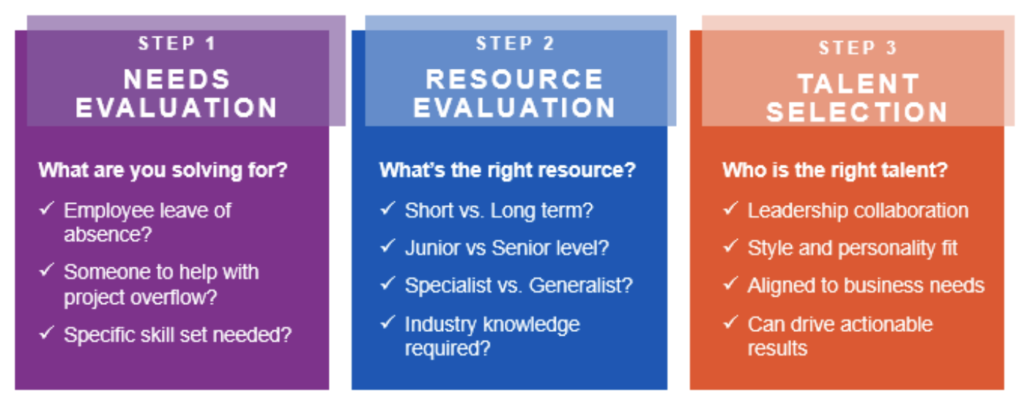
We recommend three key steps for evaluating and making the case internally for hiring contract Insights talent.
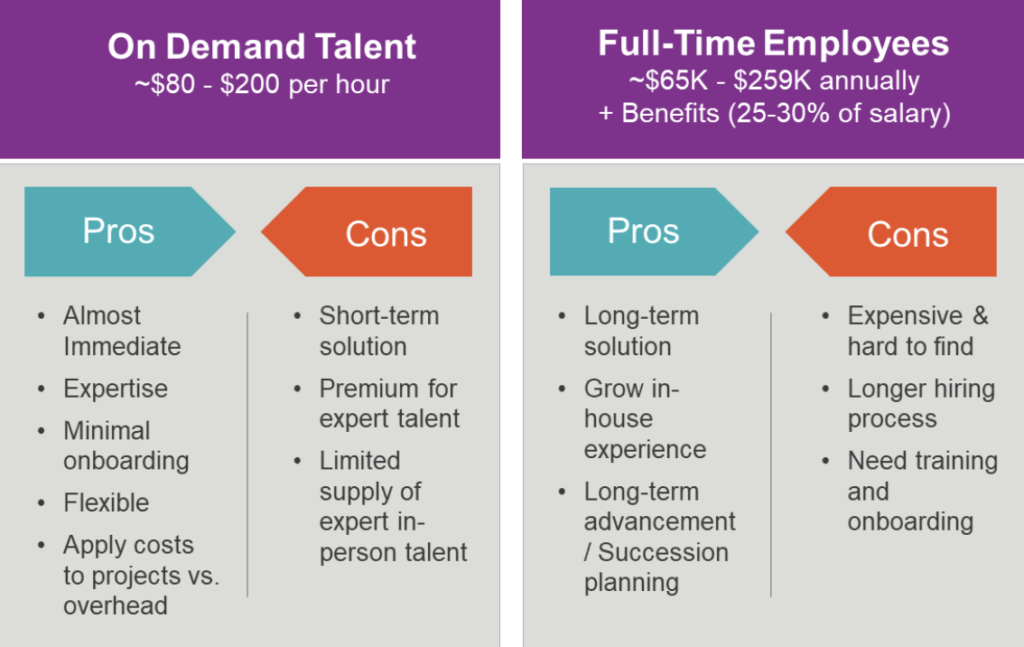
As workforce talent continues to evolve, there is no shortage of options, including interns, short or long-term contractors, contract-to-hire, or direct hire. Below, we highlight the advantages of On Demand Contract Talent vs. a Full-Time Hire:
Prove the Need for Incremental Resources
Some of our clients have struggled to make the case to their leaders for permanent incremental headcount. Instead, they started with SIVO’s On Demand Talent to show value to the business. This step helped them demonstrate the benefit of having additional resources. Let SIVO help you get the additional headcount you need in 2024.
Get Expert Consumer Insights with SIVO
We have started ODT engagements in as fast as one week. To discuss your needs and how we can match the talent with the best expertise for quick solutions in your organization, visit SIVO On Demand Talent or email Contact@SIVOInsights.com.
The great resignation took a major toll on businesses across industries in the last few years. Businesses that prided themselves in workplace culture, flexibility, and benefits saw long-time employees step down from their roles. At the same time, more and more companies face transformative restructuring, like acquisitions and mergers. Following such major changes in the world at large and within organizations, the opinions and beliefs held by workers changed tremendously, and even the most forward-thinking businesses have suffered the consequences.
With that, many businesses are looking for a path toward improving performance and commitment in the workplace. How can they avoid employee attrition in the future? How can they improve their processes to boost efficiency and support employees? How can they redirect leadership to provide the support those employees need? At the end of the day, organizational intelligence gets data-driven insights to answer all these questions, and much more.
First thing’s first, what is organizational behavior? Organizational behavior is how individuals interact and behave in groups. It’s especially relevant when looking at the workplace. Forward-thinking businesses take their organizational behavior seriously, because it greatly impacts employee satisfaction and engagement, leadership performance, and overall workplace efficiency and effectiveness. If organizations do not understand their employee behavior, perceptions and opinions, they miss out on insights that could holistically improve their business. The best way to get those opinions, and translate them into a strategic action plan is to leverage organizational intelligence solutions.
Who should gather organizational behavior data? Your team is full of subject matter experts on your business and your industry, but when it comes to gathering information on organizational behavior, they may not be the right facilitators. Internal teams will have natural bias and may have subconscious results in mind, and could therefore not ask appropriate, unbiased questions. Plus, when it comes to listening to your employees, you want to get thoughts from a wide range of team members. That means allocating the task to an outside expert, to increase cooperation by maintaining employee confidentiality. Ultimately, this gives every employee the opportunity to provide their opinions, maintaining employee anonymity while removing all potential bias from the initiative.

So, what are the keys to improving performance and commitment in the workplace? Understanding what motivates your team members is key to educating and empowering leadership to create a path toward a better future for your company. Get a breakdown on employee insights, leadership development, and strategic planning facilitation below:
What are the honest opinions of your employees when it comes to your business culture and processes? When leadership asks them directly, they will likely get a much different answer than an unbiased facilitator. However, there are many ways to gather this information from your team. An organizational intelligence expert can identify a custom learning plan based on your business, and implement solutions designed to get the most valuable feedback from employees. According to the Harvard Business Review,
“High-OQ (organizational intelligence) leaders foster an understanding, or ethos, of “who we are.” When leaders move from managing individuals or small groups to leading entire organizations, they need to create a shared understanding of what’s important and what the organization stands for — in other words, an ethos.”
What kind of exercises result in the best employee insights? This varies depending on the organization, but typically it comes down to both qualitative and quantitative research. Some examples of qualitative research include one-on-one interviews, small group employee discussions, and stakeholder interviews. Meanwhile quantitative research looks more like customized online employee engagement surveys targeted to specific employee teams, departments, functions, and regions. Often, employee engagement surveys are administered with regular frequency, e.g., annually or bi-annually, to measure positive or negative changes in employee satisfaction and engagement over time.
Your industry is constantly changing, your business is growing, and workplace expectations are ever-evolving. Is your leadership adapting to accommodate? Modern businesses must create an expectation for agility in leadership to keep employees engaged and motivated. That means regular leadership training, coaching, and development. Organizational intelligence experts can handle the task and provide tailored, relevant coaching that meets the needs of your leaders. It begins with one-on-one introductory sessions, a 360 degree leadership assessment and follow-up analysis, development planning and coaching sessions with leaders at all levels of the organization - executives, high-potential leaders, and new managers. This results in more effective leadership and impactful business management that can exceed the expectations of their teams.
What solutions are involved in leadership development? First, there is leader coaching and education, which can include leadership assessments, feedback, and career planning directly with leaders. This can take place individually or in group/cohort sessions. There is also team effectiveness training, which helps teams define their purpose, processes, roles and responsibilities, as well as individual contributions. This is especially important for businesses facing restructuring, where new teams are being formed and leadership responsibilities are changing.

You have so many initiatives in the works – strategic planning can feel like one of those tasks that could easily get pushed down the line. However, strategic planning is the high-level exercise that impacts every other element of your organization. Outsourcing guarantees timely and effective execution, especially when you pick the right partner for the job. Market research firms like SIVO offer comprehensive workshops to ensure your team develops a sound strategic plan that will successfully lead the company into the future.
These facilitated workshops are especially beneficial to newer businesses or businesses facing large changes, like acquisitions, mergers or a challenging external environment. Knowing how to bring teams together, leveraging critical and inspirational inputs is no small task. That’s why it’s beneficial to have experienced strategic planning facilitators on your side, to plan and facilitate the workshop so that you leave the session with a clearly defined vision, mission, values, plans and ownership assignments. Sessions may also focus on other topics, such as communications planning, insight activation sessions, special-interest group planning, and even competitive SWOT analysis. Regardless of the focus, each strategic planning session will help leaders develop and align on clear strategies for the future, to drive business success.
No matter the business, every employee wants to be heard. Creating a place for employees to provide their thoughts can only benefit your business. From an employee perspective, these people-focused exercises prove that leadership cares about their opinions and wants to make steps to improve their workplace experience. The same goes for dedicated strategic planning exercises and leadership development. These initiatives create a stronger, people-first organization positioned to succeed. When leaders are effective, employees are motivated, and business strategy is in place, it all adds up to improved performance and commitment in the workplace – and more success in the market.
Organizational intelligence services result in game-changing insights that can transform your business for the better – and position you for even more growth down the line. Your team members have the deep knowledge about the company and industry, and often, their perspectives can unlock opportunities that leadership would have never otherwise considered. Once those insights are relayed to leaders with actionable recommendations, you can accomplish so much more within your organization.
Are you ready to gain insights on your organizational behavior? Get information on every aspect of your organizational behavior with SIVO. Our team of organizational intelligence experts can help you lead your team through any major transition. We work with organizations across industries, and build custom insight solutions that holistically improve performance and commitment in the workplace.
Contact SIVO today to discuss your business needs and get support.
By Julie Rose
In today’s blog, we take a break from our standard format and have a little fun imagining a utopian future for market research. Jump with us to 2029, will you? We think you’ll like it!
We’ve jumped in the time machine and 2029 is a new era for market research. Picture this: AI has taken the mundane, repetitive tasks off our hands, freeing insight professionals to focus on creatively connecting insights, telling compelling stories, formulating strategies, and influencing business decisions. Gone are the days of designing surveys from scratch, laboriously cleaning data, and spending weeks on synthesis. The research role has evolved into something greater—part strategist, part AI conductor, and part visionary. Welcome to the golden age of insights.
Synthetic Personas: A New Era of Consumer Insight
In 2029, traditional surveys are feeling as outdated as fax machines. AI-driven synthetic personas have completely changed the game. These AI-generated personas are lifelike, modeled using real consumer data and machine learning, simulating consumer behaviors, preferences, and even emotions with remarkable accuracy. They behave, react, and even feel like real people—without requiring self-reported data or human subjects.
The scalability is mind-blowing. Imagine running thousands of personalized conversations and “what-if” scenarios simultaneously, testing hypotheses, and gathering nuanced feedback in real time.
Additionally, the days of complicated recruitment challenges are gone. Synthetic personas have made it possible to engage with hard-to-reach populations and conduct large-scale research without any privacy concerns.
Multimodal Inputs & Emotional AI: Understanding Consumers on a Deeper Level
Remember when we relied on surveys, focus groups, and social scraping to understand consumer sentiment? By 2029, those methods feel like relics from a distant past. Today, AI uses multimodal inputs like text, video, voice, and even biometric data to give us an authentic view of consumer attitudes, beliefs, and emotions.
For example, emotional recognition tools track subtle cues like facial expressions, vocal tones, and physiological responses in real time. When testing a product or promotional materials, AI can measure a consumer's heart rate and stress levels, bridging the gap between what people say and what they truly feel. This deeper understanding enables brands to craft emotionally resonant products, services, and communications that genuinely connect with their audiences.
Synthetic Data: Privacy-Proof and Scalable Insights
Data privacy concerns used to be a major issue in research, but not anymore. By 2029, synthetic data—artificially generated datasets that mimic real-world data—has become a staple in marketing research. This allows us to test hypotheses, simulate consumer behaviors, and run detailed "what-if" scenarios on a large scale, all without compromising privacy as the analyses do not access any personal (human) data.
Unlike the randomly generated or hallucinated data that was an issue in the past, synthetic data is now created using sophisticated machine learning algorithms that extrapolate patterns from real data to generate highly accurate, privacy-safe datasets. This isn’t new—researchers have always synthesized data—but AI now makes it faster, more accurate, and scalable. As more data is collected and validated, synthetic data models in 2029 are more precise, enabling deeper insights while respecting privacy regulations.
Agent-to-Agent Collaboration: Adapted Research Management
Perhaps the most revolutionary change in 2029 is how AI helps market research teams manage entire research projects. The team has built and now manages digital agents—AI programs designed to mimic human decision-making—to handle the repetitive aspects of a research project. The team sets business and research objectives and high-level questions. From there, digital agents collaborate with one another to execute tasks, analyze data, and refine insights. These agents work tirelessly in the background, leaving the team free to focus on more creative and strategic aspects, like storytelling, providing actionable recommendations linked to the business context, and building client relationships.
This isn’t about replacing humans; it’s about empowering them. By automating the basic operational tasks, AI gives us more time to dream big and think creatively.
Driving Action & Outcomes: AI-Enhanced Storytelling
In 2029, AI is an essential partner in crafting compelling narratives from raw data. Gone are the days of manually structuring reports or laboring over visualizations. Today, AI systems instantly outline story arcs, recommend the best supporting data, and generate tailored presentations depending on the audience. With the guiding hand of Content Strategists, AI delivers high-level insights to C-Suite audiences and produces more detailed reports for technical teams.
The most exciting development? AI-powered immersive presentations. Using augmented and virtual reality, Research Strategists (with the support of Content Strategists) guide stakeholders through dynamic, interactive experiences, allowing them to explore insights in a hands-on way. This revolutionizes the presentation experience, making it more engaging and impactful than the static reports of the past. The result? Stakeholders leave every presentation engaged, informed, and ready to act.
Humane AI: A Future of Ethical, Mindful Collaboration
Back in 2024, many feared AI—worried about bias, transparency, and job security. But by 2029, those concerns have faded. Rigorous regulations ensure that AI systems are ethical, transparent, and fair. Continuous audits minimize bias and guarantee that AI tools uphold the highest standards of integrity.
Rather than replacing us, AI complements our skills. Researchers who embraced AI early on have found themselves thriving. Together, humans and AI form a powerful partnership, pushing the boundaries of what market research can achieve.
The Researcher’s Elevated Role: Creative, Strategic Visionaries
In 2029, our favorite part of being a researcher is the freedom to focus on what we love most: strategy, insights, and relationship-building. AI handles tedious, repetitive tasks, giving us the space to drive business impact in ways we never thought possible.
The role of the researcher has evolved. We’re no longer data processors or survey designers—we’re storytellers, strategists, and visionaries. AI enhances our work, allowing us to uncover insights faster, more accurately, and with greater depth than ever before.
Are You Ready for the Future?
The future of market research isn’t coming - it’s already here and getting better every day. At SIVO, we’re embracing this transformation with open arms, empowering our team and clients to thrive in this exciting new era. Together, we can unlock the full potential of AI and create a better, brighter future for our industry.
Are you ready to join us on this journey? Let’s build the future together. Contact us at Contact@SIVOInsights.com or visit SIVOInsights.com to schedule a discovery today.
SIVO Interview with Mary McIlrath, Children and Family Market Research Expert
By Kerry Juhl
Recently, SIVO, Inc. was lucky enough to have Mary McIlrath join our expanding team. Mary has amassed a wealth of experience in Children and Family market research. She is a recognized expert in the generations space, having established a successful Generation Z and Generation Alpha research practice in her past role. She has taught MBA courses in Qualitative Research at the University of Wisconsin and Quantitative Research at the University of Illinois and lectured at Northwestern University.
I recently sat down with Mary to discuss her experience with studying families and generational differences.
Question: Mary, you have been studying families and generational differences for most of your career. How did you become a subject matter expert on this topic?
Mary: I have always been fascinated by understanding generational differences and family dynamics. I come from both industry and academic perspectives—it’s common for former academics to work in industry, but it’s rare birds like me who keep a foot in both disciplines over a career. I’ve been able to harvest the best of both worlds. For example, my academic experience instilled a mindset that respondents should benefit as much or more than the researcher. This is particularly important when working with children and adolescents. Their needs come first; when they are met, the client also benefits. Industry experience has helped me be effective and efficient in conducting research. My dual expertise gives me a deep toolbox of constructs and methods to help my clients achieve their business objectives, with the well-being of the family at center stage.
Question: Mary, what does a typical U.S. family look like today?
Mary: It’s something in continuous flux. Sometimes it’s single-parent households. Sometimes it’s families with two dads. Sometimes it’s blended homes containing multiple generations. What has gradually become less common is the Norman Rockwellian image of two opposite-gender people raising a gaggle of kids with traditional gender roles. For instance, in 1968, 85% of children under 18 yrs. old lived with two parents (regardless of marital status) but that number has dropped to 70% in 2020. About 25% of children live with a single parent in the household.*
Question: How are manufacturers and marketers responding to the needs of today’s children and families?
Mary: It’s a sea change from how brands thought about families in the early days of youth research in the 1980s and 1990s. Those who used to make simple toys, TV shows, or food and beverages for kids are now thinking of how to stay relevant with their offerings and communication in the Metaverse. They are thinking about what is to come in Augmented Reality (AR) since Pokemon Go flipped the script. They are brainstorming what Virtual Reality (VR) will look like. That’s no small task, especially since children’s sense of balance and depth are still developing and putting them outside 3D spaces risks hampering their natural brain development.
Question: What is the latest regulatory environment for marketing and advertising to youth and families?
Mary: If you work on kid brands, it is critical to understand global ethics around marketing and advertising to children and families. Countries around the world have differing laws about when it is acceptable to advertise to young people. Those in the U.S. are the least restrictive because of industry self-established watchdogs like CARU (Children’s Advertising Review Unit). This organization does regular and thorough audits of marketing campaigns to children and calls out/suggests changes to anything that seems unfair.
Question: How does this impact conducting market research with kids and families?
Mary: In the U.S. it’s allowable to do research directly with children with a parent’s consent. It’s “cleaner” data coming straight from children rather than filtered through parents who mistakenly think they know what their kids truly want.
Question: What are a few of your best practices for conducting market research with kids and families?
Mary: Here are a few tips from my experience:
SIVO is excited for Mary to join our team and strengthen our Children and Family market research capabilities. To learn about how kids and families interact with and think about your brand, please reach out to us at Contact@SIVOInsights.com.
*source: 2020 Census Bureau's Current Population Survey
As you close out this fiscal year and reflect on all that you know and have learned about your business and customer, we at SIVO have one question for you:
Do you understand what drives customer value for your brand and category?
Most teams have pieces of the answer: past studies, segmentations, trackers, performance data. But when it’s time to make real trade‑offs, what to improve, what to protect, and where to put that “$1 more or $1 less”, the picture often blurs.
That’s risky in a market where expectations and definitions of “value” are shifting faster than annual plans. Luckly, we are just heading into Q4 and there is still plenty of time to identify the Value Drivers for your consumer, to set you up for success in the year ahead.
At SIVO, we look at consumer value across four interconnected dimensions:
Most marketers understand the functional benefits for their brand. Far fewer have a clear, evidence‑based view of the emotional, life‑changing and social impact dimensions that increasingly drive choice, loyalty, and willingness to pay — and even fewer can say which specific value drivers matter most for their target consumer in their category today.
As planning ramps up, teams are asking:
Answering those questions requires more than a benefit list. You need a prioritized list of the Customer Value Drivers, that can guide your decisions.
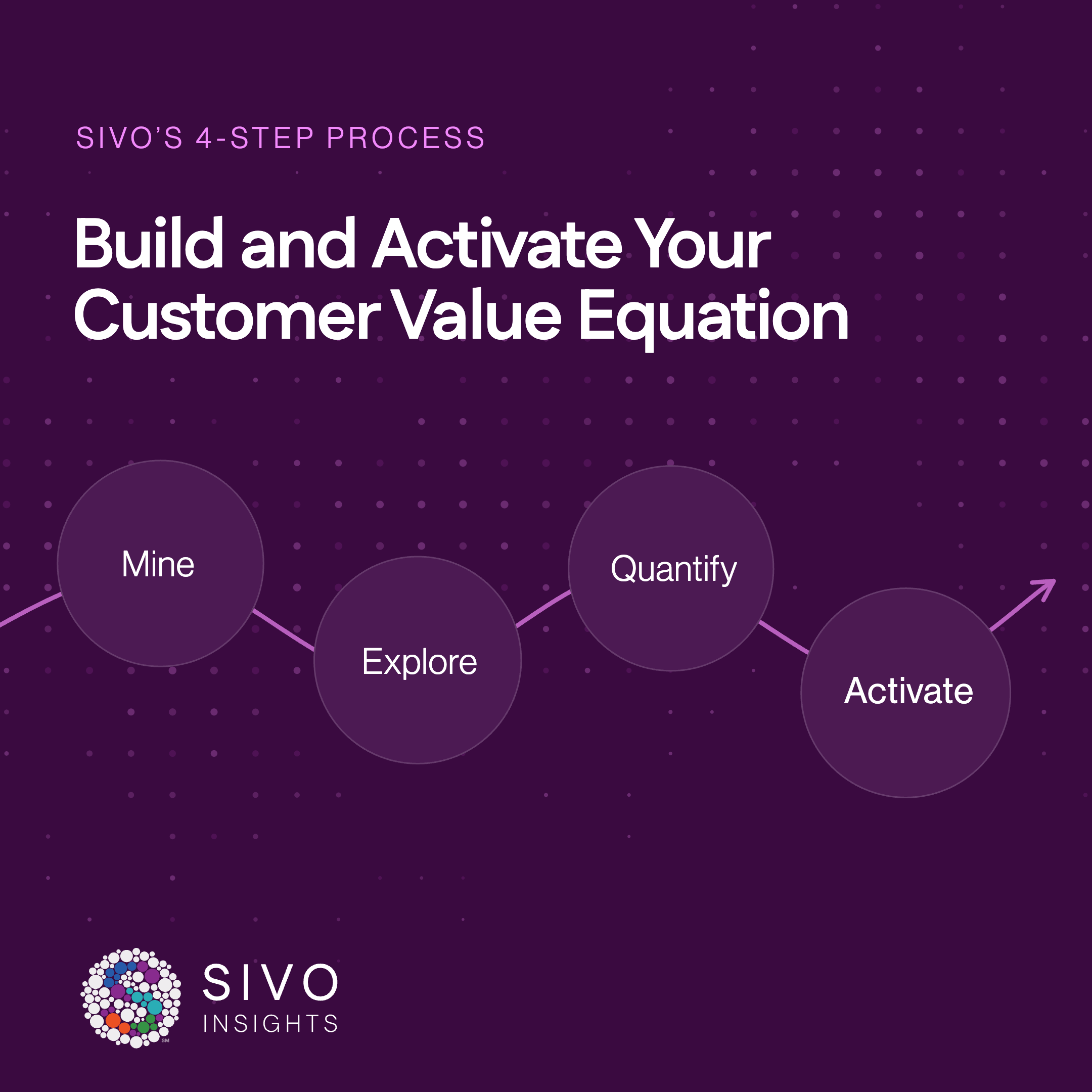
SIVO uses a four‑step process to turn “consumer value” from an abstract concept into a practical decision tool:
Each step builds on what you already know and ends with clear direction for your teams.
We begin by mining and summarizing your organization’s existing information, not starting from scratch. We synthesize:
This clarifies what you already understand customer value drivers and where the gaps, contradictions, and blind spots are. The output is a summarized view of current understanding and a focused learning agenda.
Next, we Explore through qualitative, in‑depth interviews with your target consumers.
Our researchers:
This reveals the language consumers naturally use, the hidden tensions and trade‑offs they navigate, and what is truly non‑negotiable versus what simply delights or disappoints.
We then Quantify what we’ve heard, turning rich stories into a set of “potential value drivers” among category customers. We execute a quantitative survey to size and rank the importance of all potential value drivers within a category AND how well your brand and competitive brands perform on each driver.
The result is an evidence‑based view of which Value Drivers are critical to your brand vs your key competitors, and which are less important or not essential. You will see which value drivers are:
This becomes a shared “north star” and common language for how your brand creates or maintains value for your customers.

Finally, we activate through a facilitated workshop led by SIVO’s expert team.
We bring together cross‑functional stakeholders, typically insights, marketing, R&D, sales, and key agency partners, to:
This process gives you a unifying understanding of your target customers’ purchase drivers, must‑haves, and nice‑to‑haves — and a sharp view of how you stack up versus alternatives.
Most importantly, it gives your teams confidence and clarity: where to invest, where to hold, and where to trim, across innovation, marketing, and customer experience.
As you wrap this fiscal year and shape the next, let SIVO help you understand what your customers truly value so your team is ready to deliver it better than anyone else!
SIVO Insights brings together research, talent, and intelligent technology to help organizations navigate complexity with confidence. Have a business challenge? Let's talk!
We bring together research, talent, and intelligent technology to help organizations navigate complexity with confidence