
Context. Clarity. Conviction. Consider these your driving factors for presenting Insights that shape strategic business decisions. Eliana Wahnon (General Mills, VP of Consumer & Market Insights) recently joined The SIVO Insights Forum to share her expertise.
Let’s dive deeper into the framework Eliana uses:
https://youtu.be/Yv8JdvFvILY
Tune into a lively on-demand conversation “Bridging The Gap: Translating Insights Into Meaningful Business Results" to hear from Eliana and other Insights experts including Khary Campbell (Comcast, VP of Consumer Research & Insights) and Elizabeth Oates (Book Author, and former Ulta Beauty VP of Consumer Insights.)
Learn from Insights leaders as they discuss:
Special shout out to Natasha Weith, VP of Research at SIVO Inc. for hosting The SIVO Insights Forum!
To Make Your Workload Manageable
By Marilyn Weiss
In these inflationary times, companies are cutting operational costs, including their workforce budgets. In 2022, there were at least 154,000 layoffs from more than 1,000 tech companies and so far in 2023, the trend continues with 55,000 layoffs to date. (USAToday.com & Layoffs.fyi, Jan. 2023)
Not only is this devastating for employees that have been laid off, but it is also difficult for those who remain. Post layoffs, organizations become leaner and the scope of work for each employee gets stretched wider. Employees are asked to stabilize the organization and drive future growth with fewer resources.
On the bright side, this increase in individual scope of work can create opportunities to gain new experiences and demonstrate leadership. However, the broader scope can also leave employees feeling overworked, stressed, and unable to manage the expanded workload. When it feels like there is just too much work and not enough hours in the day to get it done, the best way to manage through it, is to adopt a “Fractional Mindset.”
What is a Fractional Mindset?
A fractional mindset is a new way of thinking. It’s breaking down a system into smaller fractional pieces. When you are faced with a problem, adopting a fractional mindset makes the problem smaller. A fractional mindset, when applied to your assigned workload, allows you to approach your role and responsibilities by dividing them up into smaller, fractional tasks. This gives you freedom to take a step back to strategize and prioritize the best way to complete them.
Prioritize the Workload
The first step requires some analysis. You will need to prioritize your list of tasks and/or objectives based on what will add the most value or make the most positive impact on the business. A best practice is to sort the completed list by those items that make the most positive impact on the business or drive business growth.
Delegate the Workload
The next step requires some self-reflection. You will need to consider which tasks/objectives YOU should personally complete and which ones are best to delegate to ANOTHER to complete for you. Ask yourself some questions to determine if YOU or a delegated resource under your direction is best:
If the answer to these questions is, “No”, consider the possibility of others doing these tasks on your behalf, under your supervision. This allows you to manageably “stretch your bandwidth” across your workload, without becoming overwhelmed and stressed by trying to do it all yourself.
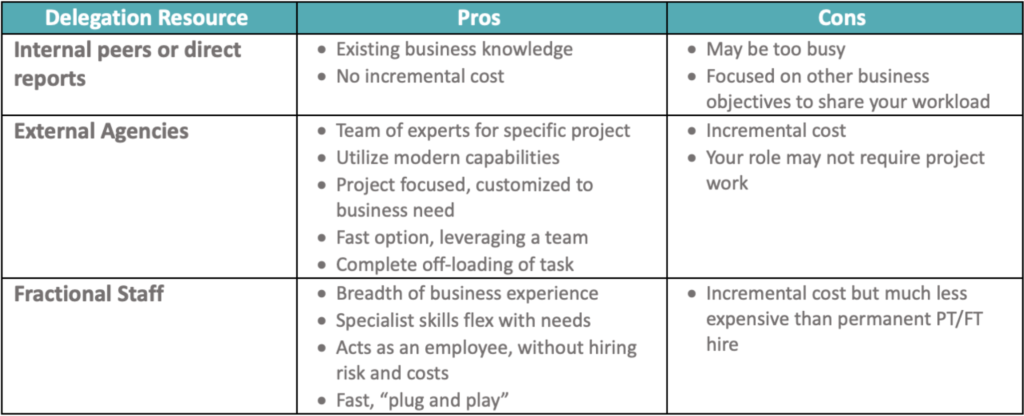
Delegation Resources to Consider:
The pros and cons of each resource are captured below:
When to Utilize your Resources
Internal peers or direct reports are a great option when the team has capacity to take on your assigned workload. If your teammates do not have capacity, delegating to your external agency partners to manage finite projects is a great option.
Sometimes, however, you just need to essentially “clone yourself” or bring in an expert with a skillset that differs from your own. In these instances, you can bring in fractional professionals that, with a little onboarding, can hit the ground running. Delegating to your fractional resources can help you work through your increased workload and objectives in a manageable way.

How SIVO can Help
For insights teams, SIVO offers full-service custom research design, management, and execution to help you with custom market research projects. SIVO On Demand Talent solution also has 100+ fractional Consumer Insights Professionals with a range of skillsets to help you meet your business objectives on your timeline, reducing your stress while allowing you to make a positive impact on your business.
Adopting a fractional mindset will help you approach your role and your workload with confidence, efficiency, and effectiveness. And when the time comes, let SIVO be the agency that you delegate to! Contact@SIVOInsights.com
If you're part of a consumer insights team, you already know what this time of year looks like. The upcoming start of annual planning season brings high expectations, overlapping requests, and limited capacity. You’re pulling together top trends, completing industry reviews, immersing stakeholders, and expected to deliver fast, sharp guidance that informs decisions across the business. There’s no shortage of urgency. But there is often a shortage of time, hands, and headspace.
In this post, we’ll focus on how teams like yours are preparing for the planning season pressure with smart, flexible insights support. From tips for handling the volume to examples of how fractional talent can plug in fast, this is a practical guide to getting through planning season without compromising on quality.
Planning season can be a moment of high visibility for insights teams. It’s when your work directly shapes decisions on budgets, brand priorities, innovation pipelines, and go-to-market plans. Expectations are high, and so is the payoff if done well.
This is also when the work becomes less linear, as you’re often not managing one big project, but you’re responding to competing needs from multiple teams, often simultaneously. You’re asked to shift from high-level trends to granular customer behavior, to turn data into strategy, and to do it all faster than ever. Internally, you may be running up against resource constraints, limited capacity for synthesis, or pressure to answer questions that haven’t been fully scoped. Stakeholders want insights, leaders want speed, and everyone wants you to predict the future so they can plan better for it.
This is the reality many insights leaders are preparing to navigate right now: how to maintain rigor under pressure, how to prioritize when everything is urgent, and how to protect the quality of insight that drives real decisions.
With overlapping asks and limited time, prioritization becomes a strategic skill. It’s not just about getting things done, but making sure the most valuable work gets done well. Below are a few practical ways we’ve seen insight teams stay focused and deliver effectively under pressure.
Start with internal alignment
Before saying yes to every request, align with key stakeholders on what’s truly critical to planning outcomes. What decisions need to be made in the next few weeks? What’s nice to have versus required? This helps filter the noise and focus resources where they matter most. If you’re a seasoned insights pro, this step probably comes naturally to you.
Map deliverables to decisions
For every request, clarify what decision it’s intended to inform. This helps the team determine how deep to go, what methods are appropriate, and whether existing insights already cover it.
Synthesize what’s already known
Planning often sparks redundant questions. A quick synthesis of past work, organized by theme, audience, or priority, can help prevent unnecessary rework and provide fast traction. Even a short “What We Know” session can help reset expectations and surface gaps more clearly.
Be transparent about trade-offs
Not everything can be done at the same depth, and it’s best to communicate that clearly. Stakeholders usually respond well when you explain what’s possible, what’s at risk, and where additional support would make a difference. This creates space for smarter resourcing decisions, and helps prevent extra stress and burnout among your team.
Build in a checkpoint before things scale
Use a mid-cycle checkpoint to review whether what’s being delivered is actually moving planning forward. If not, it’s better to adjust early than stretch your team to deliver work that won’t be used.
When insight teams hit capacity during planning season, the instinct is often to either say no, or simply push through. But overloading the team rarely leads to strategic work. It leads to shortcuts, slower turnarounds, and deliverables that lack the synthesis stakeholders expect – putting the strategic plans at risks.
Many teams are addressing this challenge by bringing in short-term support. But success depends on who you bring in and how they work. Traditional freelancers or overflow support often require onboarding, guidance, or extra training time. That adds to your workload instead of reducing it, and that’s not what you need when you’re already stretched thin.
What works better is adding insight professionals who understand planning cycles, know how to manage complexity, and can operate as part of your internal team. When done right, this model gives teams the room to focus on what matters most. It protects insight quality while meeting the volume and speed planning requires, and it also reduces pressure on the team, making it possible to stay sharp across multiple workstreams.
At SIVO, we work with companies across industries to extend insights teams during planning season. Our On Demand Talent includes seasoned researchers, strategic thinkers, moderators, planners, and communicators who can step into the specific functions you need. Whether that’s help managing an overflow of qual studies, needing someone to run stakeholder synthesis, or build strategic narratives that tie research to business planning – fractional insight experts are here to help.
You don’t need to compromise quality to meet a deadline, and you don’t need to burn out your team to deliver on planning season demands. Whether you need a sharp moderator for next week’s workstream, a strategic partner to help frame consumer implications, or someone to translate findings into clear planning outputs, we can match the right talent to your exact need.
Need Extra Capacity on Your Insights Team for Planning Season, Fast?
Let’s find your perfect match!
by Cindy Blackstock
Being part of a custom market research firm with global clients, we are often a go-to partner on international research—both qualitative and quantitative. And while all global market research has some challenges, global qualitative research has some unique ones.
From years of designing consumer research approaches, we’ve identified a list of questions we ask our clients to customize research for their needs. But whether you are researching with SIVO, another supplier, or leading research internally for your own organization; here are 5 watchouts when planning global, qualitative research. These apply for both in-person and virtual approaches.

Everything takes longer than domestic-only market research. Most global market research consists of multiple countries and languages. This requires added time to translate all materials such as recruitment screeners, discussion guides, and transcripts. For example, domestically you may receive a recruiting update every 1-2 days. But with the additional time needed to translate the recruiting progress, your updates may occur every 3 days with non-English speaking countries. And with transcripts needing translation time too, that delays the analysis and delivery of your final report.
SIVO Tip! When planning your research, build in extra time to account for translation needs on both the front and back ends of your research. This could easily add an additional 2-weeks to a simple qualitative design such as webcam focus groups.

Expect cultural differences in business norms. Corporate cultures differ around the world. When working with partners and consumers in other countries you need to expect, respect, and allow for cultural differences. One basic example of this is with interview start-times. As an example, our Thailand local moderator and consumers were consistently in-place and talking well before the official interview start time (making our client feel like they were late to observe the conversation); whereas in Brazil we had many consumers (and even a local moderator for one interview) who joined late.
SIVO tip! As a client who may be inviting other co-workers or organizational leaders to attend your research, prepare your team that some behaviors—from professionals and consumers—will be different. You can even remind your team these differences are likely one of the key reasons why you are conducting global research. Embrace it!

Know in advance if you want to adapt stimulus in real time. Particularly when researching marketing messages or communication, a client may learn from a few consumers and want to adapt the stimulus. This could be as simple as learning a word or phrase translated in your stim might be academically correct but needs to be modified to a more culturally relevant word – or it could be re-writing paragraphs of copy. In either example, you need a translator readily available to adjust the stimulus before the next interview.
SIVO Tip! Decide in advance if you will want or need to adjust your stimulus in real time. And if yes, identify the tactical steps and talent needed to achieve this.

Transcribe every word of the interview. Sometimes for efficiency (budget and time), a translator may only transcribe parts of the interview directly relevant to the brand, product and / or research objectives. But there is a lot of rich learning in the commentary! For example, consumer references to local politics can provide valuable context to their reactions to your product solution or marketing messages.
SIVO Tip! Confirm in advance that your translator understands your expectation that all words will be translated. And if efficiency is a concern, you can always limit the translation to only the ‘best’ interviews. This can condense your timeline and save costs.

Consider a collective discussion with all moderators and translators. If fielding research in multiple countries and/or markets to inform a global strategy (not a market specific plan); consider scheduling a collective debrief will all moderators and translators. This allows for discussion on what learning is consistent vs. the differentiated needs by country.
SIVO Tip! Such a discussion impacts your project timeline and costs and should be included as an expectation at the start of your project. A good research partner should be able to flex and add this to the close of your project but be aware of the implications to time and budget.
These 5 watchouts when planning global, qualitative research (in conjunction with a qualified and experienced Consumer Insights agency partner) will help ensure that you have a successful project resulting in global consumer insights to inform your business decisions.
To discuss these tips and any other questions about international or domestic consumer research, please feel free to contact the SIVO team at Contact@SIVOInsights.com for a consultation call.
Is your organization hungry for strategic intent?
We are living and working in an environment that is full of volatility and change. Many organizations are hungry for strategic intent, a term used to describe the intended direction, purpose, and plans that leaders put in place to achieve their organization’s vision.
SIVO Insights helps organizations set their strategic intent, by leading and facilitating the strategic planning process. This strategic planning process can be summarized into three steps. Leaders must:
1. Assess,
2. Align
3. Articulate
STEP 1: ASSESS
Leaders must gather and assess relevant trends, consumer insights, market intelligence and institutional knowledge to answer critical questions across the 5C’s Assessment Framework.
Trending
Do customers want to ‘hire’ your product?

STEP 2: ALIGN
With this knowledge in hand, leaders participate in a facilitated strategic planning session to review their assessment of the 5C’s, to ideate, prioritize and most importantly, to align on the mission, vision, and values that will carry the organization into the future.

STEP 3: ARTICULATE
Lastly, leaders need to articulate their strategic intent—the vision, mission and values as well as the plan—to employees, collaborators, stakeholders, and in some cases to consumers and customers. This communication needs to happen repeatedly, in multiple forums, in-person or virtually, in internal documentation, as well as, in external communication. Strategic Intent can’t be communicated enough to ensure it is internalized by all parties.

In this time of continuous change, with a refreshed grounding in foundational insights and market intelligence, combined with solid strategic planning (i.e., Assess, Align and Articulate), you can give your organization and your stakeholders what they are hungering for . . . strong strategic intent. Let SIVO help with strategic intent consulting!
Schedule a discovery with SIVO to learn how you and your leadership team can create or re-establish your organization’s strategic intent.
SIVO Insights brings together research, talent, and intelligent technology to help organizations navigate complexity with confidence. Have a business challenge? Let's talk!
We bring together research, talent, and intelligent technology to help organizations navigate complexity with confidence