
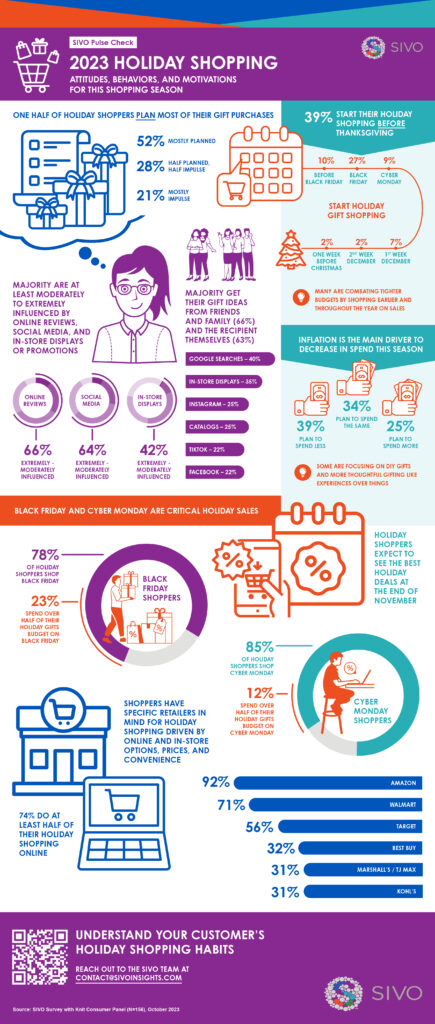
For many manufacturers and retailers, the holiday season can be a “make or break” time period for generating sales and achieving revenue goals. For this reason, it is critical to understand your customer’s holiday shopping attitudes, behaviors and motivations. This is SIVO’s strength. Through approaches like in-store shop-alongs, mobile missions, online communities and in-depth focus groups, SIVO can dig deep into understanding the mindset and behaviors of your target customers, while immersed in the holiday season. Now is the time to act! Let SIVO help you understand your holiday shoppers so you can anticipate their needs and preferences to… Win the Season!
By Natasha Weith and Leslie Turner
Successful market research begins with experts designing, collecting, processing, and analyzing data. Impactful market research goes a step further. The true power lies in how we translate that data into compelling narratives that drive action and resonate with stakeholders. Storytelling in market research reporting is an art form, one that transforms raw numbers and consumer responses into meaningful insights that can shape business strategies and decisions. Here’s a closer look at what makes effective storytelling in market research and some key components to consider.
What is Storytelling in Market Research Reporting?
Storytelling in the context of market research reporting involves presenting data and insights in a way that is not only informative but also engaging and impactful. It’s about crafting a narrative that resonates with your audience, aligns with their business objectives, and drives actionable outcomes. Effective storytelling ensures that the findings are not just understood but are also memorable and persuasive, facilitating better decision-making. This requires experience and creativity.
Key Components of Effective Storytelling in Market Research
Beyond the Report
While the report is typically a critical deliverable in a market research project, the storytelling doesn’t end with the report. It extends to the presentation, follow-up working sessions, and/or stakeholder meetings. This means thinking about how the insights will be communicated beyond the written report. Engaging presentations, interactive discussions, and follow-up conversations with key stakeholders can enhance the impact of the findings and ensure that the insights are effectively implemented.
Expect a Well-Told Story from SIVO
At SIVO, Inc., we believe that storytelling in market research reporting is about more than just presenting data; it's about creating a narrative and presenting it in a way that is compelling, memorable and inspires stakeholders to act in service of consumers and the business. This all starts with the SIVO team listening to your needs and designing and reporting in a way that delivers real business value.
Contact us via our website form or email us at Contact@SIVOInsights.com today to schedule a discovery call!
By Leslie Turner – VP, On Demand Talent
Over the past few years, we’ve had the privilege of working with organizations navigating all kinds of change: leadership transitions, unexpected surges in demand, shifting priorities, and the ever-present pressure to do more with less. One consistent theme has emerged: fractional insights talent can be a game-changer.
Not because it replaces full-time researchers. But because it complements them.
We’ve seen fractional researchers step into high-impact roles with speed, empathy, and precision. Whether they are brought in to lead key innovation or brand strategy initiatives, provide Insights leadership or optimize DIY platforms, they can play a key role in helping teams maintain momentum during critical transitions. And they’ve done it all while working alongside internal teams, to stretch their influence and impact.
Fractional insights professionals are seasoned researchers who embed into teams on a flexible, project-based basis. They’re not just temporary workers but strategic partners, who understand the demands of the business. Often former heads of insights or highly experienced research consultants, they bring deep research expertise across methodologies, industries and tools. They work part-time or on-demand, but their contributions are anything but temporary.
"Fractional leadership is the next evolution of the independent contractor economy"
– Sara Daw, Fast Company, July 11, 2025
Marketing research teams are under pressure, with tighter budgets and timelines often competing with higher expectations. It can be hard to anticipate what the next year may bring, and sometimes you just need support now. Fractional talent helps bridge the gap by offering:
They’re especially valuable when your team is trying to scale insights without compromising depth or rigor. We’ve seen them turn raw data into executive-ready outputs, design unbiased surveys, and bring fresh thinking from outside your category, all while working within your existing tools and workflows.
If you’re considering fractional support, here are a few things we’ve learned that help set the stage for success:
Fractional talent isn’t a work-around, it’s a strategic lever. It allows research teams to stay agile, deepen their insights, and build internal capabilities without overextending resources.
Full-time researchers are the backbone of any insights team. Fractional talent simply helps them go further, faster. If your team is thinking about how to balance speed and depth, fractional talent might be the answer.
For further insight into the value of fractional talent and how it could support your team, please reach out. We're always happy to share what we’ve learned, explore your team’s needs, or just talk shop about the future of insights!
Some teams see the end of the fiscal as a time to take a break, get across the finish line, report on what happened, and then roll into Q1. The problem with this is that they will start next year with the same blind spots they currently have.
Others use this window to listen more deeply, sharpen their focus, and make a few targeted moves that change the trajectory of the next 12 months. (And by the way, this work doesn’t start in Q4, in starts right now, in Q3, when there is still time to learn and make decisions for the future.)
If you want to be in the second group, here are five practical activities to prioritize now, plus how SIVO can support you with both market research solutions and fractional insights professionals along the way.
Before you finalize next year’s plans, you need clear, current truth from the people closest to your business:
Structured “truth mining” conversations cut through assumptions. They reveal:
When you bring these insights into Q4 decisions and planning, you stop guessing. You can prioritize initiatives, messaging, and investments that are anchored in reality, not internal opinion.
SIVO Research team will step in as a neutral, expert listener to:
If you need internal team capacity as well as expertise, our fractional insights professionals can also embed within your team to design and manage this work.
Once you’ve listened to people, you need to look at the numbers.
A focused year-end review should answer two questions:
The output from this analysis should be a short, honest view of:
Going into Q4 and the new fiscal year with this clarity prevents you from repeating expensive experiments and keeps your team focused on what actually creates value.
SIVO will support this review by providing fractional Data Analytics Expert leadership. We can partner with your analytics and finance teams to connect research and performance data. Our Data Analysts can build a concise “year-in-review” insights deck that integrates insights and clear implications around category and channel performance, competitive actions, customer trends and promotional performance.
With fresh insight and performance context, the next step is to see your business the way your customer actually experiences it.
Mapping the customer journey means collecting qualitative and quantitative data and then documenting the key stages from first awareness through purchase, onboarding, usage, and loyalty/advocacy. This will capture what your customer is feeling, fearing and trying to accomplish at key decision moments. This work usually reveals two things:
Identifying and fixing the biggest leaks or friction points in Q4, can improve conversion and strengthen retention among your potential and existing customers in the coming year. It also gives the marketing, sales, product, and service teams a shared picture of “the customer journey we are trying to serve.”
SIVO’s customer experience and journey mapping will help you identify key stages, emotions, needs, pain points, and opportunity areas that will have the greatest impact on satisfaction, loyalty, and revenue. Our experts will facilitate activation workshops so your team can align on the journey and choose focus areas and plan for the coming year.
At this point, you’ve heard from your stakeholders and customers, reviewed the market and your performance, and seen the end-to-end experience. Now you can answer two critical questions with much more confidence:
This work becomes a filter for which opportunities to pursue and when to move on. It gives the team a consistent and differentiated story to tell, in website copy, sales decks and customer service conversations.
Depending on the existing customer data and knowledge that you have, SIVO will customize to your needs which may include, leveraging new and existing data to identify and map jobs-to-be-done, facilitate working sessions to build your ICP and test positioning statements.
Specifically:
The final step is to turn all this learning into focused action.
Rather than a long, generic annual plan, start with a 90-day, growth-aligned plan for Q1 that:
The key is to make Q1 a testbed for insight-led action, using all that you have learned in Q4 of this year.
SIVO will support this translation from insight to action through:
SIVO doesn’t stop at the delivery of insights and recommendations. Our team’s sweet spot is in being your strategic partner to help you get from insights to action plans so your team can align and execute with confidence.
The difference between a “normal” year and a breakout one rarely comes from a single big bet. It comes from a series of better-informed decisions, made consistently.
Q4 can be a pivotal time for your team, that sets you up for a successful next year. These 5 moves:
…give your organization a different kind of starting line for the coming year.
If you’d like help with any of these steps, whether that’s a focused research engagement (using survey or AI-powered intelligence tools) or a fractional insights leader to guide the work, SIVO can plug in at the level you need and at the pace your business can absorb.
by Cindy Blackstock
In Part 1 of our Jobs Theory series, we described how uncovering the underlying needs and motivations of consumer decisions leads to new opportunities for product innovation, renovation and positioning/messaging. Now let’s dig into the keys to success for Consumer Job Mapping.
“Jobs to Be Done” mapping works for all industries and any products or service to create a competitive advantage for your company or brand. There are a few points to consider when embarking on jobs discovery:
There are multiple ways to understand your consumer: in-home observation, longitudinal diaries, one-on-one interviews, in-context intercepts, etc. The optimal approach should be customized for your objectives and your consumers.
Enlist an experienced researcher to listen and interpret your consumers’ words and behaviours to identify the Job. For example, consumers cannot answer the question “What job are you hiring this face cream for?” Asking the right questions in the right way is key to uncovering hidden motivations.
A jobs map will be comprised of multiple jobs ranging from functional to emotional. Ensure each job has been defined – or structured – with context, motivation, and desired outcome. For example, a consumer statement such as “When (the situation) … I want / need (the motivation) … so I can (outcome).
Go beyond just identifying the job. Use activation sessions to translate the Jobs to address your team’s business goals. For example, mapping competitors against your jobs map identifies “white space” opportunities for new product innovation.

At SIVO, we have successfully helped our clients identify opportunities with Job Mapping including white space and positioning opportunities to win in the market place. Here are a few examples to bring it to life.

Innovate in an existing category
OPPORTUNITY: A food manufacturer wanting to find white space in the hot snack category to grow sales and earn a bigger share of consumers’ wallets.
SIVO APPROACH: We used a multi-phased approach to get a comprehensive view into the lives of their consumers. This included mobile journals, in-home ethnographies, in-store intercepts and product user immersion.
RESULT: With the Jobs Map framework, the client was easily able to identify and prioritize jobs signalling white space opportunities, and that led to the launch of a new and unique product to the hot snacks category.

Communicate with your target
OPPORTUNITY: An apparel supplier needed to more fully understand a new consumer target to develop effective messaging.
SIVO APPROACH: We dug deep with both consumers and the sales team to uncover hidden motivations for apparel purchases. We designed an approach that used online boards to capture longitudinal learning (multiple days of apparel choice) followed with webcam focus groups to dig deeper on what was uncovered during the online board.
RESULT: We learned how the target consumer “hired” her apparel and accessories to convey her personal style. This discovery was then reflected in our client’s Facebook and Instagram posts with a focus on the finer details and accessories that are unique to this apparel brand.

Position your new product
OPPORTUNITY: A tech start-up had developed a training app for athletes and were preparing for their next wave of fundraising. They needed to demonstrate they knew their target consumer and how to communicate with them. The company had a hypothesis around what their target consumer was looking for but needed to be sure.
SIVO APPROACH: We needed to capture the First Moment of Truth when exposed to the app and the Second Moment of Truth after using the app. We combined one on one interviews capturing the immediate reaction to the app, followed by a 2-week diary using the app, then one-on-one interviews to learn about the experience.
RESULT: SIVO uncovered an new consumer job, “I want to train like a pro” which was more compelling than the client’s original positioning for the App. The client shifted the messaging, in their introductory video, to focus on this job.
Are you ready to uncover, activate and deliver on your consumers’ jobs through data-driven product evaluation services? Please reach out to SIVO and we will help you build a Consumer Job Map that is full of opportunities to grow your business!
SIVO Insights brings together research, talent, and intelligent technology to help organizations navigate complexity with confidence. Have a business challenge? Let's talk!
We bring together research, talent, and intelligent technology to help organizations navigate complexity with confidence