
By Natasha Weith and Leslie Turner
Successful market research begins with experts designing, collecting, processing, and analyzing data. Impactful market research goes a step further. The true power lies in how we translate that data into compelling narratives that drive action and resonate with stakeholders. Storytelling in market research reporting is an art form, one that transforms raw numbers and consumer responses into meaningful insights that can shape business strategies and decisions. Here’s a closer look at what makes effective storytelling in market research and some key components to consider.
What is Storytelling in Market Research Reporting?
Storytelling in the context of market research reporting involves presenting data and insights in a way that is not only informative but also engaging and impactful. It’s about crafting a narrative that resonates with your audience, aligns with their business objectives, and drives actionable outcomes. Effective storytelling ensures that the findings are not just understood but are also memorable and persuasive, facilitating better decision-making. This requires experience and creativity.
Key Components of Effective Storytelling in Market Research
Beyond the Report
While the report is typically a critical deliverable in a market research project, the storytelling doesn’t end with the report. It extends to the presentation, follow-up working sessions, and/or stakeholder meetings. This means thinking about how the insights will be communicated beyond the written report. Engaging presentations, interactive discussions, and follow-up conversations with key stakeholders can enhance the impact of the findings and ensure that the insights are effectively implemented.
Expect a Well-Told Story from SIVO
At SIVO, Inc., we believe that storytelling in market research reporting is about more than just presenting data; it's about creating a narrative and presenting it in a way that is compelling, memorable and inspires stakeholders to act in service of consumers and the business. This all starts with the SIVO team listening to your needs and designing and reporting in a way that delivers real business value.
Contact us via our website form or email us at Contact@SIVOInsights.com today to schedule a discovery call!
by Heather Niemczycki
Some changes in the market are obvious, such as, inflation, changing employment rates, and the macro effects of the pandemic. But what about those subtle, not-so-obvious changes that can also have a lasting impact on your brand? Tapping into market intelligence can help you to anticipate changing consumer behaviors, before they impact the health of your brand.
Initiating consumer research is a typical starting point for understanding changing consumer attitudes and behavior. However, you can actually super-charge your research with an informed view of market dynamics before you engage with consumers!
SIVO utilizes advanced cultural context analysis tools that combine data collection from the public web (news, blogs, social media, reviews, etc.) with statistical modeling, to uncover insights into existing market dynamics.

Keep reading to understand it in practice…
Example Output Using SIVO’s Web Analytics Tools:
Inflation Impacts + Grocery Shopping = Changing Consumer Sentiment and Values


Gaining market intelligence like this, BEFORE deep dives into qualitative or quantitative research drives better inquiry and ultimately, adds depth to the research results by delivering consumer insights in the context of the broader marketplace dynamics.
To Super-Charge your consumer research with SIVO’s Market Intelligence toolkit, contact us today at contact@SIVOinsights.com.
In partnership with METAMETRIX, SIVO Insights leverages the METAMETRIX advantage to guide clients in finding better insights, exploring bigger opportunities, and making business decisions that drive greater change by connecting them to broader consumer trends.
METAMETRIX is the first and only platform to analyze any unstructured text data in real-time, revealing the motivating values and emotions buried in the data.
Every year, businesses face the same challenge: key research projects grind to a halt when insights professionals go on vacation. Deadlines can slip, stakeholder requests pile up, and business decisions get delayed, all because critical expertise isn’t available when it’s needed most.
For many teams, the choice is either overloading remaining staff (leading to problems like burnout) or putting projects on hold (risking lost momentum and missed opportunities). But there’s a better way.
Leading brands solve this problem by leveraging On Demand Market Research Talent—highly skilled, fractional insights professionals who step in seamlessly, ensuring that research initiatives keep moving, even when core team members are out. Whether planned months in advance or needed at the last minute, these experts keep insights flowing year-round without the cost or commitment of full-time hiring.
In this article, we’ll explore:
If your research team has ever struggled to keep up during vacation seasons, this is for you. Let’s dive in.

Insights teams (or their superiors) often assume they can absorb the impact of vacation gaps—but the reality is more disruptive than expected. When key insights professionals are out of office, projects stall, timelines get pushed, and business decisions are delayed. The ripple effect extends beyond just a temporary pause—it can create significant financial, operational, and strategic costs.
Insights don’t operate in isolation. When research is postponed due to staffing shortages, marketing campaigns, product launches, and strategic initiatives suffer. A postponed concept test could mean missing the ideal market entry window, and a delayed brand study could leave unanswered questions right when leadership needs clarity.
The default response to vacation gaps? Overloading remaining team members. This short-term fix often leads to long-term burnout, reducing productivity and increasing the likelihood of rushed, lower-quality insights. High-performing researchers need time to recharge, but when teams are stretched too thin, performance—and retention—suffers.
Even with strong documentation, there’s always implicit knowledge that only team members carry—research nuances, stakeholder preferences, and the context behind past decisions. When an insights pro steps away, this expertise temporarily disappears, forcing teams to either pause projects or make assumptions that may not align with prior research.
Insights teams thrive on being trusted advisors to the business, but when gaps in coverage lead to stalled projects or incomplete data, stakeholder confidence erodes. If leadership views the insights function as unreliable, they may turn to gut instinct over data-driven decision-making—undermining the very role of the Consumer Insights function.
The bottom line? Vacation gaps in insights teams aren’t just an inconvenience—they create costly disruptions that affect business performance. But there’s a way to avoid these risks while still ensuring that research professionals get the breaks they need.
Vacation gaps are inevitable—but research delays don’t have to be.
Vacation gaps are inevitable—but research delays don’t have to be. The key to maintaining momentum without burnout is having a strategy in place before gaps happen. Whether you’re proactively planning or scrambling for last-minute coverage, here’s how leading companies keep research running smoothly, even when key team members are away.
When key team members are out, the biggest risk is insights bottlenecks—studies stall, stakeholder questions pile up, and research deliverables get delayed. SIVO’s On-Demand Talent steps in seamlessly, ensuring business-critical work continues without disruption.
Certain projects can’t afford to pause just because someone is on vacation. Product launches, consumer deep dives, and ad testing require continuity and expert oversight.
Sometimes, vacation coverage isn’t planned—it’s needed last-minute. Whether it’s a sudden leave of absence or a forgotten PTO overlap, scrambling to fill gaps can lead to expensive delays.
Whether planned or unexpected, vacation gaps don’t have to slow down insights. With an On-Demand Talent strategy in place, businesses stay ahead of potential disruptions—avoiding last-minute scrambles and keeping research moving seamlessly year-round.
Leading companies plan ahead—or react quickly—with On-Demand Talent, ensuring no critical work falls through the cracks that can impact the organization. Here’s how organizations leverage fractional insights pros to bridge gaps and keep research running smoothly:
Scenario 1: A national CPG company has ongoing brand equity tracking and ad testing, but their Senior Consumer Insights Manager was heading out for a month-long vacation.
Without coverage, research timelines would have slipped, and stakeholder meetings would have lacked fresh insights. Instead, the company brought in an On-Demand Consumer Insights Strategist to manage the process, ensuring:
This proactive approach prevented research bottlenecks and decision-making gaps, keeping the business moving.
Scenario 2: A global food & beverage company had a new product launch scheduled—but their Head of Consumer Insights and two key team members had overlapping PTO.
With final-stage concept testing still underway and last-minute adjustments needed for packaging and claims, the company faced a potential launch delay. Instead of postponing, they brought in a fractional Insights Lead to:
ODT gave them specialized expertise exactly when they needed it, ensuring no compromises in research quality or speed.
Scenario 3: A leading technology brand was in the middle of a competitive landscape study when an unexpected leave of absence left their insights team short-staffed.
Rather than overloading remaining team members or pressing pause on critical work, they:
With rapid-response talent placement, the company avoided research disruptions and kept its competitive intelligence up to date.
Scenario 4: A major retailer had a busy summer innovation pipeline, but multiple insights pros were out on PTO at the same time.
Rather than pausing consumer co-creation sessions and delaying concept testing, they used On-Demand Talent to:
With fractional insights experts seamlessly filling gaps, the company stayed on schedule without sacrificing research quality.
Whether you plan ahead or need urgent support, On-Demand Talent ensures your research stays on track—so your team can take time off without work grinding to a halt.
By leveraging fractional insights professionals, companies can prevent last-minute scrambles, reduce the risk of missed deadlines, and maintain research momentum year-round.
So, how do you avoid research slowdowns when your team is out? And if you’re already facing an urgent coverage issue, what’s the best way to bridge the gap without scrambling?Let’s break it down.
Businesses plan for financial forecasts, marketing campaigns, and supply chain logistics months in advance. Yet, many insights teams still treat PTO gaps as an inevitable issue. The key is building vacation coverage into your annual research strategy so that insights continue flowing, no matter the time of year. Some things you can do:
Planning ahead prevents vacation gaps from becoming business roadblocks. But what if PTO conflicts weren’t anticipated—and now key insights work is at risk of falling behind?
Even with careful planning, unexpected gaps happen. A last-minute PTO request, overlapping team absences, or an urgent business need can leave insights teams short-staffed at critical moments. If you’re already dealing with a research gap, here’s how to minimize disruption fast:
As companies seek more efficiency, many turn to AI-powered research tools to bridge staffing gaps. While AI can be a valuable support system, it has clear limitations that make it an unreliable substitute for expert insights professionals—especially when high-stakes decisions are involved.
For instance, AI is great at surfacing data but doesn’t interpret nuances, human motivations, or cultural relevance—leading to misaligned insights. AI models also (unfortunately) inherit biases from training data, which can skew results if not carefully reviewed and adjusted by human experts. Additionally, executives rely on strategic recommendations, not just raw data—AI lacks the credibility and business acumen needed to drive stakeholder decisions.
If you’re considering using AI to fill vacation coverage gaps for your research team, keep in mind that the more tools you introduce, the more training your team will require. This can actually take more time away from employees rather than increasing productivity—especially for short-term needs like a vacation fill. What seems like an easy solution can quickly turn into a time-consuming distraction, creating more inefficiencies rather than solving the original problem.
When critical insights projects can’t wait, finding temporary research experts quickly is essential. So, where can businesses turn for immediate, high-quality research support?
Many organizations look to freelance platforms and consulting firms, but these often require lengthy onboarding or lack the industry expertise needed for specialized research roles. Others attempt to redistribute workloads internally, which can lead to inefficiencies and overburdened teams.
A more effective approach is tapping into pre-vetted insights professionals (like ODT) who can integrate quickly, understand complex research needs, and keep projects moving without disruption. Whether covering for a planned PTO or responding to an unexpected gap, having a flexible resourcing strategy ensures that insights teams can maintain momentum—without last-minute scrambles or overburdening internal staff.
At SIVO, we provide businesses with flexible, on-demand insights talent to keep research initiatives moving—no matter the challenge. Whether you need short-term vacation coverage, interim leadership, or specialized expertise for a critical project, we place senior-level insights professionals within days.
Don’t let research slow down when key insight team members are out for vacation. Let’s talk:
contact@sivoinsights.com | www.sivoinsights.com/on-demand-talent-management/
Artificial Intelligence (AI) is revolutionizing industries, and marketing research is no exception. In the field of innovation, AI isn’t just a tool—it’s a transformative force. As market researchers strive to speed up timelines, generate breakthrough insights, and stay ahead of consumer trends, AI offers new opportunities. At SIVO, we believe in exploring AI’s strategic potential, balancing excitement with careful consideration of its limitations and practical applications.
AI’s Advantages in the Innovation Process: Speed, Cost, and Quality
AI offers unparalleled efficiency across all phases of innovation. For example, traditional brainstorming sessions might yield a few dozen ideas over several hours, but AI-driven generation tools can produce hundreds of concepts in minutes. Models like ChatGPT can produce ideas 200 times faster than humans, feeding researchers more possibilities and compressing the innovation cycle, enabling faster decision-making.
AI also delivers significant cost savings. Research shows that organizations using AI for innovation can reduce costs by as much as 85% through the automation of “front-end” work streams such as data analysis, ideation, and concept validation. By minimizing the manual labor required, AI allows companies to reallocate resources toward high-value strategic efforts without sacrificing quality.
And it’s not just about speed and cost - AI excels in generating high-quality ideas. Studies suggest that AI-powered ideation rivals, and sometimes surpasses, human creativity. AI isn’t just capable of producing novel ideas but is also highly effective in generating nuanced originality. Furthermore, the emerging field of synthetic testing allows AI to simulate human consumer sentiment, attitudes, and behaviors, enabling iterative, real-time refinement during the ideation phase.
Key Applications for Innovation Insights Work Streams
AI offers powerful tools for businesses throughout the innovation funnel, from discovery to launch. At SIVO, we’re particularly intrigued by AI’s role in the “front end” of innovation and the growing potential of synthetic validation. Key areas include:
AI is reshaping innovation research. Thoughtful adoption of these tools is essential for businesses that want to remain competitive in today’s rapidly evolving marketplace.
Challenges and Watchouts:
The Importance of Oversight in AI-Supported Innovation
While AI offers immense potential, it also presents important challenges:
In a field where accuracy and context are critical, these limitations must be accounted for. AI should not replace human creativity and research expertise but should instead serve as a collaborative partner that enhances researchers’ ability to innovate more efficiently and comprehensively.
Strategic Integration of AI for Innovation: A Balanced Approach
To successfully integrate AI into your innovation process, it’s important to narrow your focus. Identify the areas where AI can deliver the most value—whether in trend analysis, ideation, or simulated consumer testing. From there, begin experimenting with AI in those areas to build trust and familiarity.
For those hesitant to fully embrace AI, running parallel testing alongside human-led research can be a great starting point. This approach allows teams to compare AI-generated insights with traditional methods, building confidence in AI’s capabilities while reducing risk. Alternatively, AI can be applied to lower-profile projects first, allowing teams to rehearse its application and refine their approach as they gain experience.
The key is to strike a balance—lean into focused, mindful use of AI to reap its benefits and stay competitive without feeling the need to chase every new use case. AI should be applied where it truly adds value and enhances the innovation process.
SIVO: Your Partner in AI-Enhanced Innovation
At SIVO, we’re actively experimenting with AI tools and exploring AI’s potential to transform how market research supports your new product innovation needs. We see AI as a powerful tool to accelerate processes and enhance creativity, and advocate for a stepwise, cautious approach. We’re eager to guide clients through proof-of-concept tests, blending AI’s scientific power with the art of human-driven insight application, which remains at the core of our work.
If you’re ready to experiment with AI and enhance your innovation process, contact us at Contact@SIVOInsights.com or visit SIVOInsights.com today to schedule a discovery call.
Let’s navigate the future together!
As fall season begins and planning cycles ramp up, most brand teams are juggling budgets, media calendars, and launch timelines. But there’s one question that quietly determines how effective all of that work will be next year:
Ever since your brand was established, your consumers have moved through shifting economic pressures, cultural tensions, new product entrants, and evolving expectations in your category. If your brand positioning hasn’t been revisited with fresh consumer insight, you’re likely planning 2027 with an outdated map.
Q4 is the ideal time to reset.
A clear, differentiated brand positioning is the foundation of an effective marketing strategy because it forces the team to define who the brand serves, what primary benefit it delivers, why it can credibly deliver that benefit, and how it stands apart from key competitors.
Without that clarity, campaigns become fragmented, messaging drifts, and teams default to generic claims that could belong to any brand in the category.
As a reminder, a classic, disciplined positioning statement (your differentiating benefit) looks like:
For (consumer target), Brand is the only (product type) that provides (key benefit), because Brand has (reason to believe 1), (reason to believe 2), and (reason to believe 3).
For example, Peleton’s positioning statement looks something like this:
For people looking to stay motivated with their in-home workout routines, Peloton is the connected fitness platform that delivers an energizing studio experience, with premium equipment, live and on-demand classes, motivating instructors, and personalized progress tracking.
The past few years have reshaped what “value” means in many categories. Consumers are re-evaluating trade-offs between price, quality, health, and convenience; looking for brands that reflect their emotional needs and life stage; paying closer attention to how brands show up on issues like sustainability, wellbeing, and social impact; and comparing more options more quickly across digital and physical channels.
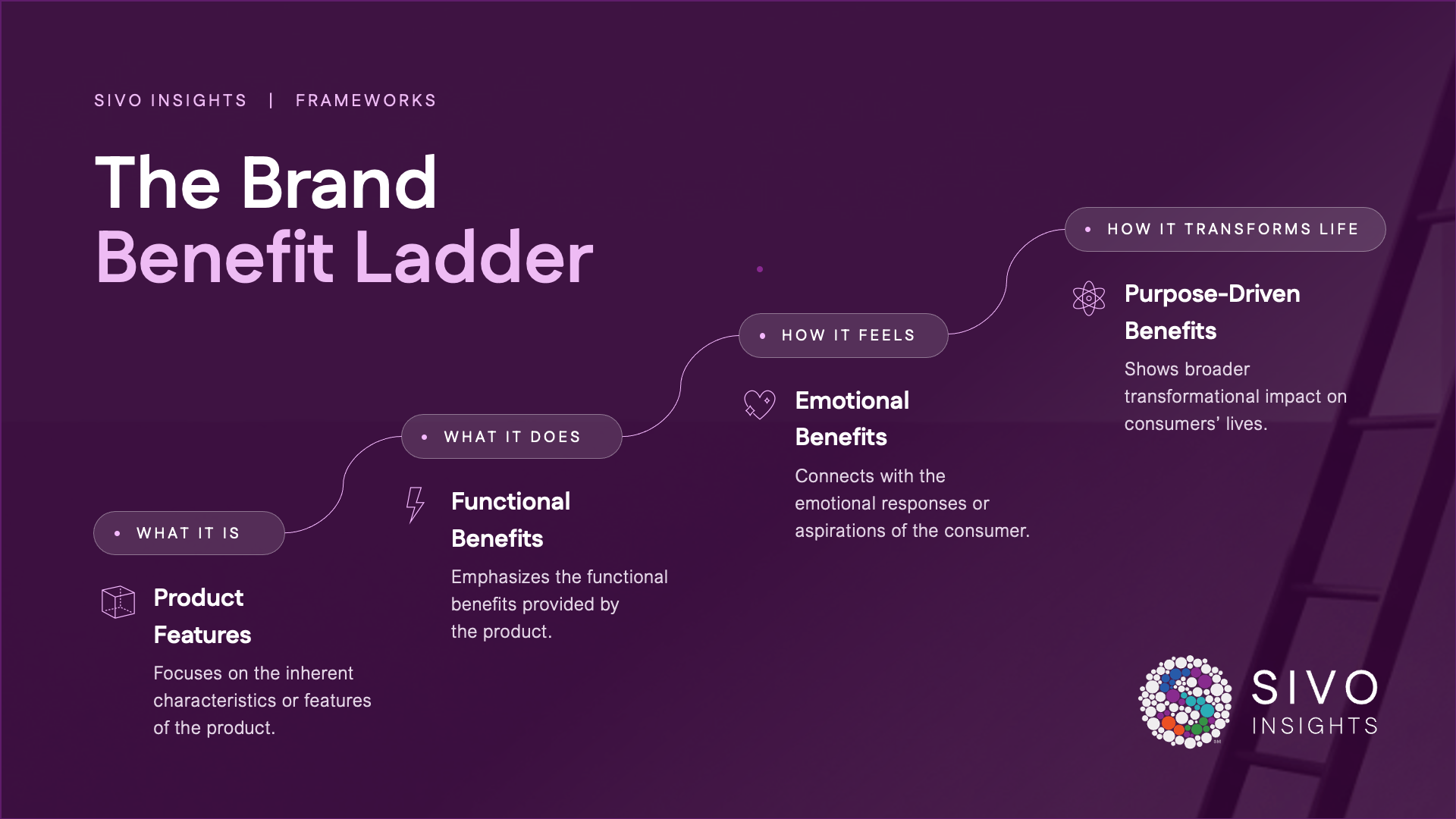
Within that context, positioning can no longer rest solely on functional benefits, i.e., “what it is” or “what it does.” Strong brands are intentionally climbing the Brand Benefit Ladder:
Depending on your brand's maturity and competitive set, you may need to refresh your positioning at any level, from sharpening a functional claim to elevating toward more emotional or purpose-led territory. But you can’t make that decision in a vacuum.
That’s where disciplined, end-of-year consumer research become critical.
Q4 is a valuable time for positioning work because it bridges “what has happened” and “what’s next”:
By investing in brand positioning research now, you give your team the time they need to align on a refined or new positioning territory, translate it into clear messaging and activations and brief your agencies and internal partners in Q1 with a strong strategic foundation.
At SIVO, we’ve spent many years helping brand teams across industries develop and evaluate brand positionings that resonate with both consumers and internal stakeholders. Our approach combines proven frameworks with rigorous qualitative and quantitative research to ensure your positioning is both inspiring and grounded.
In Q4, that typically looks like a two-step process:
1. Qualitative Exploration: Refining the Story With Real Consumers
We start by exploring how consumers currently perceive your brand, your competitors, and the broader category. For example:
We can work side-by-side with you and your agency partners toevolve the statements as we learn, so you’re not waiting months for direction.
2. Quantitative Positioning Validation: Selecting the Strongest Position
Once we’ve refined a set of viable positioning routes qualitatively, we move into quantitative validation to identify the most motivating and distinctive option.
Using surveys and, where appropriate, real-world testing (such as digital ad experiments), the SIVO team will:
The result is not just “a good idea,” but a validatedstrategic choice: a positioning that is clear, unique, credible, and proven toconnect with your consumers across channels all year long, via campaigns,packaging, digital, shopper, innovation, and more.
If you’re already planning for 2027, this is the moment to build a positioning that truly reflects today’s consumer and tomorrow’s opportunity. Let the SIVO team help you develop and validate a brand positioning that communicates exactly how your brand wants to show up in the world, and why that matters to the people you serve!
SIVO Insights brings together research, talent, and intelligent technology to help organizations navigate complexity with confidence. Have a business challenge? Let's talk!
We bring together research, talent, and intelligent technology to help organizations navigate complexity with confidence