
Through SIVO's "Modern Ways of Working" Mini Chat series, we spoke with innovative consumer insights leader, Jackie Waller, Senior Director of Enterprise Research at The Standard about how to meet the needs of the business while also managing the workload of her Insights team.
One of SIVO's leaders, Brent Budke, connected with Jackie to have a "Mini Chat" about the different strategies she employs, including the SIVO, Inc. On Demand Talent fractional staffing solution, to manage workload surges while leading the market research needs of her growing company.
Check out the entire interview here!
https://www.youtube.com/watch?v=Rz792S-dLW0
Many thanks to Jackie for generously sharing her experience and knowledge with our peers across the Insights industry!
Innovation requires seamless collaboration, agility, and the ability to pivot wisely and effectively. Timelines are tight and the right talent is critical to successfully manage the Insights process. SIVO’s On Demand Talent™ team recently provided a Consumer Insights Innovation Lead for Betsy Frost, Chief Revenue Officer at DRY Soda Company.

DRY Soda needed a Consumer Insights expert to manage the First Moment of Truth (FMOT) consumer learning for a new product launch, DRY Botanical Bitters & Soda, a ready-to-drink non-alcoholic cocktail with zero sugar.
“…it felt like SIVO was a member of our team.”
From the get-go, the SIVO’s talent creatively leveraged DRY Soda’s internal assets and owned social media to recruit the right consumers for quick-turnaround learning. Timelines and budgets were priorities, with no room for missteps. When supply chain complexities forced an immediate change in launch plans, the team worked smartly and effectively to pivot from cans to bottles in a record 15 days. Navigating a plethora of moving parts, including new package design, messaging, team alignment, and consumer feedback demanded an experienced team to pull it off successfully!
During Consumer Research, Frost was thrilled to listen, participate and ultimately make the right real-time decisions from an outside vantage point rather than having to lead and facilitate herself.
Frost said, “You made it super easy and streamlined for me…it felt like SIVO was a member of our team.”
To learn more about the DRY Soda story and line of products available, visit drinkdry. Check out this new product: DRY Botanical Bitters & Soda!
You can Shop Now or click the ‘Find Dry’ link to leverage the unique geo-locator. It allows you to buy online or from the store front retailer of your choice. This shoppable platform is powered by Pear Commerce technology.
SIVO Insights On-Demand Talent provides the right talent for your business needs; it is NOT a one size fits all model. What talent do you need to immediately impact YOUR business? Email Brent Budke to successfully match the right talent.
Are you curious what working differently looks like? – just ask. SIVO Insights can help you figure out the best path forward for you or your company to get the resources – and talent – you need. Schedule a discovery call today to get started.
As fall season begins and planning cycles ramp up, most brand teams are juggling budgets, media calendars, and launch timelines. But there’s one question that quietly determines how effective all of that work will be next year:
Ever since your brand was established, your consumers have moved through shifting economic pressures, cultural tensions, new product entrants, and evolving expectations in your category. If your brand positioning hasn’t been revisited with fresh consumer insight, you’re likely planning 2027 with an outdated map.
Q4 is the ideal time to reset.
A clear, differentiated brand positioning is the foundation of an effective marketing strategy because it forces the team to define who the brand serves, what primary benefit it delivers, why it can credibly deliver that benefit, and how it stands apart from key competitors.
Without that clarity, campaigns become fragmented, messaging drifts, and teams default to generic claims that could belong to any brand in the category.
As a reminder, a classic, disciplined positioning statement (your differentiating benefit) looks like:
For (consumer target), Brand is the only (product type) that provides (key benefit), because Brand has (reason to believe 1), (reason to believe 2), and (reason to believe 3).
For example, Peleton’s positioning statement looks something like this:
For people looking to stay motivated with their in-home workout routines, Peloton is the connected fitness platform that delivers an energizing studio experience, with premium equipment, live and on-demand classes, motivating instructors, and personalized progress tracking.
The past few years have reshaped what “value” means in many categories. Consumers are re-evaluating trade-offs between price, quality, health, and convenience; looking for brands that reflect their emotional needs and life stage; paying closer attention to how brands show up on issues like sustainability, wellbeing, and social impact; and comparing more options more quickly across digital and physical channels.
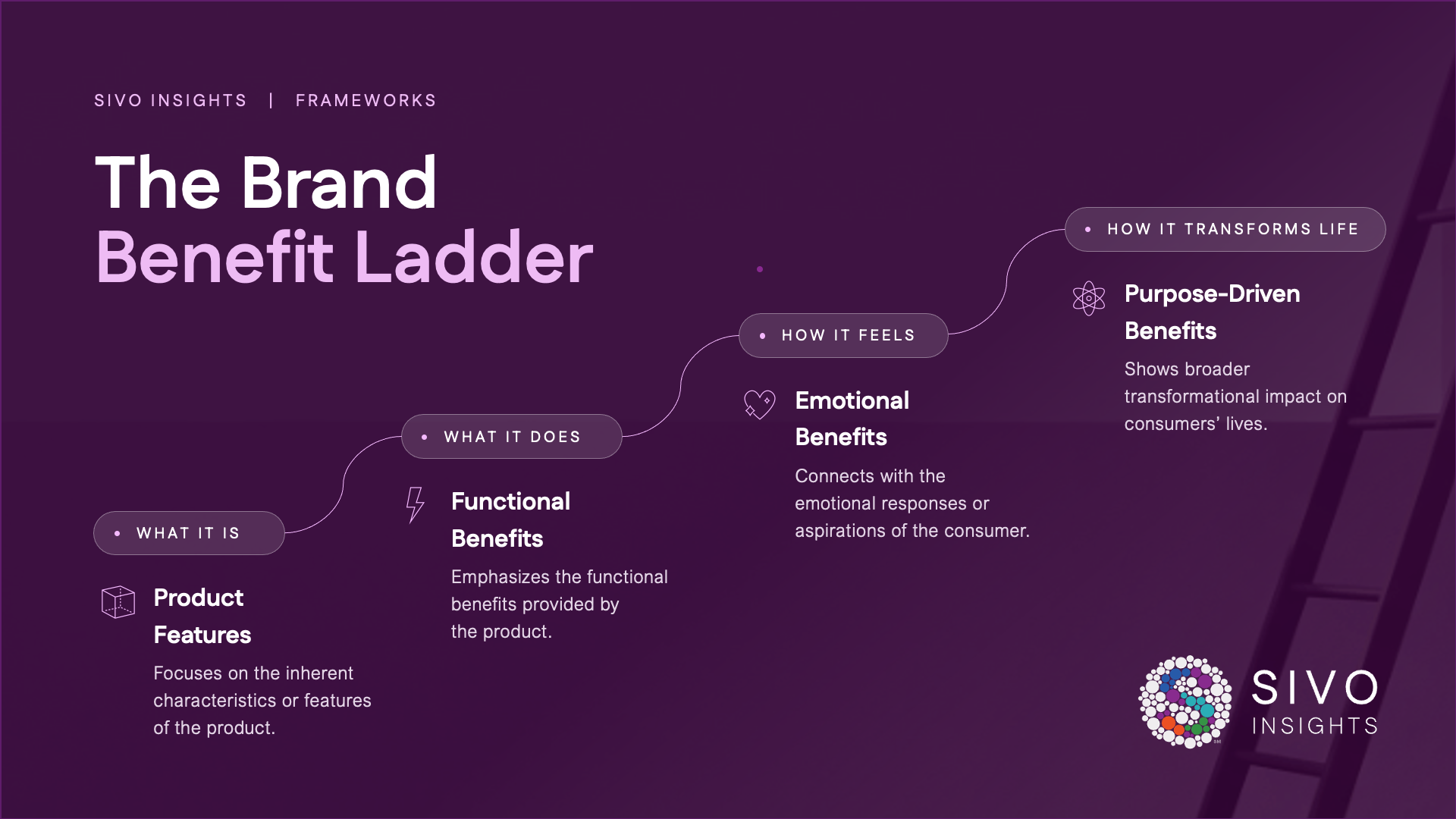
Within that context, positioning can no longer rest solely on functional benefits, i.e., “what it is” or “what it does.” Strong brands are intentionally climbing the Brand Benefit Ladder:
Depending on your brand's maturity and competitive set, you may need to refresh your positioning at any level, from sharpening a functional claim to elevating toward more emotional or purpose-led territory. But you can’t make that decision in a vacuum.
That’s where disciplined, end-of-year consumer research become critical.
Q4 is a valuable time for positioning work because it bridges “what has happened” and “what’s next”:
By investing in brand positioning research now, you give your team the time they need to align on a refined or new positioning territory, translate it into clear messaging and activations and brief your agencies and internal partners in Q1 with a strong strategic foundation.
At SIVO, we’ve spent many years helping brand teams across industries develop and evaluate brand positionings that resonate with both consumers and internal stakeholders. Our approach combines proven frameworks with rigorous qualitative and quantitative research to ensure your positioning is both inspiring and grounded.
In Q4, that typically looks like a two-step process:
1. Qualitative Exploration: Refining the Story With Real Consumers
We start by exploring how consumers currently perceive your brand, your competitors, and the broader category. For example:
We can work side-by-side with you and your agency partners toevolve the statements as we learn, so you’re not waiting months for direction.
2. Quantitative Positioning Validation: Selecting the Strongest Position
Once we’ve refined a set of viable positioning routes qualitatively, we move into quantitative validation to identify the most motivating and distinctive option.
Using surveys and, where appropriate, real-world testing (such as digital ad experiments), the SIVO team will:
The result is not just “a good idea,” but a validatedstrategic choice: a positioning that is clear, unique, credible, and proven toconnect with your consumers across channels all year long, via campaigns,packaging, digital, shopper, innovation, and more.
If you’re already planning for 2027, this is the moment to build a positioning that truly reflects today’s consumer and tomorrow’s opportunity. Let the SIVO team help you develop and validate a brand positioning that communicates exactly how your brand wants to show up in the world, and why that matters to the people you serve!
As customer needs evolve and competition intensifies, traditional segmentation frameworks often fall short. Many segmentation models are based on demographics and psychographics, and often define customers based on traits such as their age, gender, attitudes and values. They tell you who your consumer is – but not why they make the choices they do.
To fuel meaningful, strategic growth, businesses need more than demographic snapshots. They need contextual insight. This is where frameworks like Demand Space thinking comes in.
Demand Space frameworks shift the focus from static consumer traits to the moments that drive decisions. Instead of defining your audience only by traits such as age, gender, or income, this approach considers:
It’s not about who your consumer is on paper – it’s about what’s happening around them, and inside them, when they make choices.
Consumers don’t always behave the same way, even when they share similar traits on paper. A single person has different needs and behaviors throughout the day, week, or year, and traditional segmentation often misses these moments that drive real-world decisions. Demand Spaces, on the other hand, are based on the moments where context, emotion, and need converge.
When implemented thoughtfully, Demand Spaces help businesses:
Demand Spaces help businesses find the moments when consumers are underserved by existing options. These blind spots often become the clearest opportunities for growth. By identifying emotional or contextual gaps in the consumer experience, teams can design solutions that respond to real pain points and not using assumptions.
They also help businesses go beyond what consumers say they want and uncover what they actually need in specific situations. This helps teams design offerings that better reflect real-world behaviors. It’s a way to spark smarter ideas, grounded in daily routines, shifting priorities, and overlooked occasions that traditional research often misses.
Demand Space tools help position brands based on context and need, not just category. This reduces overlap and creates clearer brand roles. That means brands can carve out distinct emotional territory, ensuring each one plays a defined role in the consumer’s life, not just on a shelf.
By focusing efforts on the most critical consumer moments – when the stakes, emotions, or needs are highest – teams can prioritize smarter. It enables brands to align resources with the occasions that drive the most value, loyalty, or conversion – improving both focus and ROI.
They also help in assigning each brand, product, or service distinct moments. This ensures they serve different needs or occasions rather than competing for the same ones. By separating who serves what – and when – demand spaces bring clarity to brand architecture and reduce inefficiencies across portfolios.
Demand Spaces help businesses unlock growth by bringing clarity to what consumers need, when they need it, and why. Instead of chasing broad segments or spreading resources thin, brands can focus on the moments that truly drive behavior – revealing new opportunities, reducing internal friction, and building solutions that resonate in the real world.
Let’s say your target is a 35-year-old parent who regularly shops for snacks. Depending on the situation, they might want:
Each moment carries different emotional and functional needs – and may lead them to choose entirely different brands or products. This is the nuance Demand Spaces capture.
In a challenging market, brands can’t afford to rely on guesswork. Demand Spaces provide both smarter lenses for targeting and innovation, a more human understanding of consumer behavior, and a faster path to discovering what will actually drive choice – and growth.
To identify and activate demand spaces, brands need to move beyond static surveys. Instead, they should use context-rich research tools like:
These are some of the methods that help businesses capture real consumer behavior, in real environments. At SIVO, we combine deep qualitative expertise with flexible research models to help you map the demand spaces that matter most to your business. Whether you're reassessing brand positioning, exploring whitespace for innovation, or trying to understand behavior shifts in today’s market – we help you with the right tools and insights for your business.
Want to talk about how Demand Space research can unlock strategic clarity for your team?
We’d love to help!
Be consumer first. Don’t be consumer only. Powerful words by leading Insights executive, Khary Campbell, VP of Consumer Research & Insights at Comcast.
https://youtu.be/xJSQO7VSw5Q
During a recent SIVO Insights Forum, Khary shared the importance of considering the implications of all functions. After all, every function is working in orchestra of the business.
Click here for a lively on-demand conversation “Bridging The Gap: Translating Insights Into Meaningful Business Results" to hear from Khary and other Insights experts including Eliana Whanon (General Mills, VP of Consumer & Market Insights) and Elizabeth Oates (Book Author, and former Ulta Beauty VP of Consumer Insights.)
Learn from Insights leaders as they discuss:
Thank you to Natasha Weith, VP of Research at SIVO Inc. for hosting The SIVO Insights Forum!
SIVO Insights brings together research, talent, and intelligent technology to help organizations navigate complexity with confidence. Have a business challenge? Let's talk!
We bring together research, talent, and intelligent technology to help organizations navigate complexity with confidence