
Innovation requires seamless collaboration, agility, and the ability to pivot wisely and effectively. Timelines are tight and the right talent is critical to successfully manage the Insights process. SIVO’s On Demand Talent™ team recently provided a Consumer Insights Innovation Lead for Betsy Frost, Chief Revenue Officer at DRY Soda Company.

DRY Soda needed a Consumer Insights expert to manage the First Moment of Truth (FMOT) consumer learning for a new product launch, DRY Botanical Bitters & Soda, a ready-to-drink non-alcoholic cocktail with zero sugar.
“…it felt like SIVO was a member of our team.”
From the get-go, the SIVO’s talent creatively leveraged DRY Soda’s internal assets and owned social media to recruit the right consumers for quick-turnaround learning. Timelines and budgets were priorities, with no room for missteps. When supply chain complexities forced an immediate change in launch plans, the team worked smartly and effectively to pivot from cans to bottles in a record 15 days. Navigating a plethora of moving parts, including new package design, messaging, team alignment, and consumer feedback demanded an experienced team to pull it off successfully!
During Consumer Research, Frost was thrilled to listen, participate and ultimately make the right real-time decisions from an outside vantage point rather than having to lead and facilitate herself.
Frost said, “You made it super easy and streamlined for me…it felt like SIVO was a member of our team.”
To learn more about the DRY Soda story and line of products available, visit drinkdry. Check out this new product: DRY Botanical Bitters & Soda!
You can Shop Now or click the ‘Find Dry’ link to leverage the unique geo-locator. It allows you to buy online or from the store front retailer of your choice. This shoppable platform is powered by Pear Commerce technology.
SIVO Insights On-Demand Talent provides the right talent for your business needs; it is NOT a one size fits all model. What talent do you need to immediately impact YOUR business? Email Brent Budke to successfully match the right talent.
Are you curious what working differently looks like? – just ask. SIVO Insights can help you figure out the best path forward for you or your company to get the resources – and talent – you need. Schedule a discovery call today to get started.
By Cindy Blackstock, CEO and Founder
Customer experience—say it and everyone’s ears perk up. CX is influencing and intersecting with consumer insights across most business sectors: CPG, Retail, Automotive, Financial and Healthcare, to name a few.
The X Factor
Despite it being a buzz worthy term, there doesn’t seem to be a singular, agreed-upon, industry-wide definition for the term customer experience, affectionately referred to as CX. Definitions and approaches to CX vary but most just want to know what that “X” factor means for categories, brand, and products.
Here at SIVO, we have our own perspective:
In truth, we have been working to reveal the customer experience all along. For us, it’s not an intimidating or nebulous concept, because we are quantitative and qualitative research experts who are skilled at understanding people to reveal their truths. Through the optimal combination of quantitative and qualitative research approaches, we get to the “what” by collecting customer experience data, identifying the touchpoints along the customer journey. Then, we get to the “why” behind the customer experience data—the stories, emotions, pain points and delights—and translate it into actionable ideas that businesses can use. The two research approaches go hand in hand with the discipline of CX.
Data + Stories = A Winning Formula
Many market research vendors try to capture the customer experience primarily through quantitative research techniques. Survey data is essential for quantifying the various paths and touchpoints along the customer journey. It plays an important role in validating the experience, so teams can also measure change over time. But the process can’t stop there. Survey data is necessary but is not a comprehensive measure of the customer’s voice.
SIVO believes clients need a better blend of data and stories to get the complete picture. It is the human component, in a truly “experiential” in-context setting, that brings the customer experience to life. To make a business impact, organizations need that qualitative, intimate understanding of the experience, to find out what is truly happening during each touch point. In other words, we believe that quantitative research helps identify what to improve, and qualitative research helps identify how to improve the customer experience.
The Steps to Insights
Your customers are on a journey. There may be many individual stops on the route that make up the overall experience. For example, access may be acceptable, customer service may be satisfying, but there may be positive and negative aspects of the product experience for the user. All these individual touchpoints may net to an acceptable customer experience but may not reveal the nuanced opportunity areas that could lead to an improved experience. Brand teams need to talk to customers and ask, “How are you doing?” instead of, “How are we (the company) doing?” These questions reveal the crucial and detailed human element of CX.
SIVO stiches together a map, an outline of the touchpoints that make up the journey of the entire customer experience. SIVO’s typical approach is 4 Steps:
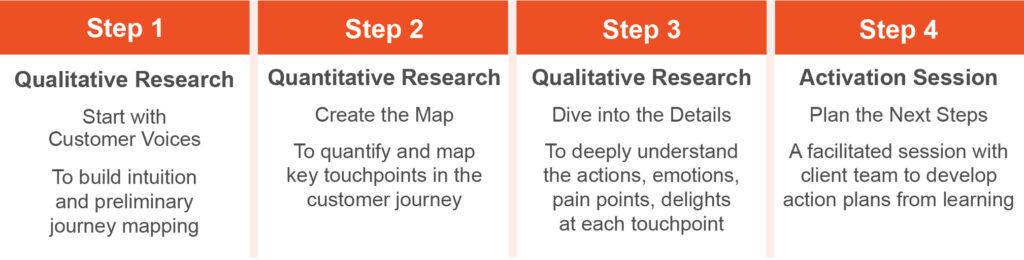
With preliminary insights that build team intuition, quantitative survey data to build and validate the journey, followed by qualitative deep dives to uncover the nuanced details, the true customer experience can be revealed. Teams can map customers’ interaction with the brand across each touchpoint, identify opportunity areas to act on and then track the customer experience annually, to ensure the quality of the experience remains positive or improves over time.
With the journey maps in hand, SIVO’s best practice is to facilitate an Activation Session so that client teams can immerse themselves in the journey and the voices of the customer. A few group discussions and exercises help teams to digest the learning, translate and prioritize into an action plan that can be shared with key stakeholders across the organization.
To discuss your customer experience research needs with experts from SIVO, please reach out to our team at Contact@SIVOInsights.com.
Be consumer first. Don’t be consumer only. Powerful words by leading Insights executive, Khary Campbell, VP of Consumer Research & Insights at Comcast.
https://youtu.be/xJSQO7VSw5Q
During a recent SIVO Insights Forum, Khary shared the importance of considering the implications of all functions. After all, every function is working in orchestra of the business.
Click here for a lively on-demand conversation “Bridging The Gap: Translating Insights Into Meaningful Business Results" to hear from Khary and other Insights experts including Eliana Whanon (General Mills, VP of Consumer & Market Insights) and Elizabeth Oates (Book Author, and former Ulta Beauty VP of Consumer Insights.)
Learn from Insights leaders as they discuss:
Thank you to Natasha Weith, VP of Research at SIVO Inc. for hosting The SIVO Insights Forum!
by Jennifer Dilley
What is a consumer insight? How do you know when you have found one? What does it look like?
These are questions that every marketer or consumer insights professional gets asked at some point. And while it might be useful to rattle off a definition in an elevator conversation, it is more important to internalize the definition so that when you are conducting consumer research you have a clear understanding of what you are looking for.
Definition of a Consumer Insight
So, what are we looking for? A consumer insight is an underlying motivation or need that explains why a consumer makes a certain decision or behaves in a certain way. But that is not all. When the underlying motivation is uncovered, it is only a consumer insight if it can be applied to a brand in an ownable way to unlock brand growth.
A consumer insight identifies consumers’ beliefs and values that drive their behavior. It provides a deeper understanding of why consumers purchase certain products and dismiss others.

Consumer Insights vs Facts
Be careful to distinguish an insight from a fact. There is a difference. A consumer fact is just a statement about a consumer behavior or the marketplace. Here are examples of facts:
These facts are interesting and might be relevant to a brand, but they don’t explain why people behave the way they do.
Consumer Insights Highlight Pain Points and Opportunities
Consumer Insights shed light on pain points for consumers and uncover potential opportunities for brands. As an example, an insight from the findings above could be articulated as, “People want a luxury car to signal their lifestyle and financial success.” This is an insight because it taps into consumers’ underlying motivation (often more emotional that functional) and a pain point, resulting in an opportunity.
Consumer Insights Must be Ownable
A consumer insight is only valuable if it is relevant and can be applied back to a brand in an ownable way. If competitive brands are already addressing a specific consumer need and motivation, then the insight is true but not necessarily ownable for a brand. A good insight will inspire ideas and communications that allow the brand team to communicate brand benefits in a unique way.
Note that an insight might link to a category benefit, but it can still be ownable by a brand, if it has not been adopted by the competition.
Consumer Insights Unlock Growth
The job of a consumer insight is to highlight the possibility for an emotional connection between a product/service and the consumer. It provides brand teams with the context that explains how the product can be relevant in consumers lives. Understanding the emotional connection between consumers motivations/needs and the brand benefits can fuel creative marketing ideas that will capture the attention and convert consumers along the marketing purchase funnel.

Consumer Insights May Not be Overtly Articulated by Consumers
Note that consumer insights are deeper motivations that are quite often subconscious. In fact, a good consumer insight is often described as an “Aha moment.” Good insights tend to be simple human truths that we don’t discuss, but are still there, right under our noses. Because of this, specialized consumer learning techniques are needed. Ethnography, in-context observation, consumer diaries, and projective techniques like mood boards and semiotics, are required to dig beneath the surface of what consumers say to uncover their actual motivations. This may also require us to look beyond consumers values and lifestyle to macro trends – demographic, economic, pop culture, health, and technology trends that are also influencing consumer behavior.
Tying back to the luxury car example, consumer perceptions are also influenced by economic and geo-political fluctuations such as, inflation, higher gas prices, climate change and the transition to electric vehicles. This can subconsciously change consumer beliefs and behaviors, leading to new consumer insights.
Consumer Insights Summary
The best consumer insights:
✔ Explain WHY? By identifying and articulating an underlying motivation, need or belief that is driving consumer behavior
✔ Address a pain point or point of tension
✔ Are ownable when applied to a brand/product/service
✔ Unlock opportunities, inspiring creative marketing ideas that fuel business growth
To discuss consumer insights with experts from SIVO, please reach out to our team at Contact@SIVOInsights.com
By Anna Stoesz, SIVO Insights in partnership with Yogesh Chavda, Y2S Consulting
There is a moment most insights professionals have experienced.
A well-designed research study is presented to a leadership team. The work is solid. The story lands. Heads nod around the room. And then . . . nothing really happens.
Not because the work wasn’t good, but because the learning wasn’t there when the decisions needed to happen. Often when it’s time to decide where to invest, which ideas to back, or how to prioritize markets, people forget about the great learning and quietly drift back to intuition, internal politics or whatever worked last year.
Now we have added AI into the mix. With AI, we talk about auto‑coding open ends, auto‑summarizing interviews, and auto‑drafting reports. We celebrate the time savings; what used to take three weeks now takes three hours. That is certainly progress, but it is not the whole story.
The more exciting shift we’re seeing is that AI can now give us the building blocks to move from episodic research to real-time decision intelligence.
Instead of treating research as a series of projects, we can begin to work in a more continuous way. By monitoring signals, recognizing patterns, and updating our understanding as behavior shifts, we can see opportunities and risks emerge in something close to real time.
In other words, companies are starting to leverage insights from intelligence engines that sit much closer to where decisions are made.
Historically, this kind of decision intelligence was a luxury reserved for companies’ proprietary models and armies of consultants. While AI doesn’t magically answer strategy questions for us, it does make the classic questions of “where should we play” and ‘how will we win” practical for brands that don’t have blue‑chip consulting budgets.
To get there, we must stop thinking about AI as a faster report writer and start thinking in terms of real-time decision intelligence.
This change will also require a shift in how researchers work.
Intelligence engines are focused, AI‑accelerated and human‑guided systems designed to answer specific strategic questions in an ongoing way. In a mature setup, you might see engines that continuously map segments and demand spaces, surface and prioritize need states, and stress‑test ideas against multiple plausible futures. Each engine tackles one slice of the strategy puzzle and together, they form a practical, reusable decision system.
The pattern is always AI + HI (human intelligence), where the human‑led inputs of clear business questions, curated data, and activation meet an AI‑powered engine. The engines are purpose-built, specialized models tuned to a task with guardrails that only come with deep expertise.
To make this concrete, let’s look at a situation common to both B2B and B2C clients.
A mid‑size health and wellness brand had a segmentation built five years earlier. It was still the official truth, but everyone knew it no longer matched reality. New players had entered; behaviors had shifted; the market had fragmented. Both the marketing and innovation teams were eager for refreshed insights as they moved into the annual plans process, which was quickly approaching.
The team considered refreshing the work as originally designed but knew it would require high costs and months of fieldwork and analysis using traditional large-scale surveys and qualitative research that would mean delivering insights too late to act on.
They came to SIVO to understand how an AI intelligence engine might provide the insights they needed to help with real-time learning to support decision-making during the planning process.
We stood up two AI engines: a refreshed dynamic segmentation and a moments engine.
The segmentation engine ingested existing qualitative and quantitative data, ecommerce data, cultural signals, and continuously incorporated new publicly available data through LLMs. It used clustering to surface needs and motivations, reframing them as current demand spaces and segments rather than fixed “personas.”
Because the heavy lift is automated, we could refresh the view as behaviors shifted without launching a new segmentation.
Once we had a sense of the target audience and their needs, the moments engine was then layered on top. It mined deep LLM research, consumer reviews and behavioral data to surface and bring-to-life micro‑moments across the journey.
For this company, the moments turned “we think awareness is the issue” into something sharper:
The team was elated to get the insights during the planning process, when they were ready to build and act on them.
Any time we move AI closer to strategic decisions, the obvious concern is whether the insights are true or not. For this, three guardrails matter:
Traceability - Every output should be traceable to sources, assumptions, and methods. If you cannot show your work, it’s not insight.
Clear Guardrails - Be explicit about what’s in-scope and where extrapolation begins. Most misuses of AI come from over‑generalizing.
Human‑led design, validation and activation - Engines should feed human judgment, not replace it. The value is in how experts design the engines and how teams use the outputs to frame decision and actions.
Human-led validation of outputs and intuition based on actual consumer interaction is also top of mind throughout the process to ensure we have the right inputs and validation to match the level of risk and rigor of the decision.
Once the guardrails are in place, a new consultative playing field opens for insights professionals. The intelligence engines give researchers the ability to play at a more strategic level and not just inform decision-making but truly own the recommendations and “where to go next” conversations.
For earlier-career team members, intelligence engines put “where to play” framing at your fingertips. This makes it easier to step into these types of conversations sooner, whether that is structuring a problem, exploring options, or contributing to decisions in a more meaningful way.
For more experienced leaders, intelligence engines provide a way to continue consulting and building on prior work. They make it possible to explore multiple paths and scenarios, better understand trade-offs, and test how ideas hold up as conditions evolve.
That is the value of moving from episodic insights to real-time decision intelligence. AI intelligence engines enable you to deliver insights confidently, place well-timed bets, and act with precision when it matters most.
This may be a change for researchers who are not accustomed to delivering insight at the point of decision-making, but one with significant opportunity for greater organizational influence and impact.
SIVO Insights brings together research, talent, and intelligent technology to help organizations navigate complexity with confidence. Have a business challenge? Let's talk!
We bring together research, talent, and intelligent technology to help organizations navigate complexity with confidence