By Kerry Juhl
The Responsibility & Privilege of Serving Customers
“A customer is the most important visitor on our premises. He is not dependent on us. We are dependent on him. He is not an interruption of our work. He is the purpose of it. He is not an outsider to our business. He is part of it. We are not doing him a favor by serving him. He is doing us a favor by giving us the opportunity to do so.”
– Mahatma Gandhi, 1890
This quote is more than 100-years old, but it is still true today. The opportunity to serve customers is a privilege. The responsibility of that privilege is ensuring the customer’s voice is heard and understood. Brand teams need to know what their customers need and what they value, as decisions about products and services are made on the customers’ behalf.
Defining Customer Value
Understanding customer value can be a differentiator for companies in today’s challenging market. Simplistically, if a brand team has $1 to invest – or needs to cut $1 in spending – knowledge about what customers’ value must guide these business decisions to stay competitive.
So let’s talk about customer value…In everyday conversations, value has many meanings including price, worth, or even benefits. It is imperative for organizations to operate with a common understanding of customer value. From a marketing and branding perspective, it helps to think about customer value as an equation:
Customer Value equals Benefits minus Cost (CV=B-C).

Benefits include the advantages of quality, service, image, brand, experience, and the functionality one gets or emotions one feels when using the product or service. Cost is not only price – which we think of as cash, credit, interest, even service fees - but it can also include non-price terms such as time, effort, energy, and convenience.*
When teams define their Customer Value Equation, they can clearly identify growth opportunities by emphasizing or improving aspects of an offering that customers value (where to invest) and they can identify cost savings by eliminating aspects of the offering that customers do not value (where to cut).
Developing the Customer Value Equation
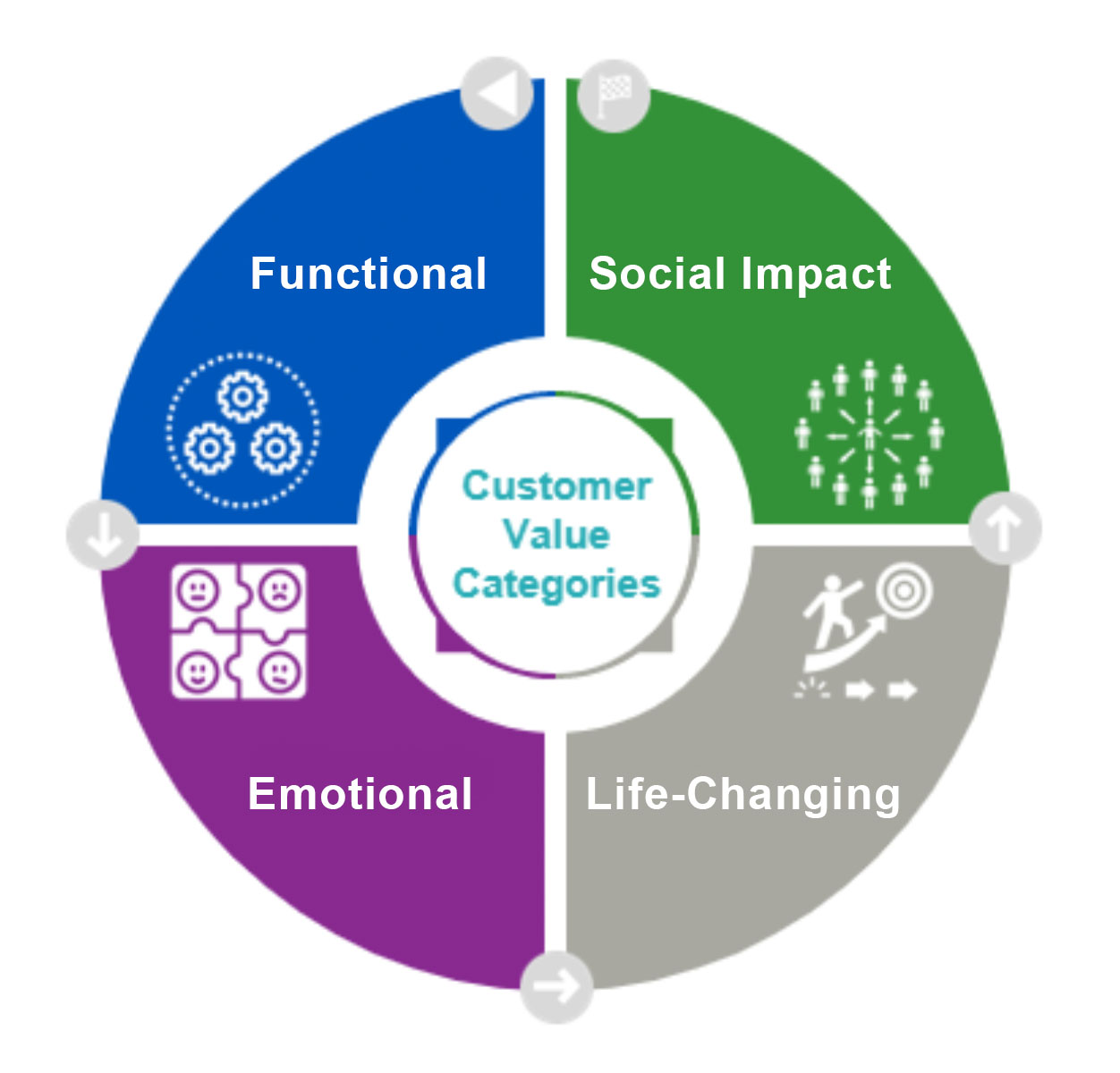
SIVO employs a 5-Step Process to develop your Customer Value Equation. In partnership with our client teams, we Mine, Explore and Quantify the customer value drivers leveraging Functional, Emotional, Life-Changing and Social Impact values. Note that the Quantify Step can be qualitative consumer learning, a quantitative survey or ideally, a combination of both. The design of this step is dependent on how much past learning that the team already has in hand.
Four Categories of Customer Value

We then partner with teams to Develop & Refine the Customer Value Equation. Lastly, we help teams Apply their equation by assessing where their products/services are over/under-delivering and facilitate them through the generation of ideas to improve the customer experience.
The result of our process is rich with discoveries. These insights provide a unifying understanding of the target customers’ purchase drivers, must-haves and nice-to-haves regarding a product or service – giving teams confidence and clarity on what to do with $1 more or $1 less.
Our Offer to You
SIVO is interested in sharing our Customer Value Equation experience and case studies with you and your insights team! Our “CVE Download” can easily be part of an in-person or virtual “Lunch & Learn” or your next team meeting.
If you can answer “yes” to at least one of the following three questions, please reach out to SIVO.
To learn more, contact us at Contact@SIVOInsights.com.
*Referenced article by Gautam Mahajan https://journals.sagepub.com/doi/full/10.1177/2394964320903557
In today’s fast-paced world of AI-powered dashboards, real-time metrics, and instant feedback loops, businesses are flooded with data. But despite this access to information, many teams are still struggling to truly understand their consumers.
Why? Because understanding doesn’t come from data points alone. It comes from empathy – the ability to see the world through your consumers’ eyes.
Empathy is not just a soft skill. In a business context, empathy for your consumer is a strategic asset. And when used intentionally, it becomes a competitive differentiator that can unlock sharper decisions, faster innovation, and stronger brand resonance.
Empathy in a business context goes beyond surface understanding: It’s the process of cognitively and emotionally connecting with your consumers’ experiences, motivations, and needs.
Consumer empathy allows teams to:
And most importantly: it allows your team to move beyond assumptions and act with confidence.
What we see most notably, with the rise of AI, more and more executive teams are pushing for faster, leaner decision-making. But without a connection to real-world consumer behavior, speed risks becoming shallow, and very costly. From an insights perspective, developing empathy within organizations and training teams isn’t a nice-to-have or a luxury – it’s a necessity.
And these are just some examples. Empathy fuels smarter decisions at every level of the business, in all departments.
Whether you’re a CMO rethinking brand positioning or an Insights Director building your learning plans, here are some key tools to bring empathy into strategy:
Spending time in your consumers’ real environments (their homes, their workplace, neighborhood stores, their daily routines, even in their cars) allows you to uncover insights that would never surface in a focus group or controlled environment. Watch for routines, artifacts, interactions, and decision-making moments. What feels normal to them might be revealing for your team.
Ethnographic interviews are perfect to use when exploring new segments, refining product strategy, or understanding how a category fits into everyday life.
Understanding how people actually make choices at shelf (or online) tells you more than any survey can. What stops them? What persuades them? How do they navigate the retail space? How does your product show up relative to your competitors? Shop-Alongs and Path to Purchase Observations are perfect when optimizing in-store experience, packaging, or online conversion strategy.
These immersive, multi-day learning experiences are designed to help teams step into the shoes of their consumers – literally. Whether it’s joining farmers on their land or shadowing a parent on a morning routine, empathy treks bring brand teams (and senior leaders) closer to the emotional context that drives decisions. It’s a common tool to aligning cross-functional teams, inspiring innovation, or uncovering core brand truths.
Mobile mission software, accessed through smart phones, gives you visibility into your consumers’ world in real time or over time. From what they eat and wear to how they talk about brands, these tools capture lived experiences in context, without disrupting them. Digital diaries are perfect for when businesses are looking to understand rituals, routines, and the evolving emotional process of the consumer journey.
Empathy doesn’t end with the research. In fact, it’s only the beginning, and companies should strive to embed it in their day-to-day businesses. But how? That’s where tools like Insight Activation Sessions come in, to help teams translate empathy into action by reframing findings as strategic questions, idea starters, or business moves. A perfect move to embedding insights into planning cycles or cross-functional decision-making, for long-term results.
At SIVO, we love helping clients across industries uncover powerful insights through empathy-driven methods. Here are just a few examples of past cases:
A leading electronics retailer struggled to connect with their consumers – their messaging felt clinical and cold. By stepping into the real lives of their target market, in their own homes, we uncovered the emotional language that truly resonated. The result? Clear direction on positioning and communication strategies – and a renewed path to success in a challenging category.
A global beverage brand was losing relevance across key consumption occasions. Through immersive virtual ethnography, we helped them see how emotions, rituals, and motivations shaped beverage choice across six countries. This empathy-powered understanding led to sharper messaging and inspired marketing activation across core segments.
An electronics brand expanding globally needed to understand what truly drives consumer decisions – but sales data alone weren’t cutting it. Through ethnographic interviews and in-store observations across multiple countries, we uncovered key journey moments that shaped how and why people buy. The insights directly informed their brand growth strategy.
A recreational vehicle company wanted to identify new opportunities for innovation and product improvement efforts – but needed to understand the deeper feelings associated with their utility vehicles. The SIVO and client team spent quality time with farmers and hunters on their properties, riding in their vehicles to see and feel how these vehicles integrated into their consumers’ lives, their farming businesses, and leisure time.
Empathy isn't just a buzzword or about "feeling good" – it's about making better decisions, for you, your company, and your consumers. When you understand the world your consumers live in, you can make decisions with more clarity, alignment, and confidence.
Ready to move from unaware to empathetic?
Let’s explore how empathy can drive better decisions across your company!
SIVO Interview with Mary McIlrath, Children and Family Market Research Expert
By Kerry Juhl
Recently, SIVO, Inc. was lucky enough to have Mary McIlrath join our expanding team. Mary has amassed a wealth of experience in Children and Family market research. She is a recognized expert in the generations space, having established a successful Generation Z and Generation Alpha research practice in her past role. She has taught MBA courses in Qualitative Research at the University of Wisconsin and Quantitative Research at the University of Illinois and lectured at Northwestern University.
I recently sat down with Mary to discuss her experience with studying families and generational differences.
Question: Mary, you have been studying families and generational differences for most of your career. How did you become a subject matter expert on this topic?
Mary: I have always been fascinated by understanding generational differences and family dynamics. I come from both industry and academic perspectives—it’s common for former academics to work in industry, but it’s rare birds like me who keep a foot in both disciplines over a career. I’ve been able to harvest the best of both worlds. For example, my academic experience instilled a mindset that respondents should benefit as much or more than the researcher. This is particularly important when working with children and adolescents. Their needs come first; when they are met, the client also benefits. Industry experience has helped me be effective and efficient in conducting research. My dual expertise gives me a deep toolbox of constructs and methods to help my clients achieve their business objectives, with the well-being of the family at center stage.
Question: Mary, what does a typical U.S. family look like today?
Mary: It’s something in continuous flux. Sometimes it’s single-parent households. Sometimes it’s families with two dads. Sometimes it’s blended homes containing multiple generations. What has gradually become less common is the Norman Rockwellian image of two opposite-gender people raising a gaggle of kids with traditional gender roles. For instance, in 1968, 85% of children under 18 yrs. old lived with two parents (regardless of marital status) but that number has dropped to 70% in 2020. About 25% of children live with a single parent in the household.*
Question: How are manufacturers and marketers responding to the needs of today’s children and families?
Mary: It’s a sea change from how brands thought about families in the early days of youth research in the 1980s and 1990s. Those who used to make simple toys, TV shows, or food and beverages for kids are now thinking of how to stay relevant with their offerings and communication in the Metaverse. They are thinking about what is to come in Augmented Reality (AR) since Pokemon Go flipped the script. They are brainstorming what Virtual Reality (VR) will look like. That’s no small task, especially since children’s sense of balance and depth are still developing and putting them outside 3D spaces risks hampering their natural brain development.
Question: What is the latest regulatory environment for marketing and advertising to youth and families?
Mary: If you work on kid brands, it is critical to understand global ethics around marketing and advertising to children and families. Countries around the world have differing laws about when it is acceptable to advertise to young people. Those in the U.S. are the least restrictive because of industry self-established watchdogs like CARU (Children’s Advertising Review Unit). This organization does regular and thorough audits of marketing campaigns to children and calls out/suggests changes to anything that seems unfair.
Question: How does this impact conducting market research with kids and families?
Mary: In the U.S. it’s allowable to do research directly with children with a parent’s consent. It’s “cleaner” data coming straight from children rather than filtered through parents who mistakenly think they know what their kids truly want.
Question: What are a few of your best practices for conducting market research with kids and families?
Mary: Here are a few tips from my experience:
SIVO is excited for Mary to join our team and strengthen our Children and Family market research capabilities. To learn about how kids and families interact with and think about your brand, please reach out to us at Contact@SIVOInsights.com.
*source: 2020 Census Bureau's Current Population Survey
By Cindy Blackstock, CEO and Founder
Customer experience—say it and everyone’s ears perk up. CX is influencing and intersecting with consumer insights across most business sectors: CPG, Retail, Automotive, Financial and Healthcare, to name a few.
The X Factor
Despite it being a buzz worthy term, there doesn’t seem to be a singular, agreed-upon, industry-wide definition for the term customer experience, affectionately referred to as CX. Definitions and approaches to CX vary but most just want to know what that “X” factor means for categories, brand, and products.
Here at SIVO, we have our own perspective:
In truth, we have been working to reveal the customer experience all along. For us, it’s not an intimidating or nebulous concept, because we are quantitative and qualitative research experts who are skilled at understanding people to reveal their truths. Through the optimal combination of quantitative and qualitative research approaches, we get to the “what” by collecting customer experience data, identifying the touchpoints along the customer journey. Then, we get to the “why” behind the customer experience data—the stories, emotions, pain points and delights—and translate it into actionable ideas that businesses can use. The two research approaches go hand in hand with the discipline of CX.
Data + Stories = A Winning Formula
Many market research vendors try to capture the customer experience primarily through quantitative research techniques. Survey data is essential for quantifying the various paths and touchpoints along the customer journey. It plays an important role in validating the experience, so teams can also measure change over time. But the process can’t stop there. Survey data is necessary but is not a comprehensive measure of the customer’s voice.
SIVO believes clients need a better blend of data and stories to get the complete picture. It is the human component, in a truly “experiential” in-context setting, that brings the customer experience to life. To make a business impact, organizations need that qualitative, intimate understanding of the experience, to find out what is truly happening during each touch point. In other words, we believe that quantitative research helps identify what to improve, and qualitative research helps identify how to improve the customer experience.
The Steps to Insights
Your customers are on a journey. There may be many individual stops on the route that make up the overall experience. For example, access may be acceptable, customer service may be satisfying, but there may be positive and negative aspects of the product experience for the user. All these individual touchpoints may net to an acceptable customer experience but may not reveal the nuanced opportunity areas that could lead to an improved experience. Brand teams need to talk to customers and ask, “How are you doing?” instead of, “How are we (the company) doing?” These questions reveal the crucial and detailed human element of CX.
SIVO stiches together a map, an outline of the touchpoints that make up the journey of the entire customer experience. SIVO’s typical approach is 4 Steps:
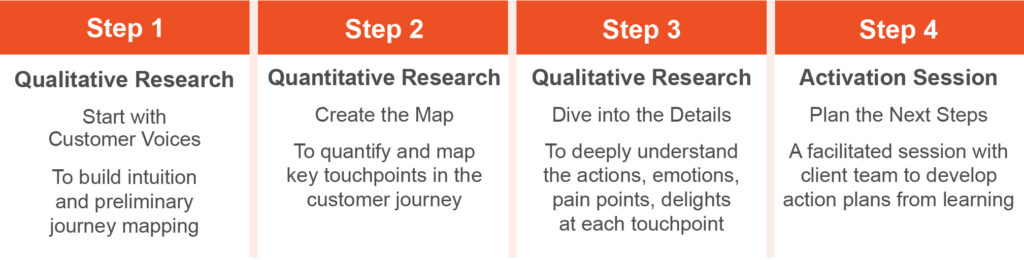
With preliminary insights that build team intuition, quantitative survey data to build and validate the journey, followed by qualitative deep dives to uncover the nuanced details, the true customer experience can be revealed. Teams can map customers’ interaction with the brand across each touchpoint, identify opportunity areas to act on and then track the customer experience annually, to ensure the quality of the experience remains positive or improves over time.
With the journey maps in hand, SIVO’s best practice is to facilitate an Activation Session so that client teams can immerse themselves in the journey and the voices of the customer. A few group discussions and exercises help teams to digest the learning, translate and prioritize into an action plan that can be shared with key stakeholders across the organization.
To discuss your customer experience research needs with experts from SIVO, please reach out to our team at Contact@SIVOInsights.com.
By Julie Rose
“CEOs aren’t feeling the need to hoard labor as much as they once did. A quarterly survey of CEO confidence released on February 8, 2024, by The Conference Board, a think tank, shows 23% of CEOs expect to lay off workers in the next 12 months, up from 13% from the previous quarter.” *
With employee staffing constraints and cutbacks sweeping through many companies, business teams are feeling the pressure. So how does the work get done?
We know that business leaders continue to seek actionable insights to guide their decisions but there are fewer people and often not enough time to get it all done. Many insights teams are turning to fractional talent to fill staffing gaps. This provides the freedom to say “YES” to internal stakeholders, set strategies and take on new projects while not burning out the team or falling short on annual objectives.
As teams consider their staffing options, here are three easy steps for making the case for adding fractional resources.
Step 1 – Outline what issue you are solving.
Use information on hand to justify what the “current state” is costing you and the business.
Step 2 – Evaluate and select the right resource for your needs.
Workforce talent continues to evolve and there is no shortage of options, including interns, fractional talent, contract to hire, or permanent hire. Determining what’s best for you and your organization is key. When evaluating the right resource for your needs, there are a few key questions. Short vs. Long term? Trained vs. Untrained? Junior vs. Senior Level? Hours per week? Budget parameters?
Step 3 – Make the case to your internal stakeholders.
Finding the right talent with experience and selling the option internally might seem daunting. With the right solution, it is possible. Present your case to internal stakeholders by outlining the business need, presenting a tight range of staffing solutions, including the benefits of your recommended choice, and the associated cost and timing. You may also want to include the bios or resumes of the potential talent you are recommending.
If your evaluation in Step 2 supports contract or fractional talent as the optimal solution, below are a few additional resources from SIVO that can help.
Why Choose SIVO On Demand Talent for your Fractional Insights Talent Needs
SIVO On Demand Talent is here for you, with exceptional insights talent for fill-in roles or finite initiatives. You will experience the uniqueness of SIVO On Demand Talent through our Experience, Service and exceptional Talent!
Contact SIVO, Inc. at Contact@SIVOInsights.com to discuss how SIVO can help you make the case for fractional talent. Also, check out SIVO’s On Demand Talent Profiles to learn more about the many fractional Insights Professionals - from Insights Generalists to Research Specialists - that can be an asset to you and your team and help you meet your goals.
* Noted in a NerdWallet article, Will 2024 Be a Big Year for Layoffs? February 2024
SIVO Insights brings together research, talent, and intelligent technology to help organizations navigate complexity with confidence. Have a business challenge? Let's talk!
We bring together research, talent, and intelligent technology to help organizations navigate complexity with confidence