
By Cindy Blackstock, CEO and Founder
Customer experience—say it and everyone’s ears perk up. CX is influencing and intersecting with consumer insights across most business sectors: CPG, Retail, Automotive, Financial and Healthcare, to name a few.
The X Factor
Despite it being a buzz worthy term, there doesn’t seem to be a singular, agreed-upon, industry-wide definition for the term customer experience, affectionately referred to as CX. Definitions and approaches to CX vary but most just want to know what that “X” factor means for categories, brand, and products.
Here at SIVO, we have our own perspective:
In truth, we have been working to reveal the customer experience all along. For us, it’s not an intimidating or nebulous concept, because we are quantitative and qualitative research experts who are skilled at understanding people to reveal their truths. Through the optimal combination of quantitative and qualitative research approaches, we get to the “what” by collecting customer experience data, identifying the touchpoints along the customer journey. Then, we get to the “why” behind the customer experience data—the stories, emotions, pain points and delights—and translate it into actionable ideas that businesses can use. The two research approaches go hand in hand with the discipline of CX.
Data + Stories = A Winning Formula
Many market research vendors try to capture the customer experience primarily through quantitative research techniques. Survey data is essential for quantifying the various paths and touchpoints along the customer journey. It plays an important role in validating the experience, so teams can also measure change over time. But the process can’t stop there. Survey data is necessary but is not a comprehensive measure of the customer’s voice.
SIVO believes clients need a better blend of data and stories to get the complete picture. It is the human component, in a truly “experiential” in-context setting, that brings the customer experience to life. To make a business impact, organizations need that qualitative, intimate understanding of the experience, to find out what is truly happening during each touch point. In other words, we believe that quantitative research helps identify what to improve, and qualitative research helps identify how to improve the customer experience.
The Steps to Insights
Your customers are on a journey. There may be many individual stops on the route that make up the overall experience. For example, access may be acceptable, customer service may be satisfying, but there may be positive and negative aspects of the product experience for the user. All these individual touchpoints may net to an acceptable customer experience but may not reveal the nuanced opportunity areas that could lead to an improved experience. Brand teams need to talk to customers and ask, “How are you doing?” instead of, “How are we (the company) doing?” These questions reveal the crucial and detailed human element of CX.
SIVO stiches together a map, an outline of the touchpoints that make up the journey of the entire customer experience. SIVO’s typical approach is 4 Steps:
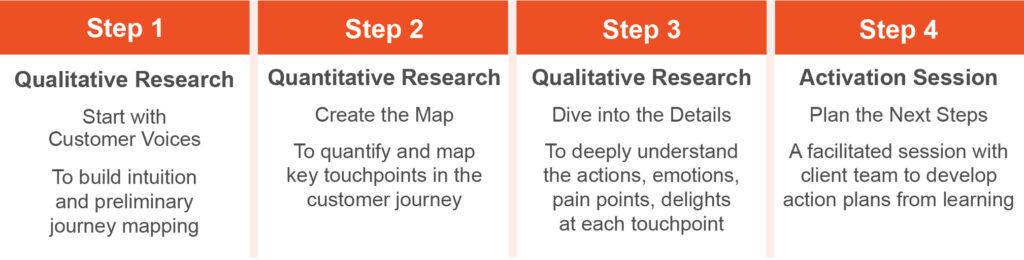
With preliminary insights that build team intuition, quantitative survey data to build and validate the journey, followed by qualitative deep dives to uncover the nuanced details, the true customer experience can be revealed. Teams can map customers’ interaction with the brand across each touchpoint, identify opportunity areas to act on and then track the customer experience annually, to ensure the quality of the experience remains positive or improves over time.
With the journey maps in hand, SIVO’s best practice is to facilitate an Activation Session so that client teams can immerse themselves in the journey and the voices of the customer. A few group discussions and exercises help teams to digest the learning, translate and prioritize into an action plan that can be shared with key stakeholders across the organization.
To discuss your customer experience research needs with experts from SIVO, please reach out to our team at Contact@SIVOInsights.com.
To Make Your Workload Manageable
By Marilyn Weiss
In these inflationary times, companies are cutting operational costs, including their workforce budgets. In 2022, there were at least 154,000 layoffs from more than 1,000 tech companies and so far in 2023, the trend continues with 55,000 layoffs to date. (USAToday.com & Layoffs.fyi, Jan. 2023)
Not only is this devastating for employees that have been laid off, but it is also difficult for those who remain. Post layoffs, organizations become leaner and the scope of work for each employee gets stretched wider. Employees are asked to stabilize the organization and drive future growth with fewer resources.
On the bright side, this increase in individual scope of work can create opportunities to gain new experiences and demonstrate leadership. However, the broader scope can also leave employees feeling overworked, stressed, and unable to manage the expanded workload. When it feels like there is just too much work and not enough hours in the day to get it done, the best way to manage through it, is to adopt a “Fractional Mindset.”
What is a Fractional Mindset?
A fractional mindset is a new way of thinking. It’s breaking down a system into smaller fractional pieces. When you are faced with a problem, adopting a fractional mindset makes the problem smaller. A fractional mindset, when applied to your assigned workload, allows you to approach your role and responsibilities by dividing them up into smaller, fractional tasks. This gives you freedom to take a step back to strategize and prioritize the best way to complete them.
Prioritize the Workload
The first step requires some analysis. You will need to prioritize your list of tasks and/or objectives based on what will add the most value or make the most positive impact on the business. A best practice is to sort the completed list by those items that make the most positive impact on the business or drive business growth.
Delegate the Workload
The next step requires some self-reflection. You will need to consider which tasks/objectives YOU should personally complete and which ones are best to delegate to ANOTHER to complete for you. Ask yourself some questions to determine if YOU or a delegated resource under your direction is best:
If the answer to these questions is, “No”, consider the possibility of others doing these tasks on your behalf, under your supervision. This allows you to manageably “stretch your bandwidth” across your workload, without becoming overwhelmed and stressed by trying to do it all yourself.
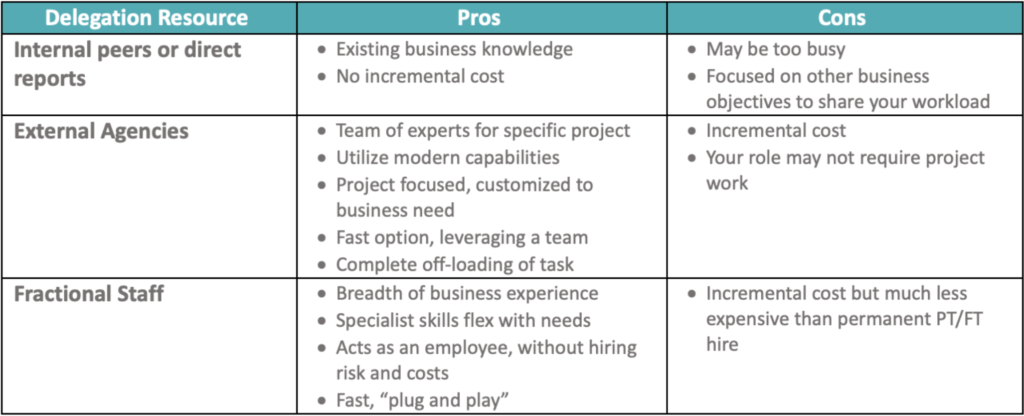
Delegation Resources to Consider:
The pros and cons of each resource are captured below:
When to Utilize your Resources
Internal peers or direct reports are a great option when the team has capacity to take on your assigned workload. If your teammates do not have capacity, delegating to your external agency partners to manage finite projects is a great option.
Sometimes, however, you just need to essentially “clone yourself” or bring in an expert with a skillset that differs from your own. In these instances, you can bring in fractional professionals that, with a little onboarding, can hit the ground running. Delegating to your fractional resources can help you work through your increased workload and objectives in a manageable way.

How SIVO can Help
For insights teams, SIVO offers full-service custom research design, management, and execution to help you with custom market research projects. SIVO On Demand Talent solution also has 100+ fractional Consumer Insights Professionals with a range of skillsets to help you meet your business objectives on your timeline, reducing your stress while allowing you to make a positive impact on your business.
Adopting a fractional mindset will help you approach your role and your workload with confidence, efficiency, and effectiveness. And when the time comes, let SIVO be the agency that you delegate to! Contact@SIVOInsights.com
The great resignation took a major toll on businesses across industries in the last few years. Businesses that prided themselves in workplace culture, flexibility, and benefits saw long-time employees step down from their roles. At the same time, more and more companies face transformative restructuring, like acquisitions and mergers. Following such major changes in the world at large and within organizations, the opinions and beliefs held by workers changed tremendously, and even the most forward-thinking businesses have suffered the consequences.
With that, many businesses are looking for a path toward improving performance and commitment in the workplace. How can they avoid employee attrition in the future? How can they improve their processes to boost efficiency and support employees? How can they redirect leadership to provide the support those employees need? At the end of the day, organizational intelligence gets data-driven insights to answer all these questions, and much more.
First thing’s first, what is organizational behavior? Organizational behavior is how individuals interact and behave in groups. It’s especially relevant when looking at the workplace. Forward-thinking businesses take their organizational behavior seriously, because it greatly impacts employee satisfaction and engagement, leadership performance, and overall workplace efficiency and effectiveness. If organizations do not understand their employee behavior, perceptions and opinions, they miss out on insights that could holistically improve their business. The best way to get those opinions, and translate them into a strategic action plan is to leverage organizational intelligence solutions.
Who should gather organizational behavior data? Your team is full of subject matter experts on your business and your industry, but when it comes to gathering information on organizational behavior, they may not be the right facilitators. Internal teams will have natural bias and may have subconscious results in mind, and could therefore not ask appropriate, unbiased questions. Plus, when it comes to listening to your employees, you want to get thoughts from a wide range of team members. That means allocating the task to an outside expert, to increase cooperation by maintaining employee confidentiality. Ultimately, this gives every employee the opportunity to provide their opinions, maintaining employee anonymity while removing all potential bias from the initiative.

So, what are the keys to improving performance and commitment in the workplace? Understanding what motivates your team members is key to educating and empowering leadership to create a path toward a better future for your company. Get a breakdown on employee insights, leadership development, and strategic planning facilitation below:
What are the honest opinions of your employees when it comes to your business culture and processes? When leadership asks them directly, they will likely get a much different answer than an unbiased facilitator. However, there are many ways to gather this information from your team. An organizational intelligence expert can identify a custom learning plan based on your business, and implement solutions designed to get the most valuable feedback from employees. According to the Harvard Business Review,
“High-OQ (organizational intelligence) leaders foster an understanding, or ethos, of “who we are.” When leaders move from managing individuals or small groups to leading entire organizations, they need to create a shared understanding of what’s important and what the organization stands for — in other words, an ethos.”
What kind of exercises result in the best employee insights? This varies depending on the organization, but typically it comes down to both qualitative and quantitative research. Some examples of qualitative research include one-on-one interviews, small group employee discussions, and stakeholder interviews. Meanwhile quantitative research looks more like customized online employee engagement surveys targeted to specific employee teams, departments, functions, and regions. Often, employee engagement surveys are administered with regular frequency, e.g., annually or bi-annually, to measure positive or negative changes in employee satisfaction and engagement over time.
Your industry is constantly changing, your business is growing, and workplace expectations are ever-evolving. Is your leadership adapting to accommodate? Modern businesses must create an expectation for agility in leadership to keep employees engaged and motivated. That means regular leadership training, coaching, and development. Organizational intelligence experts can handle the task and provide tailored, relevant coaching that meets the needs of your leaders. It begins with one-on-one introductory sessions, a 360 degree leadership assessment and follow-up analysis, development planning and coaching sessions with leaders at all levels of the organization - executives, high-potential leaders, and new managers. This results in more effective leadership and impactful business management that can exceed the expectations of their teams.
What solutions are involved in leadership development? First, there is leader coaching and education, which can include leadership assessments, feedback, and career planning directly with leaders. This can take place individually or in group/cohort sessions. There is also team effectiveness training, which helps teams define their purpose, processes, roles and responsibilities, as well as individual contributions. This is especially important for businesses facing restructuring, where new teams are being formed and leadership responsibilities are changing.

You have so many initiatives in the works – strategic planning can feel like one of those tasks that could easily get pushed down the line. However, strategic planning is the high-level exercise that impacts every other element of your organization. Outsourcing guarantees timely and effective execution, especially when you pick the right partner for the job. Market research firms like SIVO offer comprehensive workshops to ensure your team develops a sound strategic plan that will successfully lead the company into the future.
These facilitated workshops are especially beneficial to newer businesses or businesses facing large changes, like acquisitions, mergers or a challenging external environment. Knowing how to bring teams together, leveraging critical and inspirational inputs is no small task. That’s why it’s beneficial to have experienced strategic planning facilitators on your side, to plan and facilitate the workshop so that you leave the session with a clearly defined vision, mission, values, plans and ownership assignments. Sessions may also focus on other topics, such as communications planning, insight activation sessions, special-interest group planning, and even competitive SWOT analysis. Regardless of the focus, each strategic planning session will help leaders develop and align on clear strategies for the future, to drive business success.
No matter the business, every employee wants to be heard. Creating a place for employees to provide their thoughts can only benefit your business. From an employee perspective, these people-focused exercises prove that leadership cares about their opinions and wants to make steps to improve their workplace experience. The same goes for dedicated strategic planning exercises and leadership development. These initiatives create a stronger, people-first organization positioned to succeed. When leaders are effective, employees are motivated, and business strategy is in place, it all adds up to improved performance and commitment in the workplace – and more success in the market.
Organizational intelligence services result in game-changing insights that can transform your business for the better – and position you for even more growth down the line. Your team members have the deep knowledge about the company and industry, and often, their perspectives can unlock opportunities that leadership would have never otherwise considered. Once those insights are relayed to leaders with actionable recommendations, you can accomplish so much more within your organization.
Are you ready to gain insights on your organizational behavior? Get information on every aspect of your organizational behavior with SIVO. Our team of organizational intelligence experts can help you lead your team through any major transition. We work with organizations across industries, and build custom insight solutions that holistically improve performance and commitment in the workplace.
Contact SIVO today to discuss your business needs and get support.
By Kerry Juhl
Fast changing marketplace dynamics and consumer behavior tied to the recessionary economy are putting businesses at a crossroads. Teams need to quickly assess their priorities and pivot to new revenue and profit growth strategies. But in times of upheaval, the activities of teams can take over and they run the risk of confusing activity for progress. The alignment gained by pausing and reflecting as a team can keep the momentum going on key priorities while letting go of the rest.
An important step amidst a consumer learning initiative is to reflect, assess, and decide on next steps. It can happen in-person or virtually and can take as little as 60-90 minutes of the team’s valuable time. For this critical step in the journey, an outside, unbiased facilitator can be your most powerful tool.
There is no better time than now to consider these top 5 benefits of engaging a professional facilitator:
1. Unbiased Professional
A trained facilitator brings the valuable benefit of being an objective leader who can listen to all points of view, not vested in a particular position or outcome. This creates the conditions for a more open dialogue and opportunity to see possibilities that otherwise may be missed.
2. Participate in the Discussion
Ask yourself where you can add the most value. Should you try to participate and facilitate or focus 100% on participating with your team? Engaging a trained facilitator does a couple of things. It sends a message that this work is important. It also allows you, the owner, to invest your energy into the discussion while allowing an expert facilitator to customize the process and tools around your needs and objectives.
3. Full Engagement
Critical to success is hearing from everyone in the group. This can be tricky, particularly if there are strong (or silent) opinions and voices, and now you are not in the same room! Facilitators are skilled at navigating the group dynamics and engaging all participants into the discussion to ensure each voice is heard. They also know how to keep the ideas flowing when the group might get stuck.
4. Stretch Thinking
One of the most valuable benefits of a trained facilitator is the ability to stretch the group’s thinking. They are experts at quickly capturing ideas, summarizing, asking the right questions to build on ideas, connecting the dots between ideas, and pushing participants to think outside the box.
5. Drive to Solutions
With a process designed to meet the objective, the facilitator continually uses techniques to ensure a successful outcome with clear next steps, accountability and buy-in from the group.
Through the stages of Immersion, Interaction and Ideation, we help our clients gain empathy and develop the strategies and alignment needed to boost momentum and forward progress toward the team’s goal. Please contact Kerry.Juhl@SIVOInsights.com to learn how we can customize an approach with the right professional facilitator to meet your needs. We have a team of seasoned professionals who are passionate about working with like-minded clients and would love to talk to you!
By Kerry Juhl
Do you know how your customers feel about their experience with your brand? Do they love it, or does it leave them feeling frustrated?
If your customers don’t love their experience with your products or services, your market share is likely at risk. According to a study from PWC,
Even if people love your company or product, in the U.S., 59% will walk away after several bad experiences, 17% after just one bad experience.
You cannot afford to not know how your customers are experiencing your brand.
The Importance of your Customers’ Experience (CX)
Understanding your customers’ experience can identify product or service flaws. It can be important, even if you are coming from a place of strength. It allows you to build stronger customer relationships, seize new growth opportunities, and maintain a competitive edge in the market. Companies that prioritize a strong understanding of the customer experience are better positioned to meet the needs of their customers where they are and how they want to be served. This allows companies to thrive in today’s customer-centric business environment
Typical Stages in a Customer Journey
The customer journey is typically divided into sequential stages that represent the key phases of the customer’s interaction with the brand. Stages typically align with the marketing funnel and include “Awareness,” “Consideration,” “Purchase,” “Retention” and “Advocacy.” These stages may differ, depending on the industry, category, or channels that the brand is competing in.

What is a Customer Experienced Journey Map?
A customer experience (CX) journey map is a visual illustration that outlines the steps a customer takes when interacting with a company, brand or specific products or services. It helps organizations gain a deep understanding of the customer’s experience, including their motivations, decision moments, delights, pain points, and emotions that come into play, across all the touchpoints with a brand. Companies may also map the customer journey for competing brands to better understand product strengths and opportunities in a competitive context.

Understanding the Experience
Building a customer journey map requires comprehensive qualitative research exploration and is often followed by quantitative validation. CX Insights Experts start with a combination of observation and qualitative methodologies (e.g., mobile missions, bulletin boards, shop-alongs, in-home visits) to facilitate in-depth conversations with brand or category users. This allows them to delve deeply into each key milestone and brand touchpoint within the customer journey. With the qualitative exploration completed, experts will often conduct an online quantitative survey to validate the journey and quantify the consumer experience with statistically significant sample sizes. Note that the journey may differ for various user segments (e.g., younger vs. older customers, multicultural customers, households with kids vs. no kids, etc.) so the research must be inclusive of customer groups that are important to the business.
Activation Planning with a CX Journey Map
Once the CX Journey Map is complete, it is time to bring the team together to immerse and align on the learning and develop an activation plan. SIVO recommends a 1-day workshop with key team members and stakeholders to:
A Key Asset to Customer Journey Mapping
Hiring a strategic market research agency with proven CX experience, or a fractional Customer Experience (CX) Insights professional to lead the journey mapping process will set you up for success. You will need experts who have a strong background in CX research design, journey mapping, research execution and activation planning. They will help your team:
Contact SIVO, Inc. at Contact@SIVOInsights.com to discuss how SIVO can help you map your customer experience. Also, check out SIVO’s On Demand Talent Profiles to learn more about how a fractional Customer Experience (CX) Insights Manager can be an asset to you and your team.
SIVO Insights brings together research, talent, and intelligent technology to help organizations navigate complexity with confidence. Have a business challenge? Let's talk!
We bring together research, talent, and intelligent technology to help organizations navigate complexity with confidence