
How listening to customers can benefit the bottom line
By Kerry Juhl
42% of companies don’t listen to their customers (Hubspot)
85% of products fail when companies don’t talk to consumers (Forbes)
Up to 73% of company data goes unused for analytics (Inc.)
Do you see a pattern here? When companies don’t take the time to understand people and what drives their behavior, they miss out on the very thing that could fuel business growth and innovation. According to Rob Holland, CEO of research technology platform Feedback Loop, companies are not speaking with consumers regularly enough because “they don’t have researchers or they don’t have resources to gather and speak with a group of targeted consumers quickly.” The solution to this problem can be found in three words: Fractional Insights Professionals.
What are Fractional Insights Professionals?
A fractional employee is part of an emerging employment model where an individual offers a niche or advanced experience to an employer and is hired for a fraction of the work week, month or year. Fractional Insights Professionals are temporary employees that specialize in designing and executing market research and identifying and applying consumer/customer insights to guide business decisions and identify opportunities for growth.

Knowledge is Power
When companies neglect to take time to understand the wants and needs of their customers, it is like driving a car with a blindfold on. It can be challenging to stay on course, and you can easily swerve in the wrong direction. The art and science of obtaining consumer insights can provide businesses with an in-depth look at how consumers think, feel, behave, and make choices. Having this valuable knowledge can steer companies on how to improve their businesses, better engage with customers and stay ahead of the competition. According to Microsoft, organizations that leverage their customer behaviors to generate insights outperform their competitors by 85% in sales growth.
Fractional Insights Professionals to the Rescue
When departments do not have market researchers on staff or when employees do not have the time or expertise to execute market research projects and apply the learning to the business, fractional insights professionals can be the solution to ensure your business is not driving blind.
SIVO Fractional Research Capabilities
SIVO On Demand Talent team includes an extensive pool of Fractional Insights Professionals with years of experience and expertise across an array of industries such as CPG, healthcare, finance, technology, apparel and retail. You can rely on SIVO’s team of experts to collect high-quality data, provide an accurate interpretation of that data, and offer guidance on how to best utilize the insights learned. From managing a portion of a research project to full-service research design through insight application, SIVO helps clients make data-driven decisions and identify opportunities for growth.
We’d love to talk to you about how partnering with SIVO can eliminate guesswork and help your company drive positive results. Please contact us at Contact@SIVOInsights.com or request a discovery call from our website at SIVOInsights.com.
By Cindy Blackstock, CEO and Founder
Customer experience—say it and everyone’s ears perk up. CX is influencing and intersecting with consumer insights across most business sectors: CPG, Retail, Automotive, Financial and Healthcare, to name a few.
The X Factor
Despite it being a buzz worthy term, there doesn’t seem to be a singular, agreed-upon, industry-wide definition for the term customer experience, affectionately referred to as CX. Definitions and approaches to CX vary but most just want to know what that “X” factor means for categories, brand, and products.
Here at SIVO, we have our own perspective:
In truth, we have been working to reveal the customer experience all along. For us, it’s not an intimidating or nebulous concept, because we are quantitative and qualitative research experts who are skilled at understanding people to reveal their truths. Through the optimal combination of quantitative and qualitative research approaches, we get to the “what” by collecting customer experience data, identifying the touchpoints along the customer journey. Then, we get to the “why” behind the customer experience data—the stories, emotions, pain points and delights—and translate it into actionable ideas that businesses can use. The two research approaches go hand in hand with the discipline of CX.
Data + Stories = A Winning Formula
Many market research vendors try to capture the customer experience primarily through quantitative research techniques. Survey data is essential for quantifying the various paths and touchpoints along the customer journey. It plays an important role in validating the experience, so teams can also measure change over time. But the process can’t stop there. Survey data is necessary but is not a comprehensive measure of the customer’s voice.
SIVO believes clients need a better blend of data and stories to get the complete picture. It is the human component, in a truly “experiential” in-context setting, that brings the customer experience to life. To make a business impact, organizations need that qualitative, intimate understanding of the experience, to find out what is truly happening during each touch point. In other words, we believe that quantitative research helps identify what to improve, and qualitative research helps identify how to improve the customer experience.
The Steps to Insights
Your customers are on a journey. There may be many individual stops on the route that make up the overall experience. For example, access may be acceptable, customer service may be satisfying, but there may be positive and negative aspects of the product experience for the user. All these individual touchpoints may net to an acceptable customer experience but may not reveal the nuanced opportunity areas that could lead to an improved experience. Brand teams need to talk to customers and ask, “How are you doing?” instead of, “How are we (the company) doing?” These questions reveal the crucial and detailed human element of CX.
SIVO stiches together a map, an outline of the touchpoints that make up the journey of the entire customer experience. SIVO’s typical approach is 4 Steps:
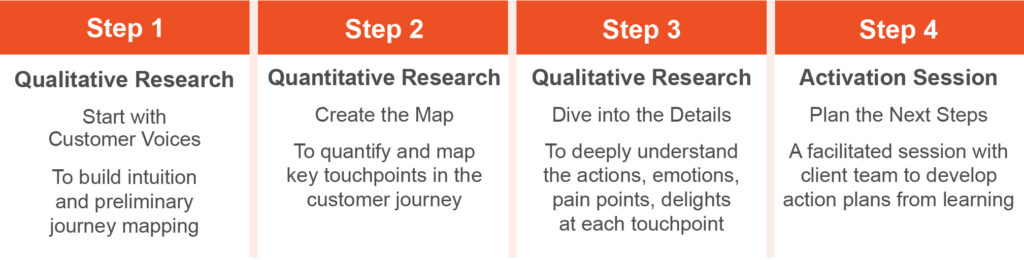
With preliminary insights that build team intuition, quantitative survey data to build and validate the journey, followed by qualitative deep dives to uncover the nuanced details, the true customer experience can be revealed. Teams can map customers’ interaction with the brand across each touchpoint, identify opportunity areas to act on and then track the customer experience annually, to ensure the quality of the experience remains positive or improves over time.
With the journey maps in hand, SIVO’s best practice is to facilitate an Activation Session so that client teams can immerse themselves in the journey and the voices of the customer. A few group discussions and exercises help teams to digest the learning, translate and prioritize into an action plan that can be shared with key stakeholders across the organization.
To discuss your customer experience research needs with experts from SIVO, please reach out to our team at Contact@SIVOInsights.com.
Here at SIVO, one of our targeted solutions to your business challenges is ethnographic research. But what exactly is ethnography research? And why do you need it? Let’s take a closer look.
Ethnography is a flexible, qualitative research method that can be adapted to fit different audiences, markets, learning objectives, and environments.
Ethnographers immerse themselves in the natural environment of their research participants (home/office), and then observe their behavior. They also conduct an intimate one-on-one interview (usually lasting around 2 hours in length) with the respondent, where they learn about the life, values, beliefs, and attitudes of the consumer. When you need to develop a deep understanding of your audience by hearing their stories and truly learning about their lives, an ethnography consultancy may be the right fit for your consumer research and insights needs.
Related Trending Ethnography Research:
Do customers want to ‘hire’ your product?
Because ethnography research is conducted in the comfort of the consumer’s home or workspace, valuable insight is shared in a more truthful and open manner as compared to focus group research settings.
This up close and personal observation is critical because ethnographers can both witness and understand what consumers actually do on a daily basis, versus what they say they do.
There is also an opportunity to interact with the family and friends of the participant, to gain a more complete picture of his/her life. Engagement on such a personal level creates the foundation for intimate and empathetic consumer learning, which could prove valuable to a brand for years to come.
In addition, videographers can capture the ethnographic interviews and key moments with research participants, such as pantry tours, product interactions, and family meals. This video footage can then be translated into a powerful highlight reel to share with your marketing, design, or sales teams; to build empathy and gain a better understanding of your consumers.
Ethnography research is the perfect research tool to help you understand your audience, their mindset, their daily experiences, and their relationship with your product/service.
If you want to know how to frame your brand message in order to connect effectively with consumers, an ethnography consultancy will help provide the insights you need to craft a clear message.
You can also recognize ways to improve your product/service, while spotting potential product innovation opportunities. Additionally, ethnography can help you answer questions about your competitor and their core audience, as well as reveal opportunities for differentiating your brand.
Ethnography provides a unique, crucial perspective on how your brand fits into the actual lives of your consumers. So, if you’re ready to tackle your business challenges and discover powerful insights that will help move your business forward, ethnography might just be the missing research tool you’ve been looking for.
We specialize in providing businesses with valuable insights through ethnographic research. Our team of experienced researchers has the skills and knowledge needed to conduct in-depth studies of your customers' behavior and preferences.
We use a variety of ethnographic research methods and our researchers are skilled at interpreting the data gathered through these methods and can provide you with actionable insights that you can use to improve your business.
We work closely with our clients to ensure that our research is tailored to their specific needs. Whether you are looking to develop a new product or service, improve your marketing strategies, or gain a deeper understanding of your customers, we can help.
Contact SIVO today to learn about our ethnographic research services and discover what ethnography can do for you.
By Julie Rose
As someone who has spent over three decades in the market research industry, I've seen firsthand how technology reshapes our professional lives. The advent of online surveys, the rise of internet scraping and text analytics, opportunities coming from big data mining, and the now the integration of Artificial Intelligence (AI) all represent significant milestones in the Digital Age intersecting with the Market Research Industry.
AI isn't just a new tool; it's a game-changer. It's capable of automating repetitive tasks, processing and analyzing vast amounts of data, at speeds previously unimaginable. It is an exciting time to once again, adopt new ways of working that will advance our mission to understand people and deliver insights that drive business growth.
New Heights in Market Research Analysis
In today's fast-paced world, the volume of data generated daily is staggering. AI excels at sifting through this data, identifying patterns, and providing preliminary insights. This capability is invaluable in market research analytics, where the first step is often labor intensive to comb through a variety of data sources to identify patterns, anomalies, outliers, consistencies and inconsistencies.
Here are a few examples of where AI analyses can advance market research:
Practical Considerations
AI takes data processing and analysis to new levels, providing speed and pattern recognition that was unheard of even a few years ago. That said, the storytelling aspect of market research - translating data into a clear and inspiring story with actionable insights that will unlock new growth opportunities - is where human expertise shines.
Embracing the Future of AI in Market Research
As AI technology continues to evolve, so will SIVO’s approaches and techniques. We view AI as a powerful augmentation to our workflows and capabilities and will continue to experiment and adopt new ways of working that drive our effectiveness and efficiency. At the same time, we believe that it is the combination of the AI tools and experienced, empathetic market researchers that skillfully identify the nuances of consumers perceptions and behaviors that leads to actionable, strategic insights. We will continue to invest in both resources – artificial intelligence and human intelligence.
Join us on this exciting journey
At SIVO, we are committed to blending the best of human expertise and AI innovation to deliver insights that drive your business forward. Contact us at Contact@SIVOInsights.com or visit SIVOInsights.com to schedule a discovery call and explore how we can help you take your market research to new heights!
by Julie Rose
Did somebody say recession? Unfortunately, recessions are a normal part of the business cycle. There are periods of economic growth and periods of economic slowdown. During a recession, the economy slows, companies struggle with sales, people lose their jobs, and the stock market suffers. The point where the economy officially falls into a recession depends on multiple factors, but many experts indicate that two consecutive quarters of decline in Gross Domestic Product (GDP) is a sign of recession. The recession in 2020 occurred when the pandemic impacted our economy. The Great Recession in 2008 was caused by the collapse of the housing market. We are seeing signs for the next recession too, with some experts predicting late 2022 or early 2023. According to the Washington Post, the economy contracted in the first three months of 2022, by shrinking at a 1.4 percent pace.
Source: https://www.washingtonpost.com/business/2022/05/19/recession-economy-markets/
One common result of recession is that unemployment rises. Companies sometimes employ “hiring freezes” to maintain profits, while they wait for the economy to stabilize. This puts stress on the rest of the workforce so companies must look for ways to protect their current employees from burnout while also ensuring the most critical work gets done.
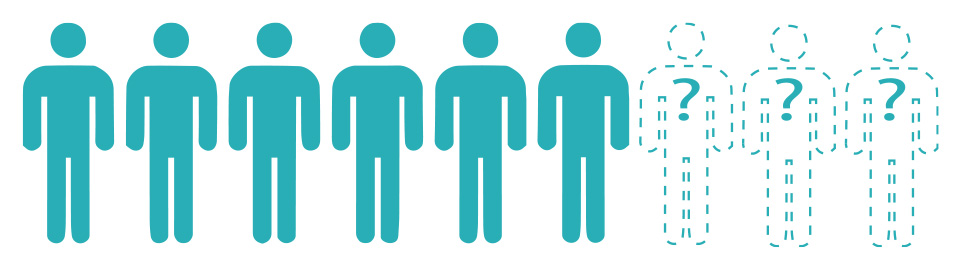
It’s common for businesses today to look for creative ways to expand their bandwidth to continue to achieve short and long-term goals. For companies that don’t want to make the long-term commitment of hiring full-time employees or are trying to conserve budgets, hiring temporary or “on demand” professionals is a low-risk, cost-effective option.
Recession-Proof Insights Talent from SIVO On Demand Talent
SIVO On Demand Talent can help with skilled Consumer Insight and Market Research Professionals that ease your team’s workload and help you achieve your business goals while also relieving you of the financial risk that is common during a recession.

We offer flexible solutions, like short or long-term assignments for fill-in roles or finite projects. Additionally, we can serve as an extension of your internal Consumer Insights Team, what we like to call your “back-pocket” consultants. For some clients, our talent serves as the virtual CI team, supporting initiatives in a cost-effective way while also ensuring high quality insights.
SIVO On Demand Talent offers far more flexibility than full-time employee expansion. Plus, you don’t have to spend your valuable time searching for, hiring, and training talent. We take care of it all for you, freeing you from the burden of a lengthy process.
Let SIVO help you manage through the ‘hiring freeze” by temporarily meeting your Insights, Analytics or Market Research talent needs.
Reach out to ondemandtalent@sivoinsights.com for a consultation.
SIVO Insights brings together research, talent, and intelligent technology to help organizations navigate complexity with confidence. Have a business challenge? Let's talk!
We bring together research, talent, and intelligent technology to help organizations navigate complexity with confidence