
To Know Thyself is the Beginning of All Wisdom [Aristotle]… and as it turns out, it’s also the beginning of your Brand Strategy
At SIVO Insights, we spend a lot of time helping our clients understand who their consumers are, what they need and why. It is just as important to help our clients understand the competitive context within which they operate, to understand where and how their brands can differentiate and create an ownable competitive advantage.
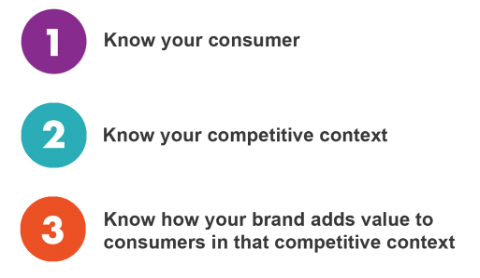
We work with our clients using a three-pronged approach to set a solid brand strategy:
A simple exercise that teams can use to consider and articulate the market that their brand best competes in, is the “Big Box, Little Box” Model.

In this model, teams define the market, or “Little Box” that they believe their brand currently operates in, and what benefits they distinctly deliver to that market. Next, the team considers a broader market definition, the “Big Box”, to understand who is in the brand’s expanded list of competitors and what benefits their product could distinctly deliver in that broader context. By doing this exercise, the team broadens their view of who they are truly competing with and where they can source volume. This helps teams reframe how they present their brand and its ownable benefits to the world. i.e., the brand positioning, which in turn, impacts future renovation, innovation, and communication efforts.
Trending
Do customers want to ‘hire’ your product?
A team that manages a coffee brand might define their “Little Box” as the Coffee category. In that competitive context, the team will likely focus on functional coffee benefits such as richest flavor or best price, to compete with other coffee brands. But when they broadened their view of the competitive context to the “Big Box”, they might find that they are competing with the broader ‘caffeinated beverage’ market. In this context, the key benefits that the team may focus on to differentiate and compete with caffeinated sodas and energy drinks would be things like “warmth, comfort, and enabling your morning ritual.”
The big box, little box model allows teams to…
Discover who they are truly competing with
Reframe their brand strengths within the broader, and likely more accurate, competitive context
Identify which brand benefits are most ownable and distinctive vs. the competitive set
Reconsider who their target consumer is and how to position the brand to meet the needs of this larger consumer target group
Our experts can…
Facilitate a Big Box/Little Box exercise with your team
Execute a qualitative exploration to understand where your brand truly competes
Execute an Attitude and Usage (A&U) study to quantify which competitive products/categories are true competitors
Facilitate a workshop, using the learning above, to rethink and redefine brand strategy
Contact us at Contact@SIVOInsights.com for more information and next steps.
In your brand's early development stages, you likely gave much thought to the idea of a buyer persona.
You researched who you expected to purchase your products, how they would interact with your brand, and which factors would influence them to choose your brand over a competitor's. You painted a picture of what their needs are, what they do, and how their key motivators would align with your offerings.
Now, it's time to see that journey in action.
The path to purchase describes the journey that your target buyers take from the moment they first discover your product or service until they ultimately decide to buy it. The better you understand this journey, the easier it is to connect with them at key milestones and decision points to convert them from awareness to consideration to purchase, and then to repeat purchases.
Today, we're sharing how to conduct this research effectively and what to do with the results you uncover.
Put simply, the path to purchase encompasses all of the steps that your users take as they convert from a prospect into a paying customer. This can include multiple different channels, touchpoints, and platforms.
While each person's brand experience will be nuanced and unique, most leads take a few central steps as they travel along this journey. These include:
Also known as a customer journey or buyer journey, the path to purchase can be a valuable part of your audience analysis. It allows you to climb inside the mind of your prospective buyers, and current buyers and understand why and how they're engaging with your brand.
Let's break these stages down a little, explaining the important aspects to research and analyze.
The first step in the path to purchase is awareness. This is the moment that your prospective customers first learn about your brand, and it sets the tone and the stage for the rest of your interactions together.
Years ago, mass marketing campaigns were more effective than they were today. Modern buyers want customization and personalization at every turn, and 80% are more likely to purchase from a brand that offers tailored experiences. This means that gone are the days when you could send out one e-mail blast or a generic postcard to your leads and expect them to convert.
Now, the most effective ways to reach your target audience include:
Not only should these outreach measures be personalized, but they should also include a call-to-action (CTA) that encourages users to take that next step. Do you want them to check out your website, sign up for your e-newsletter, contact you to set up a consultation? Remember to make the CTA clear, actionable, and easy to follow.
Once you've initiated the path to purchase, you can track your marketing efforts, e.g., engagement and response rate, to understand how effective your chosen tactics were. For instance, with inbound marketing campaigns, most website analytics platforms, such as Google Analytics, or CRM systems, such as, HubSpot, allow you to easily monitor the traffic going to your website, the number of views each blog gets, or the success rate of your paid online ads.
Regularly review these numbers to understand which channels are the most successful. Then, fine-tune the most profitable ones and look for ways to eliminate or phase out the ones that aren't as fruitful.
For larger brands with national distribution, you can also conduct advertising and brand awareness tracking research to understand the percentage of consumers who are aware of your advertising and brand, pre vs. post the execution of your marketing campaign or in regular intervals such as, one or two times per year.
Key questions to ask at this stage include:
Piquing the interest of your target buyer is only the first part of the path to purchase. Next, the prospect will consider all of the features that your company or product offers, comparing them against others in your same space. They're looking for differentiators that set your brand apart, such as price point, quality, speed of delivery, product features, and more.
To perform this competitive analysis, they may perform the following steps:
At the core of this step is the buyer's need for information and insights. If you can provide this intelligence about your solution better than anyone else can, then you're more likely to move them from this phase of the buyer journey to the next.
In this step, you'll need to research and manage your online presence and reputation. Do you know what your target buyers will see when they search for your brand name online?
There are reputation management tools that can help you uncover and respond to your company reviews. In addition to the reviews on your website or Google Business Profile, remember to also check common and industry-specific third-party review sites.
Another area to research is how well you've explained and demonstrated your product or service. If a prospective customer wanted to learn more about how your solution works, are there online descriptions, manuals, sheets, videos, or in-store signage that make this step simple? The more transparent you can be, the easier it is to compare your solution against another.
Key questions to ask at this stage include:
After a lead discovers and researches your brand, they may decide to take that next step and make a purchase. To help them get there, you'll need to provide information that reveals why your company or offering is the best fit for their needs.
Depending on the solution you offer, this could require the buyer to make a significant investment. They'll want to review all of their options and compare top features to make sure they're making a wise decision.
This final stage of the path to purchase is all about sealing the deal. Research your company's current methods for engaging prospects and moving them along the sales funnel.
Some companies with “Business to Business” (B2B) offerings might use this time to perform presentations, pitches, and demos to share how their products work. Others with “Business to Consumer” (B2C) offerings might use advertising, on-package claims, third-party endorsements and in-store signage to demonstrate their benefits to prospective buyers. . The nature of your business and the type of audience you serve will dictate the exact strategy you deploy.
Key questions to ask at this stage include:
At each stage of the consumer path to purchase, you'll have the opportunity to gather insights into buyer behaviors. As you do, it's important to know what metrics to track, when to dive in, and who to involve. Here are a few tips to help you make the most of the data you obtain.
As brands seek to improve their buyers’ path to purchase experience, most are focused primarily on hard numbers, aka quantitative data, about the purchase, including volume, amount and frequency of sales, who and where purchased, percent of repeat purchases, etc. While this type of behavioral data is extremely important -, but don't underestimate the value of qualitative insights about the buying journey.
The ultimate goal of each phase is to understand the mindset of your buyers, and you can't get there with quantitative measurements alone. You need to understand the emotions that your prospective buyers are feeling, as well as what's behind their concerns, hesitancies, and excitement.
A few of the ways you can capture qualitative feedback include:
Not only are these insights helpful in directing your current and future campaigns, but they can also motivate your internal stakeholders. If you can share direct quotes and client feedback with your C-suite and marketing teams, it's easier for them to understand the human side of their work, in addition to the technical and economical side.
For some B2C companies, there is a primary shopper involved in each brand interaction. However, most B2B transactions involve other, behind-the-scenes decision-makers and influencers.
As such, resist the temptation to consider the path to purchase as strictly linear and one-dimensional in nature. In reality, it's more multi-faceted and complex.
Try to learn about the key stakeholders involved in buying decisions, as well as their specific roles. It also helps to understand how they interact with one another, as well as when each one enters and leaves the buyer journey. While some will be involved from start to finish, others may join and leave at different times.
To get the fullest view of your path to purchase, don't start your research at the first time the buyer and seller interact. Instead, go back even further to the pre-shopping stage. Increasingly, this means analyzing how buyers live, work, and how they find and compare offerings to meet their needs.
Today, most buyers are hopping online to discover new brands. In fact, in the B2B sphere, the average customer performs 12 different searches before deciding to engage with a specific brand. While it can be difficult to pinpoint exactly when a buyer first discovers your brand, spend time exploring different purchasing triggers to understand how to optimize these interactions.
As you research and learn more about your customerpath to purchase, you can customize and fine-tune your offerings and marketing communications to appeal precisely to those who are interested in them the most.
At SIVO, we're dedicated to helping our clients understand their buyers' needs, beliefs, and behaviors. We can help you gain visibility and address challenges by asking the right questions directly to your target audiences. Then, we'll work with you to turn those insights into actionable steps that can drive conversions, improve engagement, and build brand reputation. Contact us at Contact@SIVOInsights.com or go to SIVOInsights.com today to schedule a discovery call and connect!
By Marilyn Weiss
In the evolving landscape of market research, methods that leverage technology are continually being developed to gain deeper insights into consumer behavior. Mobile Missions are a straightforward approach that has proven successful for SIVO clients. This approach allows researchers to tap into consumers' real-life experiences in a natural and engaging way, collecting meaningful data in the form of open-ended responses, photos and video footage.
Understanding Mobile Missions
Mobile Mission research is an immersive approach that leverages mobile technology to engage participants on their own schedule and in their natural environments. This involves prompting consumers to complete a series of activities and questions via their mobile devices, capturing their experiences, thoughts, and behaviors in real-time.
Benefits of Mobile Missions
Mobile Missions offer several advantages over traditional research techniques:
Real-Time Interaction: Participants receive prompts and tasks on their mobile devices, allowing them to respond in real-time as they shop, prepare, or use products.
Natural Environment: The method captures consumer behavior in real-life settings, such as their homes or local stores, ensuring more genuine participation and deeper insights.
Engagement and Comfort: Participants can complete tasks at their own pace, allowing them time to reflect and encouraging more thoughtful and honest responses.
Remote Observation: Researchers can observe and interact with participants remotely, making it easier to conduct research in environments where in-person observation might be challenging or restricted.
Applications for Mobile Missions
Mobile Missions are versatile and can be utilized to achieve various research objectives. Five common applications that we see at SIVO include:
1. Shopper Insights
2. Customer Journey Mapping
3. Brand and Promotion Engagement
4. Behavioral Insights
5. Competitive Analysis
By utilizing Mobile Missions across these diverse areas, companies can gain a holistic understanding of their consumers and their products, leading to more informed decisions and tailored strategies that resonate with their target audience.
Executional Details
The execution of Mobile Missions typically involves the following specifications:
Your Partner for Progressive Solutions and Actionable Insights
At SIVO, Inc., we are on a constant quest to identify innovative solutions that lead to meaningful insights for our clients. We have had great success in utilizing Mobile Mission technology to capture consumer perceptions and behaviors in a natural and engaging manner to achieve your learning objectives.
Contact us via our website form or email us at Contact@SIVOInsights.com to schedule a discovery call to discuss your business and market research needs.
As 2026 planning season approaches, most leaders are focused on big decisions: where to invest, how to grow, and which bets to place. But the strongest strategies don’t begin with goals, they begin with your consumers.
In fact, the annual planning season is the perfect time to pressure-test assumptions. Before you finalize budgets or commit to growth strategies, it pays to refresh your understanding of today’s consumer landscape. What’s changed? What’s emerging? And what gaps in understanding could derail your decisions?
This post outlines how to approach annual planning through the lens of consumer truth, so you can build smarter, more aligned strategies. Let’s dive in!
For many organizations, planning still begins with internal goal-setting: revenue and profit targets, innovation and growth priorities, and cost cutting. And high-performing teams know that successful strategy isn’t just about setting ambition, it’s about aligning that ambition to current market conditions.
Consumer behavior is one of the most dynamic variables in that equation, and often, one of the most overlooked. Market assumptions that were true a year ago may no longer apply. Purchasing patterns, motivations, and category expectations can shift quickly, especially in volatile economic environments like the current one. And if your plan doesn’t reflect those changes, it’s much more likely to underperform.
This consumer-centric understanding is foundational. It informs product decisions, pricing, messaging, innovation, and channel strategy. Without it, even well-intentioned plans can quickly drift out of sync with real consumer needs. Starting with the consumer also accelerates alignment. It gives cross-functional teams, from marketing to finance to sales, a shared understanding of where the business is heading and why. It moves planning conversations from opinion to evidence and from speculation to strategy.
If the case still isn’t clear, consider this: even well-resourced plans fail when they aren’t aligned with current consumer behavior. It’s often not about effort or execution, it’s about starting with the right inputs. Let’s look at a few examples:
Outdated consumer insights can lead to misdirected efforts, misaligned messaging, missed opportunities, and unnecessary risk. To illustrate what this looks like in practice, here are two common scenarios where strategy easily goes off track because the consumer context was never fully validated.
A company sets aggressive growth targets and decides to compete more directly with newer players in the category. They allocate budget toward developing a new product with features they believe will differentiate them. The plan gets approved. Timelines are set. Everyone is getting ready to mobilize fast and execute.
But the innovation was based on an internal assumption about what consumers wanted – not on recent consumer insight. In reality, consumers weren’t looking for more features. They were looking for simplicity, availability and value. The company spends $$$ getting the launch ready, but the product doesn’t gain any traction. The opportunity for a product refresh was real, but the execution missed the mark because actual buyers weren’t consulted.
Another company, facing margin pressure, looks for quick wins through cost reductions. They make the decision to cut a service element they believe is underutilized, based on operational data and internal team feedback.
What they didn’t realize is that this element was one of the few remaining differentiators in the eyes of their customers. It wasn’t used loudly, but it created trust and loyalty. Cutting it might save money in the short term, but it might erode value perception and reduce retention in the long term.
A brand team, focused on stabilizing performance, decides to stick with the same marketing and channel strategy that had worked well in the past. But in the background, both consumer behavior and category norms had shifted.
Competitors began simplifying their digital experience, consolidating touchpoints, and creating seamless mobile journeys. Meanwhile, this brand was still investing in a fragmented app strategy and outdated content flows. The team didn’t realize that expectations had changed. Consumers weren’t looking for more brand interaction, they were looking for convenience and control in one place. By the time results started to dip, the gap was already visible. A competitive audit or trend review could have flagged these shifts much earlier, giving the brand time to adapt before losing relevance.
These are not unusual cases. They reflect a planning process that moved forward before validating the reality on the ground. Other common issues include planning around outdated needs or occasions, targeting segments that have shifted or declined, or simply prioritizing the things that don’t matter to consumers anyways. None of these decisions are inherently flawed, but when they’re based on outdated or assumed insight, the risk of “planning in the wrong direction” increases.
The good news is you don’t always need to start from scratch. In many cases, the best approach is to audit what you already have, identify gaps, and decide what needs to be refreshed or revalidated.
Here are some key areas worth pressure-testing, before you commit to planning:
Many teams start with a Get Smart session. It’s a fast-turn immersion that pulls together everything you already know, from existing data to partner knowledge to internal POVs, and highlights what’s still missing. These sessions help surface blind spots, align teams, and set the foundation for what to explore further through new research or analysis, which will lay the foundation for a solid and strategic plan.
Insight work at this stage doesn’t need to be complex. It just needs to be focused, current, and relevant to the decisions you’re about to make.
The strongest strategic plans are built on a clear understanding of the consumer. When that understanding is current, relevant, and grounded in reality, teams make better decisions, faster, with less risk, and greater impact. At SIVO, we help businesses enter planning season with confidence:
Whether you need to revalidate consumer segments, understand emerging behaviors, or map new usage occasions, our team designs studies that answer the right questions at the right time. We work fast, focus on what matters to your business, and turn insight into clear recommendations for strategic use you can easily relate to in your annual plans.
Need to align insights and teams quickly? Our Get Smart sessions help you make sense of what you already know and highlight the gaps that matter most. These sessions help build internal alignment early and avoid late pivots, and are perfect as a foundation for your annual plans.
Already have an internal insights team, but planning season is stretching your resources? SIVO’s On Demand Talent gives you access to senior insights professionals who can plug into your team quickly. Whether you need a trends lead, moderator, or strategic storyteller, we match you with the right expert, without hiring delays and long-term commitments. The perfect flexbile insights approach to supercharge your insights team for the planning season!
Consumer truth is the foundation of smarter annual planning. Whether you're building that foundation or scaling your team to deliver it, we're here to help.
Innovation requires seamless collaboration, agility, and the ability to pivot wisely and effectively. Timelines are tight and the right talent is critical to successfully manage the Insights process. SIVO’s On Demand Talent™ team recently provided a Consumer Insights Innovation Lead for Betsy Frost, Chief Revenue Officer at DRY Soda Company.

DRY Soda needed a Consumer Insights expert to manage the First Moment of Truth (FMOT) consumer learning for a new product launch, DRY Botanical Bitters & Soda, a ready-to-drink non-alcoholic cocktail with zero sugar.
“…it felt like SIVO was a member of our team.”
From the get-go, the SIVO’s talent creatively leveraged DRY Soda’s internal assets and owned social media to recruit the right consumers for quick-turnaround learning. Timelines and budgets were priorities, with no room for missteps. When supply chain complexities forced an immediate change in launch plans, the team worked smartly and effectively to pivot from cans to bottles in a record 15 days. Navigating a plethora of moving parts, including new package design, messaging, team alignment, and consumer feedback demanded an experienced team to pull it off successfully!
During Consumer Research, Frost was thrilled to listen, participate and ultimately make the right real-time decisions from an outside vantage point rather than having to lead and facilitate herself.
Frost said, “You made it super easy and streamlined for me…it felt like SIVO was a member of our team.”
To learn more about the DRY Soda story and line of products available, visit drinkdry. Check out this new product: DRY Botanical Bitters & Soda!
You can Shop Now or click the ‘Find Dry’ link to leverage the unique geo-locator. It allows you to buy online or from the store front retailer of your choice. This shoppable platform is powered by Pear Commerce technology.
SIVO Insights On-Demand Talent provides the right talent for your business needs; it is NOT a one size fits all model. What talent do you need to immediately impact YOUR business? Email Brent Budke to successfully match the right talent.
Are you curious what working differently looks like? – just ask. SIVO Insights can help you figure out the best path forward for you or your company to get the resources – and talent – you need. Schedule a discovery call today to get started.
SIVO Insights brings together research, talent, and intelligent technology to help organizations navigate complexity with confidence. Have a business challenge? Let's talk!
We bring together research, talent, and intelligent technology to help organizations navigate complexity with confidence