
What is a Consumer Target
At the foundation of all great marketing initiatives is a complete and deep understanding of the consumer target. The consumer target is a specific and detailed description of the type of person who has needs or desires that you believe can be served or helped with your products or services. Truly identifying and understanding the consumer target can inspire creative and innovative thinking to help grow your brand through new products, marketing campaigns, or promotions that fulfill their needs and wants.
Segmenting the Market to Identify Your Consumer Target
Teams must be focused and clear about who their consumer target is and is not. This consumer does not represent everyone that purchases your product or service.
A typical first step to identifying your consumer target is to segment the market you operate in. Market or consumer segmentation is a market research approach that allows you to divide the universe of potential consumers into smaller groups or segments based on their characteristics. The segments are composed of consumers who will respond similarly to marketing strategies because they have shared demographics, needs, interests, values and/or locations. Once the market has been segmented, an assessment is required to understand which segment of consumers offer the most potential for growth, i.e., which group is most likely to find value and be motivated by your business proposition and respond to your initiatives, across the 4Ps of product, placement, pricing, and promotion.
Building Knowledge About Your Consumer Target
While segmentation is a great first step in identifying your consumer target, it is only the beginning. Every day you will be faced with making business decisions based on what you know about your consumer target and how you think they will respond to your actions. You should have basic knowledge covering five key areas:
Answering these questions requires a combination of sales data analyses, quantitative assessments such as, attitude and usage studies plus, qualitative, or observational techniques such as, in-depth interviews, in-store shop-alongs, and in-home ethnographic research to fully immerse in how your consumer target thinks, lives and shops. Oftentimes, this is referred to as developing the consumer target persona.
Building Consumer Empathy
The ultimate goal is to build empathy for and intuition about your consumer target. You need knowledge to understand what is in their head (how they think) and empathy to understand what is in their hearts (how they feel and their underlying motivations). Most of the time, you yourself are not the target consumers so you must spend time with them to truly understand their lives, values, beliefs, and behaviors. The goal should be to move through the following spectrum to be able to genuinely empathize with your consumer target.
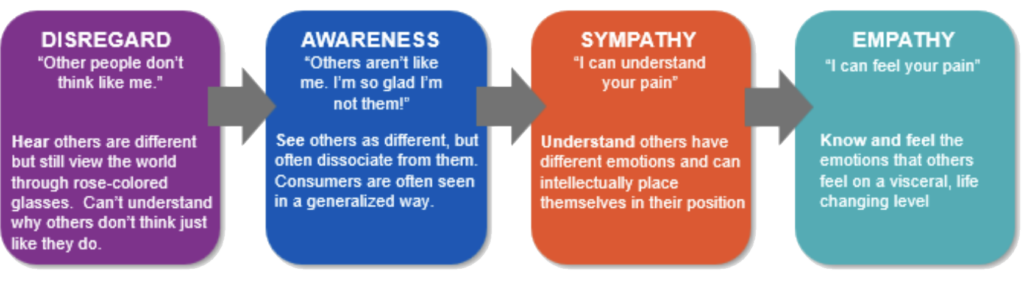
How to Get to Empathy for Your Consumer Target
Building empathy is different from conducting a typical market research study. Market research is designed to answer specific business questions by getting feedback and perspective from consumers. For instance, you might conduct market research to understand how your product compares to the competition or what product varieties you should launch next.
An empathy trek is solely designed to gain better understanding of who your consumer target is. It is a listening and observation exercise, designed to help you “walk in their shoes” and “feel what they feel.” In an empathy trek, you’ll explore how your consumer target lives, what they value, believe and how they behave. By building consumer empathy, you will build your intuition about them, and are able to make business decisions on their behalf.
The Value of Truly Knowing Your Consumer Target
The value of building empathy for your consumer target is tremendous. Specifically, it can:
Your Source for Expert Consumer Insights
As you and your team learn more about your consumer, your marketing and innovation ideas will get more targeted at serving their needs, which will in turn, make them more successful. Ideally, you will be able to reach them at key moments of truth, physically or digitally with personalized content that improves the brand experience and loyalty.
At SIVO, we are dedicated to helping our clients identify and understand their consumer target’s perceptions, needs, beliefs, and behaviors. We create learning plans that will help you gain valuable insights by applying the right approaches to identify your market segments, consumer target persona and to build consumer empathy for you and your team.
Contact us via our website form or email us at Contact@SIVOInsights.com today to schedule a discovery call!
By Cindy Blackstock, CEO and Founder
Customer experience—say it and everyone’s ears perk up. CX is influencing and intersecting with consumer insights across most business sectors: CPG, Retail, Automotive, Financial and Healthcare, to name a few.
The X Factor
Despite it being a buzz worthy term, there doesn’t seem to be a singular, agreed-upon, industry-wide definition for the term customer experience, affectionately referred to as CX. Definitions and approaches to CX vary but most just want to know what that “X” factor means for categories, brand, and products.
Here at SIVO, we have our own perspective:
In truth, we have been working to reveal the customer experience all along. For us, it’s not an intimidating or nebulous concept, because we are quantitative and qualitative research experts who are skilled at understanding people to reveal their truths. Through the optimal combination of quantitative and qualitative research approaches, we get to the “what” by collecting customer experience data, identifying the touchpoints along the customer journey. Then, we get to the “why” behind the customer experience data—the stories, emotions, pain points and delights—and translate it into actionable ideas that businesses can use. The two research approaches go hand in hand with the discipline of CX.
Data + Stories = A Winning Formula
Many market research vendors try to capture the customer experience primarily through quantitative research techniques. Survey data is essential for quantifying the various paths and touchpoints along the customer journey. It plays an important role in validating the experience, so teams can also measure change over time. But the process can’t stop there. Survey data is necessary but is not a comprehensive measure of the customer’s voice.
SIVO believes clients need a better blend of data and stories to get the complete picture. It is the human component, in a truly “experiential” in-context setting, that brings the customer experience to life. To make a business impact, organizations need that qualitative, intimate understanding of the experience, to find out what is truly happening during each touch point. In other words, we believe that quantitative research helps identify what to improve, and qualitative research helps identify how to improve the customer experience.
The Steps to Insights
Your customers are on a journey. There may be many individual stops on the route that make up the overall experience. For example, access may be acceptable, customer service may be satisfying, but there may be positive and negative aspects of the product experience for the user. All these individual touchpoints may net to an acceptable customer experience but may not reveal the nuanced opportunity areas that could lead to an improved experience. Brand teams need to talk to customers and ask, “How are you doing?” instead of, “How are we (the company) doing?” These questions reveal the crucial and detailed human element of CX.
SIVO stiches together a map, an outline of the touchpoints that make up the journey of the entire customer experience. SIVO’s typical approach is 4 Steps:
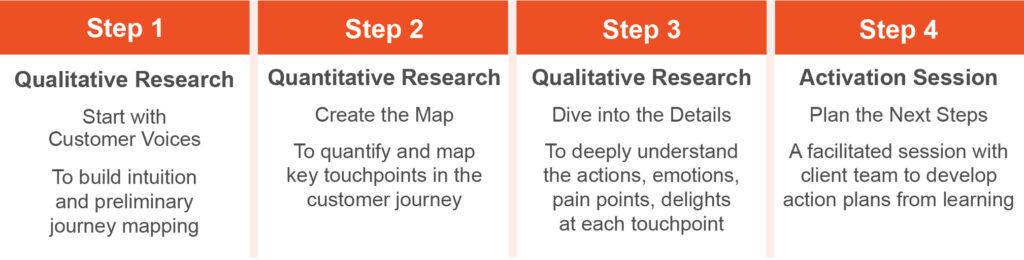
With preliminary insights that build team intuition, quantitative survey data to build and validate the journey, followed by qualitative deep dives to uncover the nuanced details, the true customer experience can be revealed. Teams can map customers’ interaction with the brand across each touchpoint, identify opportunity areas to act on and then track the customer experience annually, to ensure the quality of the experience remains positive or improves over time.
With the journey maps in hand, SIVO’s best practice is to facilitate an Activation Session so that client teams can immerse themselves in the journey and the voices of the customer. A few group discussions and exercises help teams to digest the learning, translate and prioritize into an action plan that can be shared with key stakeholders across the organization.
To discuss your customer experience research needs with experts from SIVO, please reach out to our team at Contact@SIVOInsights.com.
Most “ideation sessions” start in the wrong place.
A marketer or insights associate is told, “We need new ideas—can you run a brainstorm session?” A room is booked, a stack of Post‑its appears, or someone fires off a quick AI prompt: “Give me 50 new product ideas.” The output is usually the same: lots of activity, very little innovation, and no traction.
The ideas are “meh” and not fundamentally new. They don’t feel unique nor anchored in real consumer pain points or the realities of the business. They’re hard to advance with leadership or retail partners.
At SIVO, we see the same pattern across companies: teams are ideating before they’ve earned the right to ideate.
In speaking to our newest SIVO team member, Jon Overlie, who specializes in getting brand teams to great ideas, he says,
“Breakthrough ideas are not the starting point—they’re the result of work that happens earlier: aligning on project expectations, assessing consumers’ needs and pain points, and then making sense of what you’ve learned together. Only then have you earned the right to ideate.”
That’s why Jon and the SIVO team are sharing the EARN Framework with our clients. It is a practical approach to building and facilitating consumer‑fueled idea sessions instead of meh brainstorms.
EARN has four stages:
In this article, we introduce the EARN Framework and share a “Practical Guide to Building Consumer‑Fueled Idea Sessions” so you have a DIY toolkit for support at every stage, should you choose to run the process on your own.
The first step is to set team expectations for what you want to accomplish and how to accomplish it.
Most weak ideation sessions start with fuzzy intent. People walk in with different definitions of success, different consumers in mind, and no shared problem statement. The session becomes a catch‑all for every gripe, wish and idea in the organization.
In the Expectations stage, you slow down tospeed up:
When teams see this captured in one place, ideation stops being a vague “idea grab bag” and becomes focused problem‑solving in service of a business and consumer need.
In the Practical Guide, this stage is supported by simple prompts and a project scoping template you can use to get everyone on the same page before you ever schedule an ideation.
With the project scope in place, it is time to assess the behaviors, motivations, and pain points of your target consumers, and the performance of your business, to build team understanding and identify moments or occasions in consumers’ lives that your brand can support.
You can’t create consumer‑fueled ideas if you haven’t actually spent time with your consumers or fully understand the dynamics surrounding your business.
In the Assess stage, you expose the team to both:
Along with a comprehensive business review, the consumer/customer immersion can take different forms depending on your risk and budget:
The goal is to move beyond abstract “targets” and into real, lived consumer or customer stories that everyone in the room has seen or heard.
In the Practical Guide, this stage is supported by an immersion “menu” that helps you choose appropriate ways to assess customer and business input at low, medium, and high levels of investment.
Next, it’s time to reflect on what you hear from consumers and converge on key consumer problems / job territories.
Even when teams invest in good immersion, they often jump straight from “we showed some videos” into “now let’s brainstorm.” That jump skips the most important cognitive step: making meaning together.
In the Reflect stage, you:
Each prioritized territory becomes a “field of play” for later ideation: a specific consumer or customer, in a specific situation, with a specific job and tension, and a clear picture of what success would look and feel like if you solved it.
In the Practical Guide, this stage is supported by a reflection worksheet and a simple job territory card template you can use in to move from scattered observations to 2–5 clear, inspiring consumerjob territories.
Now you have earned the right to ideate, getting to new ideas for products, services, improvements, and customer promotions, depending on project scope.
Only after you’ve set expectations, assessed consumer and business reality, and reflected to identify job territories are you truly readyfor New Ideas.
In this stage, you:
Because the work of E, A, and R has been done, getting to New Ideas becomes sharper, faster, and more productive. Also, new ideas are easier to evaluate against consumer jobs, business realities, and the decision you set out to make.
In the Practical Guide, this stage is supported by a ready‑to‑use workshop agenda example and a short readiness checklist to confirm you’ve truly “earned” the right to ideate before you bring everyone into the room.
The EARN Framework is intentionally practical. Depending on resources, teams can run parts, or even all of it themselves:
Either way, the goal is the same: to move from “meh brainstorms” to consumer‑fueled idea sessions that your organization can believe in and act on.
To make this concrete, we’ve created the Earn the Right to Ideate Practical Guide, a set of simple tools that support you a teach stage of EARN, from aligning expectations to running a half‑day ideation session.
You can use the guide to lead your own earned‑ideation process, or partner with SIVO to co‑design and facilitate it with you on your next brand renovation, innovation pipeline, or consumer promotion.
If you’d like to explore how EARN could apply to a specific project, we’d be glad to connect. Comment below, send us a LinkedIn Message or contact us via SIVOInsights.com.
Every year, businesses face the same challenge: key research projects grind to a halt when insights professionals go on vacation. Deadlines can slip, stakeholder requests pile up, and business decisions get delayed, all because critical expertise isn’t available when it’s needed most.
For many teams, the choice is either overloading remaining staff (leading to problems like burnout) or putting projects on hold (risking lost momentum and missed opportunities). But there’s a better way.
Leading brands solve this problem by leveraging On Demand Market Research Talent—highly skilled, fractional insights professionals who step in seamlessly, ensuring that research initiatives keep moving, even when core team members are out. Whether planned months in advance or needed at the last minute, these experts keep insights flowing year-round without the cost or commitment of full-time hiring.
In this article, we’ll explore:
If your research team has ever struggled to keep up during vacation seasons, this is for you. Let’s dive in.

Insights teams (or their superiors) often assume they can absorb the impact of vacation gaps—but the reality is more disruptive than expected. When key insights professionals are out of office, projects stall, timelines get pushed, and business decisions are delayed. The ripple effect extends beyond just a temporary pause—it can create significant financial, operational, and strategic costs.
Insights don’t operate in isolation. When research is postponed due to staffing shortages, marketing campaigns, product launches, and strategic initiatives suffer. A postponed concept test could mean missing the ideal market entry window, and a delayed brand study could leave unanswered questions right when leadership needs clarity.
The default response to vacation gaps? Overloading remaining team members. This short-term fix often leads to long-term burnout, reducing productivity and increasing the likelihood of rushed, lower-quality insights. High-performing researchers need time to recharge, but when teams are stretched too thin, performance—and retention—suffers.
Even with strong documentation, there’s always implicit knowledge that only team members carry—research nuances, stakeholder preferences, and the context behind past decisions. When an insights pro steps away, this expertise temporarily disappears, forcing teams to either pause projects or make assumptions that may not align with prior research.
Insights teams thrive on being trusted advisors to the business, but when gaps in coverage lead to stalled projects or incomplete data, stakeholder confidence erodes. If leadership views the insights function as unreliable, they may turn to gut instinct over data-driven decision-making—undermining the very role of the Consumer Insights function.
The bottom line? Vacation gaps in insights teams aren’t just an inconvenience—they create costly disruptions that affect business performance. But there’s a way to avoid these risks while still ensuring that research professionals get the breaks they need.
Vacation gaps are inevitable—but research delays don’t have to be.
Vacation gaps are inevitable—but research delays don’t have to be. The key to maintaining momentum without burnout is having a strategy in place before gaps happen. Whether you’re proactively planning or scrambling for last-minute coverage, here’s how leading companies keep research running smoothly, even when key team members are away.
When key team members are out, the biggest risk is insights bottlenecks—studies stall, stakeholder questions pile up, and research deliverables get delayed. SIVO’s On-Demand Talent steps in seamlessly, ensuring business-critical work continues without disruption.
Certain projects can’t afford to pause just because someone is on vacation. Product launches, consumer deep dives, and ad testing require continuity and expert oversight.
Sometimes, vacation coverage isn’t planned—it’s needed last-minute. Whether it’s a sudden leave of absence or a forgotten PTO overlap, scrambling to fill gaps can lead to expensive delays.
Whether planned or unexpected, vacation gaps don’t have to slow down insights. With an On-Demand Talent strategy in place, businesses stay ahead of potential disruptions—avoiding last-minute scrambles and keeping research moving seamlessly year-round.
Leading companies plan ahead—or react quickly—with On-Demand Talent, ensuring no critical work falls through the cracks that can impact the organization. Here’s how organizations leverage fractional insights pros to bridge gaps and keep research running smoothly:
Scenario 1: A national CPG company has ongoing brand equity tracking and ad testing, but their Senior Consumer Insights Manager was heading out for a month-long vacation.
Without coverage, research timelines would have slipped, and stakeholder meetings would have lacked fresh insights. Instead, the company brought in an On-Demand Consumer Insights Strategist to manage the process, ensuring:
This proactive approach prevented research bottlenecks and decision-making gaps, keeping the business moving.
Scenario 2: A global food & beverage company had a new product launch scheduled—but their Head of Consumer Insights and two key team members had overlapping PTO.
With final-stage concept testing still underway and last-minute adjustments needed for packaging and claims, the company faced a potential launch delay. Instead of postponing, they brought in a fractional Insights Lead to:
ODT gave them specialized expertise exactly when they needed it, ensuring no compromises in research quality or speed.
Scenario 3: A leading technology brand was in the middle of a competitive landscape study when an unexpected leave of absence left their insights team short-staffed.
Rather than overloading remaining team members or pressing pause on critical work, they:
With rapid-response talent placement, the company avoided research disruptions and kept its competitive intelligence up to date.
Scenario 4: A major retailer had a busy summer innovation pipeline, but multiple insights pros were out on PTO at the same time.
Rather than pausing consumer co-creation sessions and delaying concept testing, they used On-Demand Talent to:
With fractional insights experts seamlessly filling gaps, the company stayed on schedule without sacrificing research quality.
Whether you plan ahead or need urgent support, On-Demand Talent ensures your research stays on track—so your team can take time off without work grinding to a halt.
By leveraging fractional insights professionals, companies can prevent last-minute scrambles, reduce the risk of missed deadlines, and maintain research momentum year-round.
So, how do you avoid research slowdowns when your team is out? And if you’re already facing an urgent coverage issue, what’s the best way to bridge the gap without scrambling?Let’s break it down.
Businesses plan for financial forecasts, marketing campaigns, and supply chain logistics months in advance. Yet, many insights teams still treat PTO gaps as an inevitable issue. The key is building vacation coverage into your annual research strategy so that insights continue flowing, no matter the time of year. Some things you can do:
Planning ahead prevents vacation gaps from becoming business roadblocks. But what if PTO conflicts weren’t anticipated—and now key insights work is at risk of falling behind?
Even with careful planning, unexpected gaps happen. A last-minute PTO request, overlapping team absences, or an urgent business need can leave insights teams short-staffed at critical moments. If you’re already dealing with a research gap, here’s how to minimize disruption fast:
As companies seek more efficiency, many turn to AI-powered research tools to bridge staffing gaps. While AI can be a valuable support system, it has clear limitations that make it an unreliable substitute for expert insights professionals—especially when high-stakes decisions are involved.
For instance, AI is great at surfacing data but doesn’t interpret nuances, human motivations, or cultural relevance—leading to misaligned insights. AI models also (unfortunately) inherit biases from training data, which can skew results if not carefully reviewed and adjusted by human experts. Additionally, executives rely on strategic recommendations, not just raw data—AI lacks the credibility and business acumen needed to drive stakeholder decisions.
If you’re considering using AI to fill vacation coverage gaps for your research team, keep in mind that the more tools you introduce, the more training your team will require. This can actually take more time away from employees rather than increasing productivity—especially for short-term needs like a vacation fill. What seems like an easy solution can quickly turn into a time-consuming distraction, creating more inefficiencies rather than solving the original problem.
When critical insights projects can’t wait, finding temporary research experts quickly is essential. So, where can businesses turn for immediate, high-quality research support?
Many organizations look to freelance platforms and consulting firms, but these often require lengthy onboarding or lack the industry expertise needed for specialized research roles. Others attempt to redistribute workloads internally, which can lead to inefficiencies and overburdened teams.
A more effective approach is tapping into pre-vetted insights professionals (like ODT) who can integrate quickly, understand complex research needs, and keep projects moving without disruption. Whether covering for a planned PTO or responding to an unexpected gap, having a flexible resourcing strategy ensures that insights teams can maintain momentum—without last-minute scrambles or overburdening internal staff.
At SIVO, we provide businesses with flexible, on-demand insights talent to keep research initiatives moving—no matter the challenge. Whether you need short-term vacation coverage, interim leadership, or specialized expertise for a critical project, we place senior-level insights professionals within days.
Don’t let research slow down when key insight team members are out for vacation. Let’s talk:
contact@sivoinsights.com | www.sivoinsights.com/on-demand-talent-management/
Are you facing these challenges?
More workload and pipeline projects than your team can execute
Questioning how to keep saying “Yes” to internal stakeholders
Not enough time or resources to meet multiple requests for actionable insights from leadership, product development, marketing, or strategy
SIVO Insights On-Demand Talent™ is a solution for Insights talent needs for teams just like yours. We leverage our extensive pool of Insights professionals, with years of experience and expertise, to help you achieve your business objectives.
We recommend three key steps for evaluating and making the case internally for hiring contract Insights talent.

As workforce talent continues to evolve, there is no shortage of options, including interns, short or long-term contractors, contract-to-hire, or direct hire. Below, we highlight the advantages of Contract Talent vs. Full Time Hire:
Trending
Do customers want to ‘hire’ your product?

We have started engagements in as quickly as one week. To discuss your needs and how we can match the talent with the best expertise for quick solutions in your organization, visit SIVO Insights On-Demand Talent or email Brent.Budke@SIVOInsights.com.
SIVO Insights brings together research, talent, and intelligent technology to help organizations navigate complexity with confidence. Have a business challenge? Let's talk!
We bring together research, talent, and intelligent technology to help organizations navigate complexity with confidence