



By Kerry Juhl
The Responsibility & Privilege of Serving Customers
“A customer is the most important visitor on our premises. He is not dependent on us. We are dependent on him. He is not an interruption of our work. He is the purpose of it. He is not an outsider to our business. He is part of it. We are not doing him a favor by serving him. He is doing us a favor by giving us the opportunity to do so.”
– Mahatma Gandhi, 1890
This quote is more than 100-years old, but it is still true today. The opportunity to serve customers is a privilege. The responsibility of that privilege is ensuring the customer’s voice is heard and understood. Brand teams need to know what their customers need and what they value, as decisions about products and services are made on the customers’ behalf.
Defining Customer Value
Understanding customer value can be a differentiator for companies in today’s challenging market. Simplistically, if a brand team has $1 to invest – or needs to cut $1 in spending – knowledge about what customers’ value must guide these business decisions to stay competitive.
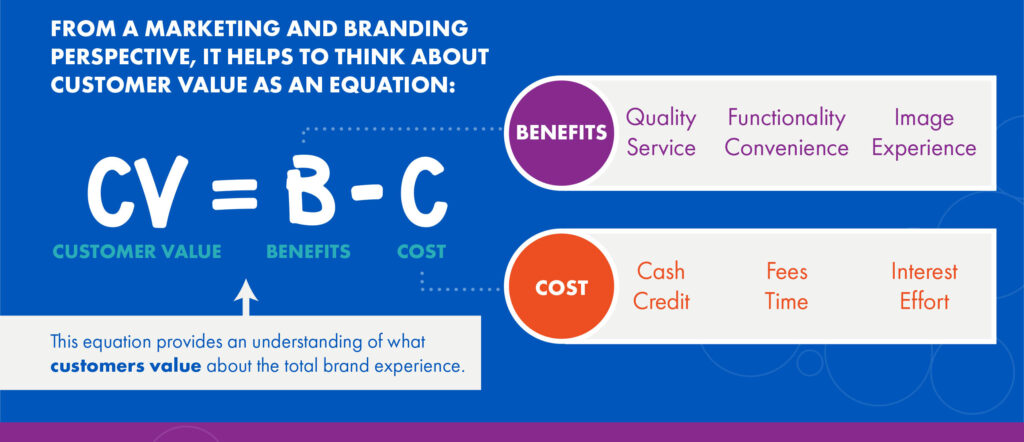
So let’s talk about customer value…In everyday conversations, value has many meanings including price, worth, or even benefits. It is imperative for organizations to operate with a common understanding of customer value. From a marketing and branding perspective, it helps to think about customer value as an equation:
Customer Value equals Benefits minus Cost (CV=B-C).

Benefits include the advantages of quality, service, image, brand, experience, and the functionality one gets or emotions one feels when using the product or service. Cost is not only price – which we think of as cash, credit, interest, even service fees - but it can also include non-price terms such as time, effort, energy, and convenience.*
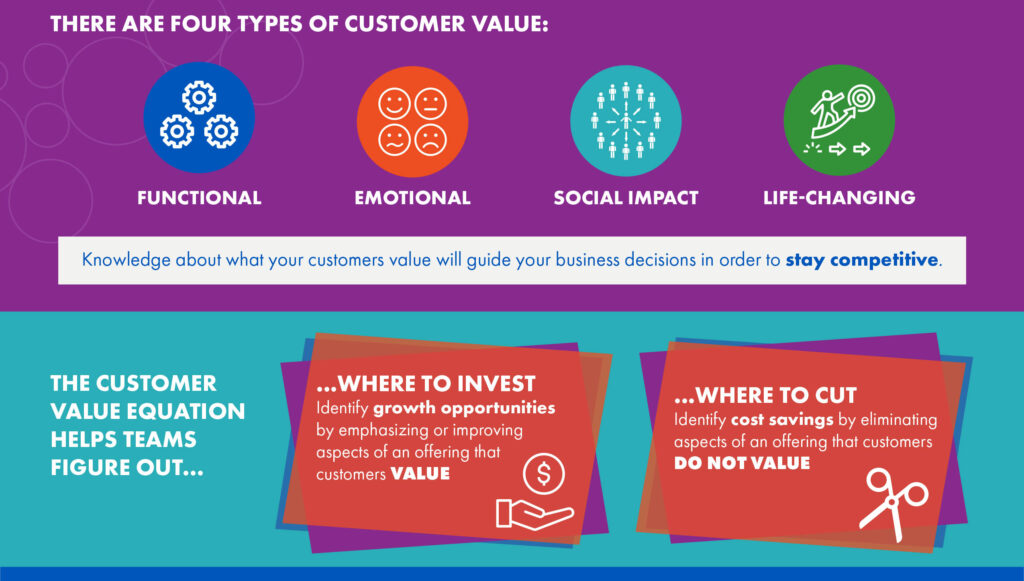
When teams define their Customer Value Equation, they can clearly identify growth opportunities by emphasizing or improving aspects of an offering that customers value (where to invest) and they can identify cost savings by eliminating aspects of the offering that customers do not value (where to cut).
Developing the Customer Value Equation
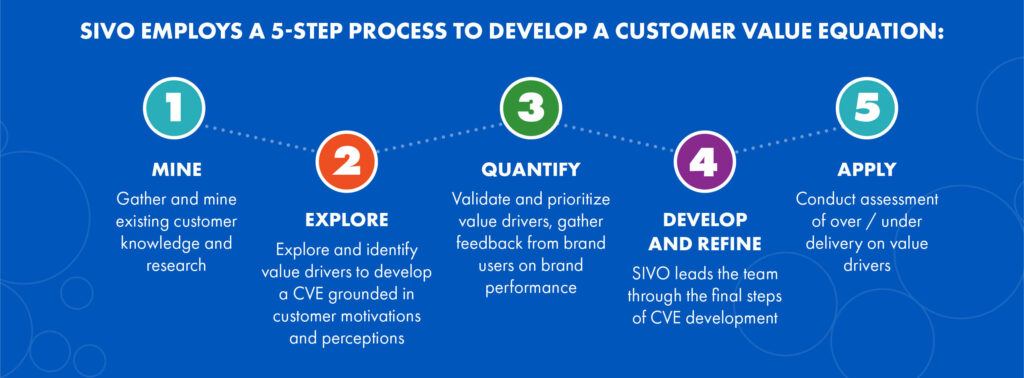
SIVO employs a 5-Step Process to develop your Customer Value Equation. In partnership with our client teams, we Mine, Explore and Quantify the customer value drivers leveraging Functional, Emotional, Life-Changing and Social Impact values. Note that the Quantify Step can be qualitative consumer learning, a quantitative survey or ideally, a combination of both. The design of this step is dependent on how much past learning that the team already has in hand.
Four Categories of Customer Value

We then partner with teams to Develop & Refine the Customer Value Equation. Lastly, we help teams Apply their equation by assessing where their products/services are over/under-delivering and facilitate them through the generation of ideas to improve the customer experience.
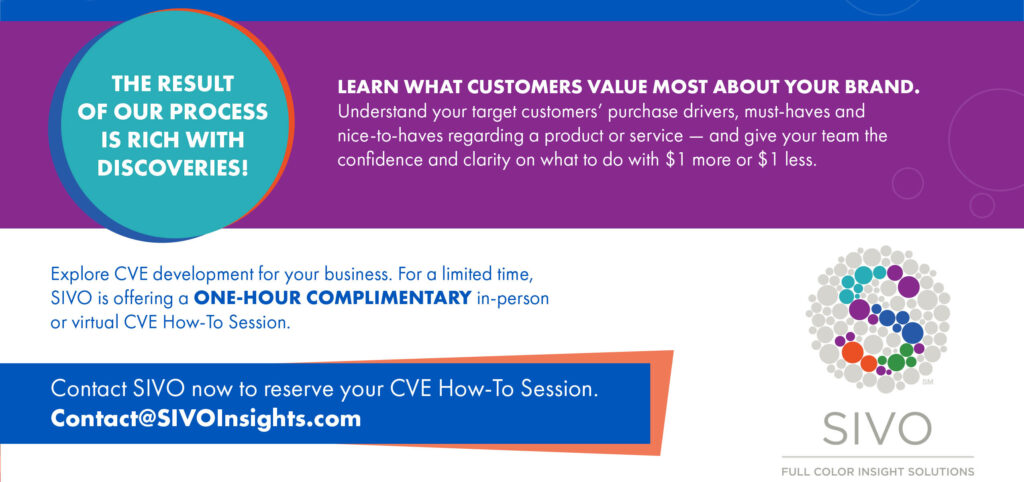
The result of our process is rich with discoveries. These insights provide a unifying understanding of the target customers’ purchase drivers, must-haves and nice-to-haves regarding a product or service – giving teams confidence and clarity on what to do with $1 more or $1 less.
Our Offer to You
SIVO is interested in sharing our Customer Value Equation experience and case studies with you and your insights team! Our “CVE Download” can easily be part of an in-person or virtual “Lunch & Learn” or your next team meeting.
If you can answer “yes” to at least one of the following three questions, please reach out to SIVO.
To learn more, contact us at Contact@SIVOInsights.com.
*Referenced article by Gautam Mahajan https://journals.sagepub.com/doi/full/10.1177/2394964320903557
Through SIVO's "Modern Ways of Working" Mini Chat series, we spoke with innovative consumer insights leader, Jackie Waller, Senior Director of Enterprise Research at The Standard about how to meet the needs of the business while also managing the workload of her Insights team.
One of SIVO's leaders, Brent Budke, connected with Jackie to have a "Mini Chat" about the different strategies she employs, including the SIVO, Inc. On Demand Talent fractional staffing solution, to manage workload surges while leading the market research needs of her growing company.
Check out the entire interview here!
https://www.youtube.com/watch?v=Rz792S-dLW0
Many thanks to Jackie for generously sharing her experience and knowledge with our peers across the Insights industry!
By Kerry Juhl
Managing a business is non-stop, full-time leadership. Typically, 90% of a leader's workday is focused on the daily needs of employees, customers, supply chain, marketing, sales, financials... and the list goes on. However, it is also a leader's job to present their team with a vision for the future, a "north star" that provides direction and goals for the organization, allowing them to compete effectively and transform opportunities into growth.
A great step in looking toward the future is to take stock of the landscape that you operate within, especially when there are changing dynamics in the external environment. The future growth of your business requires you to have a point of view on how your business will be impacted by changing consumer behaviors and preferences, the actions of your competitive set and external partners, and possibly the impact of new technologies. In other words, you need to have a vision of what your category/industry will look like in 5+ years to remain relevant in that future state and capitalize on future growth opportunities.
Trending
Do customers want to ‘hire’ your product?
Our team at SIVO has experience with helping clients build their category vision of the future. In fact, we have developed a step-by-step process that results in a defined Future-State Category Map to inform the Category Vision and Key Strategies for growth. A Category Vision not only demonstrates category leadership and anticipates the future, but it allows clients to take control and literally create their own destiny…a future where the business can thrive.

Define Current State:
Clients need to define the space that they currently play in. For some it might be narrow, for example, Skin Care. For others it might be broad, for example, Beauty Products. (There are pros and cons for how narrow or broad your category definition is and SIVO can guide your team to get to a definition that is relevant and actionable through our consumer insights solutions).
This step requires the gathering of category, competitive and consumer intelligence from a variety of sources, to answer questions, like:
Articulate Future State:
SIVO facilitates the client team through a small series of assignments and working sessions to envision the Future State of the category and to prioritize where to “place bets” within the category to maximize growth.
Create a Vision & Strategies to build Future State:
With the future state of the category defined, SIVO facilitates client teams through the creation of a Category Vision that serves as the "North Star", and Growth Strategies that the organization can put into action to drive category and brand growth for years to come.
A solid process with proven success. Are you ready to help your business create a category vision for the future? Schedule a discovery call today or reach out at Contact@SIVOInsights.com to develop strategies and plans that not only anticipate the future but create it!
Bringing you innovative performance marketing and
real-time digital shopper insights.
SIVO strives to be on the forefront of new technology and innovations in the insights industry. That is how we discovered Pear Commerce, a brilliant technology company that is on-pace to be the largest provider of shoppable media by the end of 2022!

In 2018, Pear Commerce was founded by two talented serial tech entrepreneurs, Eric Martell and Alex Wyler, bringing their tech expertise to the world of retail.
What is Shoppable Media?
Shoppable media in retail means connecting any media (e.g. free and paid social, digital display, content, influencer, email, owned webpages, etc) to retailers with add-to-cart (ATC) functionality that is just “a click away”.
What are the benefits to Consumers?
Pear provides an industry-leading technology making shoppers online path to purchase frictionless which has been a leading reservation for consumers to shop online. Whether through a digital ad or your brand’s website, Pear uniquely gives consumers a “where to buy” choice, based on real time stock inventory checks and connects them to over 2,000 retail chains across the U.S. That is a clear point of difference.
What are the benefits to Marketing Teams?
A unique way-in to performance marketing. This revolution of advanced technology provides more data and less work for brand teams with real results. At the foundation, Pear provides full funnel click-to-conversion data which improves digital marketing performance while campaigns are in-market. They help marketers with:
What are the benefits to Insights Teams?
At this point you might be thinking, “That’s great, but isn’t SIVO an insights company?” The answer is, “Yes!” SIVO is all about understanding people and in this case, Pear’s technology helps SIVO and our clients better understand consumer preferences and consumers’ digital shopping behavior through real-time, in-market experimentation, such as:
As an example, Pear was able to help a CPG client create a data-driven approach to managing their digital marketing campaigns while also helping them to understand and optimize the plan based on shopper and retailer behavior.
The results were fantastic! Pear created custom audiences for the brand using the client’s own 1st party conversion data and saw 5x add-to-cart (ATC) rates compared to 3rd party audiences and 20x ATC rates compared to the client’s website visitor audience. During the process, Pear scanned over 2,000 retailer’s digital shelves for real-time inventory to help shoppers purchase at their retailer of choice while also helping them avoid hitting out-of-stocks. The client also received valuable digital path to purchase insights and A/B testing results on different creative options to help optimize their digital campaign along the way.
Through our partnership with Pear Commerce, SIVO can now help you achieve strong digital marketing results and new insights via performance marketing and real-time digital experimentation. To learn more about Pear Commerce and SIVO Market Intelligence solutions, please contact our SIVO team at Contact@SIVOInsights.com.
SIVO Insights brings together research, talent, and intelligent technology to help organizations navigate complexity with confidence. Have a business challenge? Let's talk!
We bring together research, talent, and intelligent technology to help organizations navigate complexity with confidence