
Are you facing these challenges?
More workload and pipeline projects than your team can execute
Questioning how to keep saying “Yes” to internal stakeholders
Not enough time or resources to meet multiple requests for actionable insights from leadership, product development, marketing, or strategy
SIVO Insights On-Demand Talent™ is a solution for Insights talent needs for teams just like yours. We leverage our extensive pool of Insights professionals, with years of experience and expertise, to help you achieve your business objectives.
We recommend three key steps for evaluating and making the case internally for hiring contract Insights talent.

As workforce talent continues to evolve, there is no shortage of options, including interns, short or long-term contractors, contract-to-hire, or direct hire. Below, we highlight the advantages of Contract Talent vs. Full Time Hire:
Trending
Do customers want to ‘hire’ your product?

We have started engagements in as quickly as one week. To discuss your needs and how we can match the talent with the best expertise for quick solutions in your organization, visit SIVO Insights On-Demand Talent or email Brent.Budke@SIVOInsights.com.
As your company is developing and promoting their products and services, it is critical to understand your consumers’ attitudes and behavior to grow the business.
Understanding your consumers require specialized professionals who have the proven market researchtools and best practices. They use a combination of art and scientific methods to gather data regarding consumers’ attitudes, needs, desires and behaviors. So, how do they gather this relevant and meaningful information about the individuals they are seeking to reach and understand more deeply? The answer is Market Research.
Connecting with your consumers and understanding their opinions, needs byutilizing a market research-driven approach can make all the difference in identifying opportunities to build a successful business.
According to Forbes, “Data-driven decision-making (DDDM) is just a fancy term for making intelligent decisions based on what your data is telling you. Modern market research combines DDDM with advanced technology to uncover even more granular data, which can be used to personalize market messaging and find potential areas for growth. Traditionally, market research encompasses four major disciplines: primary, secondary, quantitative and qualitative.”
Primary research gathers first-hand data from consumers. It gives brand teams direct feedback on their services or products from those who are familiar with it or use it. The results are considered conclusive when the data is collected from a representative sample of consumers. Secondary research is when your sources of feedback come from other researchers or second-hand information. This type of market research provides consumer insights by studying trade journal articles, social media conversations, government agency data and published market studies and applying the information to inform business decisions and guide strategies. Together, primary and secondary research can provide more comprehensive and meaningful consumer insights.
Primary research is comprised of both qualitative and quantitative research methods. Qualitative research, which is often exploratory in nature. It captures the in-depth nuances of what consumers say, do, and think by collecting non-numerical data. This could be done through ethnographies, in-depth interviews, focus groups, shopper intercepts, and mobile missions to gather insights that help solve a problem or help you understand your consumers better. Qualitative methodologies focus on obtaining smaller sample sizes so more time can be spent with each consumer. It focuses on the “why” behind consumer opinions, beliefs and behaviors.
Quantitative research is centered on identifying, benchmarking, prioritizing, validating, and translating data into insights that reveal opportunities. Typically, data is collected via online surveys. Quantitative methodologies focus on obtaining larger sample sizes that allow for a higher degree of statistical reliability. This type of research deals with applying statistical analytics to numerical datasets for many business objectives, such as building consumer segmentations, assessing product appeal, understanding the attitude toward and usage of products and services, and mapping consumers’ path-to-purchase journeys.
Both of these research approaches can provide excellent results. It is important to choose the approach that best addresses the business objectives, while taking timing, cost and level of business risk into account.
While primary research provides useful feedback on consumer attitudes and behaviors that can be utilized for developing marketing strategies, there are additional research methods that businesses can leverage to offer teams a holistic view of the consumer.
Brand Sentiment Analysis
Knowing how your brand is perceived by consumers and potential consumers can help you understand the impact of your marketing efforts. . A few factors to look at are consumer awareness, loyalty, advocacy, and value, . Social media monitoring tools are great assets when it comes to measuring consumer sentiment. Studying social media conversations and metrics allow team to identify insights and translate them into actionable strategies. This is a great way to gather unfiltered consumer feedback on your brand.
Understanding your brand sentiment also means knowing how your brand is perceived versus key competitors. It requires selecting the right web conversations to track consumer sentiment for your brand and the competitive brands, to understand strengths, weaknesses, potential threats and opportunities to better compete.
Competitive Intelligence
According to the U.S. Small Business Administration,
“Competitive analysis helps you learn from businesses competing for your potential customers. This is key to defining a competitive edge that creates sustainable revenue. Your competitive analysis should identify your competition by product line or service and market segment.”
Competitive intelligence can support your brand in creating or optimizing marketing campaigns and strategies such as advertising, pricing, and product development and placement. Consider gathering competitive intelligence to get clear on your level of competition and proactively develop relevant actions to compete effectively.
Customer Segmentation
Consumer segmentation is an excellent way to classify customers into specific groups based on their shared characteristics. From here, you can refine your messaging, sales tactics, voice, and tone to connect with these segments of people who are most likely to respond positively to your strategies. This effective approach involves categorizing consumers into different segments, based on their demographics, geographics, behaviors, and psychographics.
The benefit of this market research analytic technique is that consumer segmentation helps businesses devise comprehensive strategies that can help brands attract new customers, retain existing ones, and create brand loyalty across the consumer base.
How Your Business Can Stay Competitive
With technology rapidly increasing and new products and services entering the market daily, it can feel like an uphill battle to stay ahead of the competition. This is why utilizing SIVO’s consumer insight and market intelligence solutions are some of the best decisions you can make for your business. At SIVO, we help you better understand your customers, differentiate from the competition, and develop consistent, consumer-centric products and services by providing your team with actionable insights.
We do this by analyzing market research data that reveals consumer attitudes and behaviors.. This information is turned into actionable insights that result in satisfied consumers, thus higher salesand incremental growth. SIVO will:
SIVO has worked with start-ups to Fortune 500 companies to understand their most essential needs. We then design and execute best-in-class custom market research aligned with your business objectives.
Trust SIVO to Help You Better Understand Your Consumer’s Behavior
SIVO will help you drive your business forward with consumer insights, organizational intelligence, market and competitive intelligence, or on demand talent solutions.
Contact SIVO today to schedule your discovery call.
by Cindy Blackstock
Have you had a conversation with your consumer?
It is an enlightening and humbling experience to really get to know who they are, what they think, how they experience your product or service, and what they need from that experience. It can be very beneficial to be face to face, having conversations with consumers to build your intuition and empathy. However, often it is more valuable to leave the interviewing to expert moderators, allowing you to focus on the answers, rather than how to pose the questions.
Why Use Experts Qualitative Research Moderators
Expert qualitative research Moderators are skilled at conducting qualitative research to uncover the “why” behind the “what” of consumer behavior and preferences. Experienced Moderators apply a range of specific research techniques, with nuance and finesse, to get beyond consumers’ top-of-mind thoughts. This allows them to identify the underlying needs and motivations that drive behaviors and choices.
Specifically, Moderators can help teams across four key learning dimensions:
Moderation Techniques Enable Insights to Surface
With certifications from organizations such as, RIVA, QRCA, and the Insights Association, great Moderators have a broad toolkit, employing specific qualitative research techniques to achieve their research objectives. These research techniques include:
Open-Ended Questions: Starting with open-ended questions that encourage participants to provide detailed responses. These questions typically begin with phrases like “Can you describe…” or “Tell me about…”
Comparative Questions: Asking participants to compare or contrast different aspects of their experiences or opinions. For example, “How does this compare to your previous experience in a similar situation?”
Timeline and Sequencing: Exploring the chronological aspects of experiences by asking participants to recount events in a specific order. This can help create a detailed narrative.
Sensory Exploration: Encouraging participants to describe sensory aspects of their experiences, such as what they saw, heard, felt, or smelled during a particular event.
Metaphorical or Analogical Questions: Asking participants to describe their experiences using metaphors or analogies. This can help participants express complex concepts more vividly. For example, “If this brand was a shoe, what kind of shoe would it be and why?”
Projective Techniques: Using projective techniques like storytelling, drawings, or role-playing to access participants’ subconscious thoughts and feelings.
Whether it is through in-depth interviews, in-context missions, ethnographic research or through online community bulletin boards, great Moderators will employ these techniques to discover underlying insights about the consumer that they could not otherwise articulate through simple conversations.
Trust SIVO with your Qualitative Research
Contact SIVO, Inc. at Contact@SIVOInsights.com to discuss how SIVO can provide you with the insights you need, via our team of expert Moderators to lead your qualitative research projects. Also, check out SIVO’s On Demand Talent Profiles to learn more about how a fractional Qualitative Research Strategist/Expert Moderator can be an asset to you and your team.
To Know Thyself is the Beginning of All Wisdom [Aristotle]… and as it turns out, it’s also the beginning of your Brand Strategy
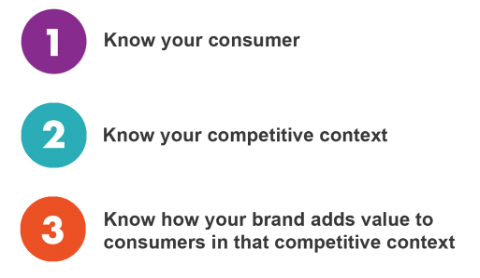
At SIVO Insights, we spend a lot of time helping our clients understand who their consumers are, what they need and why. It is just as important to help our clients understand the competitive context within which they operate, to understand where and how their brands can differentiate and create an ownable competitive advantage.
We work with our clients using a three-pronged approach to set a solid brand strategy:
A simple exercise that teams can use to consider and articulate the market that their brand best competes in, is the “Big Box, Little Box” Model.

In this model, teams define the market, or “Little Box” that they believe their brand currently operates in, and what benefits they distinctly deliver to that market. Next, the team considers a broader market definition, the “Big Box”, to understand who is in the brand’s expanded list of competitors and what benefits their product could distinctly deliver in that broader context. By doing this exercise, the team broadens their view of who they are truly competing with and where they can source volume. This helps teams reframe how they present their brand and its ownable benefits to the world. i.e., the brand positioning, which in turn, impacts future renovation, innovation, and communication efforts.
Trending
Do customers want to ‘hire’ your product?
A team that manages a coffee brand might define their “Little Box” as the Coffee category. In that competitive context, the team will likely focus on functional coffee benefits such as richest flavor or best price, to compete with other coffee brands. But when they broadened their view of the competitive context to the “Big Box”, they might find that they are competing with the broader ‘caffeinated beverage’ market. In this context, the key benefits that the team may focus on to differentiate and compete with caffeinated sodas and energy drinks would be things like “warmth, comfort, and enabling your morning ritual.”
The big box, little box model allows teams to…
Discover who they are truly competing with
Reframe their brand strengths within the broader, and likely more accurate, competitive context
Identify which brand benefits are most ownable and distinctive vs. the competitive set
Reconsider who their target consumer is and how to position the brand to meet the needs of this larger consumer target group
Our experts can…
Facilitate a Big Box/Little Box exercise with your team
Execute a qualitative exploration to understand where your brand truly competes
Execute an Attitude and Usage (A&U) study to quantify which competitive products/categories are true competitors
Facilitate a workshop, using the learning above, to rethink and redefine brand strategy
Contact us at Contact@SIVOInsights.com for more information and next steps.
by Heather Niemczycki
Some changes in the market are obvious, such as, inflation, changing employment rates, and the macro effects of the pandemic. But what about those subtle, not-so-obvious changes that can also have a lasting impact on your brand? Tapping into market intelligence can help you to anticipate changing consumer behaviors, before they impact the health of your brand.
Initiating consumer research is a typical starting point for understanding changing consumer attitudes and behavior. However, you can actually super-charge your research with an informed view of market dynamics before you engage with consumers!
SIVO utilizes advanced cultural context analysis tools that combine data collection from the public web (news, blogs, social media, reviews, etc.) with statistical modeling, to uncover insights into existing market dynamics.

Keep reading to understand it in practice…
Example Output Using SIVO’s Web Analytics Tools:
Inflation Impacts + Grocery Shopping = Changing Consumer Sentiment and Values


Gaining market intelligence like this, BEFORE deep dives into qualitative or quantitative research drives better inquiry and ultimately, adds depth to the research results by delivering consumer insights in the context of the broader marketplace dynamics.
To Super-Charge your consumer research with SIVO’s Market Intelligence toolkit, contact us today at contact@SIVOinsights.com.
In partnership with METAMETRIX, SIVO Insights leverages the METAMETRIX advantage to guide clients in finding better insights, exploring bigger opportunities, and making business decisions that drive greater change by connecting them to broader consumer trends.
METAMETRIX is the first and only platform to analyze any unstructured text data in real-time, revealing the motivating values and emotions buried in the data.
SIVO Insights brings together research, talent, and intelligent technology to help organizations navigate complexity with confidence. Have a business challenge? Let's talk!
We bring together research, talent, and intelligent technology to help organizations navigate complexity with confidence