
by Heather Niemczycki
Some changes in the market are obvious, such as, inflation, changing employment rates, and the macro effects of the pandemic. But what about those subtle, not-so-obvious changes that can also have a lasting impact on your brand? Tapping into market intelligence can help you to anticipate changing consumer behaviors, before they impact the health of your brand.
Initiating consumer research is a typical starting point for understanding changing consumer attitudes and behavior. However, you can actually super-charge your research with an informed view of market dynamics before you engage with consumers!
SIVO utilizes advanced cultural context analysis tools that combine data collection from the public web (news, blogs, social media, reviews, etc.) with statistical modeling, to uncover insights into existing market dynamics.

Keep reading to understand it in practice…
Example Output Using SIVO’s Web Analytics Tools:
Inflation Impacts + Grocery Shopping = Changing Consumer Sentiment and Values


Gaining market intelligence like this, BEFORE deep dives into qualitative or quantitative research drives better inquiry and ultimately, adds depth to the research results by delivering consumer insights in the context of the broader marketplace dynamics.
To Super-Charge your consumer research with SIVO’s Market Intelligence toolkit, contact us today at contact@SIVOinsights.com.
In partnership with METAMETRIX, SIVO Insights leverages the METAMETRIX advantage to guide clients in finding better insights, exploring bigger opportunities, and making business decisions that drive greater change by connecting them to broader consumer trends.
METAMETRIX is the first and only platform to analyze any unstructured text data in real-time, revealing the motivating values and emotions buried in the data.
What is a Consumer Target
At the foundation of all great marketing initiatives is a complete and deep understanding of the consumer target. The consumer target is a specific and detailed description of the type of person who has needs or desires that you believe can be served or helped with your products or services. Truly identifying and understanding the consumer target can inspire creative and innovative thinking to help grow your brand through new products, marketing campaigns, or promotions that fulfill their needs and wants.
Segmenting the Market to Identify Your Consumer Target
Teams must be focused and clear about who their consumer target is and is not. This consumer does not represent everyone that purchases your product or service.
A typical first step to identifying your consumer target is to segment the market you operate in. Market or consumer segmentation is a market research approach that allows you to divide the universe of potential consumers into smaller groups or segments based on their characteristics. The segments are composed of consumers who will respond similarly to marketing strategies because they have shared demographics, needs, interests, values and/or locations. Once the market has been segmented, an assessment is required to understand which segment of consumers offer the most potential for growth, i.e., which group is most likely to find value and be motivated by your business proposition and respond to your initiatives, across the 4Ps of product, placement, pricing, and promotion.
Building Knowledge About Your Consumer Target
While segmentation is a great first step in identifying your consumer target, it is only the beginning. Every day you will be faced with making business decisions based on what you know about your consumer target and how you think they will respond to your actions. You should have basic knowledge covering five key areas:
Answering these questions requires a combination of sales data analyses, quantitative assessments such as, attitude and usage studies plus, qualitative, or observational techniques such as, in-depth interviews, in-store shop-alongs, and in-home ethnographic research to fully immerse in how your consumer target thinks, lives and shops. Oftentimes, this is referred to as developing the consumer target persona.
Building Consumer Empathy
The ultimate goal is to build empathy for and intuition about your consumer target. You need knowledge to understand what is in their head (how they think) and empathy to understand what is in their hearts (how they feel and their underlying motivations). Most of the time, you yourself are not the target consumers so you must spend time with them to truly understand their lives, values, beliefs, and behaviors. The goal should be to move through the following spectrum to be able to genuinely empathize with your consumer target.
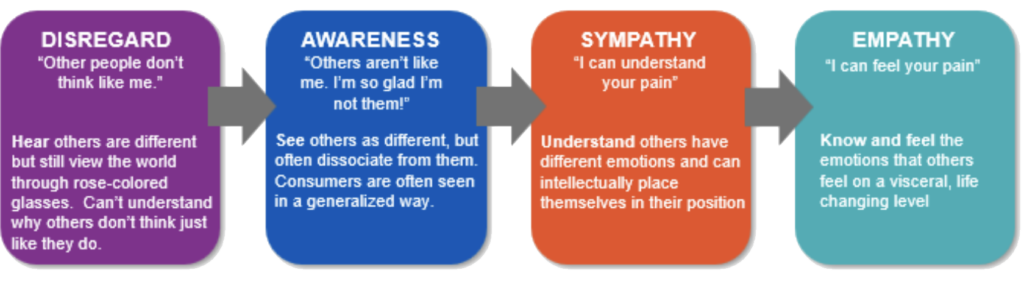
How to Get to Empathy for Your Consumer Target
Building empathy is different from conducting a typical market research study. Market research is designed to answer specific business questions by getting feedback and perspective from consumers. For instance, you might conduct market research to understand how your product compares to the competition or what product varieties you should launch next.
An empathy trek is solely designed to gain better understanding of who your consumer target is. It is a listening and observation exercise, designed to help you “walk in their shoes” and “feel what they feel.” In an empathy trek, you’ll explore how your consumer target lives, what they value, believe and how they behave. By building consumer empathy, you will build your intuition about them, and are able to make business decisions on their behalf.
The Value of Truly Knowing Your Consumer Target
The value of building empathy for your consumer target is tremendous. Specifically, it can:
Your Source for Expert Consumer Insights
As you and your team learn more about your consumer, your marketing and innovation ideas will get more targeted at serving their needs, which will in turn, make them more successful. Ideally, you will be able to reach them at key moments of truth, physically or digitally with personalized content that improves the brand experience and loyalty.
At SIVO, we are dedicated to helping our clients identify and understand their consumer target’s perceptions, needs, beliefs, and behaviors. We create learning plans that will help you gain valuable insights by applying the right approaches to identify your market segments, consumer target persona and to build consumer empathy for you and your team.
Contact us via our website form or email us at Contact@SIVOInsights.com today to schedule a discovery call!
Through the SIVO, Inc. "Modern Ways of Working" Mini Chat series, we spoke with a strategic consumer insights leader, Anna Estlund, Senior Director of Insights and Strategy at Pernod Ricard.
In this conversation with Natasha Weith, Anna discusses how she is working to the ways her team works to drive impact and efficiency. Examples include building more flexibility into her teams roles, spending more time focused on the front and end stages of projects and hiring on demand talent to extend the bandwidth of her team. All of these things allow Anna and her team to maximize their value and relevance to the organization. Check it out!
https://www.youtube.com/watch?v=yhrIyqHooiM
Special thanks to Anna for generously sharing her experience and knowledge with our peers across the Insights industry!
Bringing you innovative performance marketing and
real-time digital shopper insights.
SIVO strives to be on the forefront of new technology and innovations in the insights industry. That is how we discovered Pear Commerce, a brilliant technology company that is on-pace to be the largest provider of shoppable media by the end of 2022!

In 2018, Pear Commerce was founded by two talented serial tech entrepreneurs, Eric Martell and Alex Wyler, bringing their tech expertise to the world of retail.
What is Shoppable Media?
Shoppable media in retail means connecting any media (e.g. free and paid social, digital display, content, influencer, email, owned webpages, etc) to retailers with add-to-cart (ATC) functionality that is just “a click away”.
What are the benefits to Consumers?
Pear provides an industry-leading technology making shoppers online path to purchase frictionless which has been a leading reservation for consumers to shop online. Whether through a digital ad or your brand’s website, Pear uniquely gives consumers a “where to buy” choice, based on real time stock inventory checks and connects them to over 2,000 retail chains across the U.S. That is a clear point of difference.
What are the benefits to Marketing Teams?
A unique way-in to performance marketing. This revolution of advanced technology provides more data and less work for brand teams with real results. At the foundation, Pear provides full funnel click-to-conversion data which improves digital marketing performance while campaigns are in-market. They help marketers with:
What are the benefits to Insights Teams?
At this point you might be thinking, “That’s great, but isn’t SIVO an insights company?” The answer is, “Yes!” SIVO is all about understanding people and in this case, Pear’s technology helps SIVO and our clients better understand consumer preferences and consumers’ digital shopping behavior through real-time, in-market experimentation, such as:
As an example, Pear was able to help a CPG client create a data-driven approach to managing their digital marketing campaigns while also helping them to understand and optimize the plan based on shopper and retailer behavior.
The results were fantastic! Pear created custom audiences for the brand using the client’s own 1st party conversion data and saw 5x add-to-cart (ATC) rates compared to 3rd party audiences and 20x ATC rates compared to the client’s website visitor audience. During the process, Pear scanned over 2,000 retailer’s digital shelves for real-time inventory to help shoppers purchase at their retailer of choice while also helping them avoid hitting out-of-stocks. The client also received valuable digital path to purchase insights and A/B testing results on different creative options to help optimize their digital campaign along the way.
Through our partnership with Pear Commerce, SIVO can now help you achieve strong digital marketing results and new insights via performance marketing and real-time digital experimentation. To learn more about Pear Commerce and SIVO Market Intelligence solutions, please contact our SIVO team at Contact@SIVOInsights.com.
Every business has customers, but how well they know their customers is another question. In a recent Harvard Business Review blog, Peter Merholz explains that many large companies lose that vital interaction with their customers as their business begins to grow.
“Business cannot exist without customers, so it’s sadly ironic that many, if not most, businesses, actually understand so little about them,” says Merholz. “In order to become customer experience-driven, you need to go beyond who your customers are, and understand what they do.”
While it may feel tempting to place your customers into simple, definable categories, Merholz urges companies to dig deeper and understand their customers as real people living in a messy, complicated world. What does that mean for your company? It means going beyond the high-level data and seeking to understand and appreciate your customer’s behavior and true motivation.
Trending
Do customers want to ‘hire’ your product?
Through SIVO On Demand Talent or with SIVO custom qualitative research, our clients uncover the underlying motivations behind their customer’s unique behavior. With SIVO On Demand Talent, we have storytellers who mine existing research to bring our clients’ customers to life. And, we ensure the next phase of research fills a customer knowledge gap, extending our clients’ research budgets. With SIVO custom research, our clients tap into valuable customer insights through approaches like In-Store Intercepts, Shop-Alongs, and Ethnographic research, to gain clear, in-depth analysis of their customer in the context of their daily lives.
How well do you know your customer? Maybe it’s time to take a deeper look…
Contact us at Contact@SIVOInsights.com for more information and next steps.
SIVO Insights brings together research, talent, and intelligent technology to help organizations navigate complexity with confidence. Have a business challenge? Let's talk!
We bring together research, talent, and intelligent technology to help organizations navigate complexity with confidence